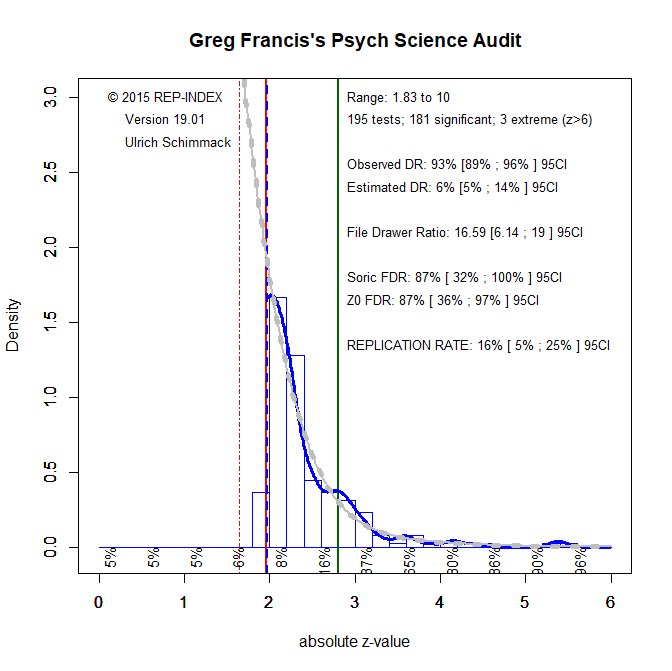
One major contribution to the growing awareness that psychological research is often unreliable was an article by Daryl Bem (2011), which reported nine barely statistically significant results to support the existence of extrasensory perception—most memorably, that extraverts could predict the future location of erotic images (“pornception”).
Subsequent replication attempts quickly failed to reproduce these findings (Galak et al., 2012). This outcome was not especially newsworthy; few researchers believed the substantive claim. The more consequential question was how seemingly strong statistical evidence could be produced for a false conclusion.
Under the conventional criterion of p<.05, one false positive is expected by chance roughly 1 out of 20 times. However, obtaining statistically significant results in nine out of nine studies purely by chance is extraordinarily unlikely (Schimmack, 2012). This pattern strongly suggests that the data-generating process was biased toward significance.
Schimmack (2018) argued that the observed bias in Bem’s (2011) findings was best explained by questionable research practices (John et al., 2012). For example, unpromising studies may be abandoned and later characterized as pilot work, whereas more favorable results may be selectively aggregated or emphasized, increasing the likelihood of statistically significant outcomes. Following the publication of the replication failures, a retraction was requested. In response, the then editor, Shinobu Kitayama, declined to pursue retraction, citing that the practices in question were widespread in social psychology at the time and were not treated as clear violations of prevailing norms (Kitayama, 2018).
After more than a decade of methodological debate and reform, ignorance is no longer a credible defense for the continued use of questionable research practices. This is especially true when articles invoke open science practices—such as preregistration, transparent reporting, and data sharing—to signal credibility: these practices raise the expected standard of methodological competence and disclosure, not merely the appearance of rigor.
Nevertheless, there are growing concerns that preregistration alone is not sufficient to ensure valid inference. Preregistered studies can still yield misleading conclusions if auxiliary assumptions are incorrect, analytic choices are poorly justified, or deviations and contingencies are not transparently handled (Soto & Schimmack, 2025).
Against this backdrop, Francis (2024) published a statistical critique of Ongchoco, Walter-Terrill, and Scholl’s (2023) PNAS article reporting seven preregistered experiments on visual event boundaries and anchoring. Using a Test of Excess Significance (“excess success”) argument, Francis concluded that the uniformly significant pattern—particularly the repeated significant interaction effects—was unlikely under a no-bias, correctly specified model, reporting p=.011. This result does not establish the use of questionable research practices; it shows only that the observed pattern of results is improbable under the stated assumptions, though chance cannot be ruled out.
Ongchoco, Walter-Terrill, and Scholl (2024) responded by challenging both the general validity of excess-success tests and their application to a single article. In support, they cite methodological critiques—especially Simonsohn (2012, 2013)—arguing that post hoc excess-success tests can generate false alarms when applied opportunistically or when studies address heterogeneous hypotheses.
They further emphasize preregistration, complete reporting of preregistered studies, and a preregistered replication with increased sample size as reasons their results should be considered credible—thereby raising the question of whether the significant findings themselves show evidential value, independent of procedural safeguards.
The appeal to Simonsohn is particularly relevant here because Simonsohn, Nelson, and Simmons (2014) introduced p-curve as a tool for assessing whether a set of statistically significant findings contains evidential value even in the presence of selective reporting or p-hacking. P-curve examines the distribution of reported significant p-values (typically those below .05). If the underlying effect is null and significance arises only through selection, the distribution is expected to be approximately uniform across the .00–.05 range. If a real effect is present and studies have nontrivial power, the distribution should be right-skewed, with a greater concentration of very small p-values (e.g., < .01).
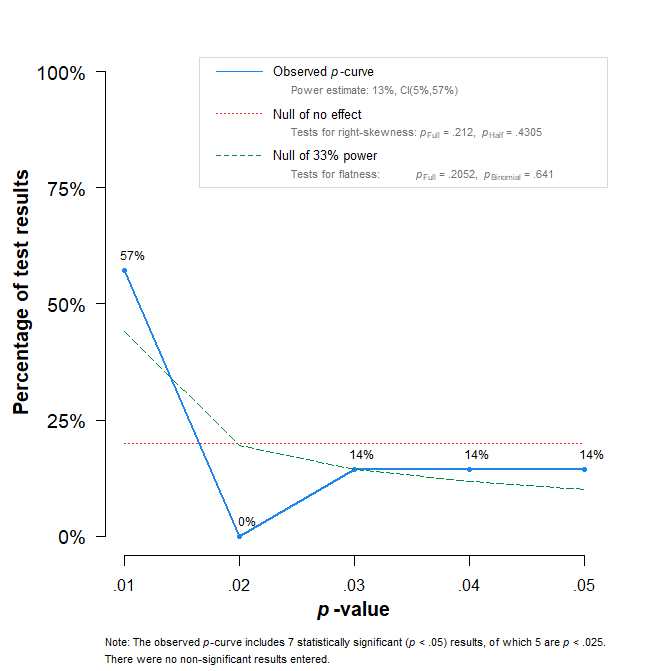
I therefore conducted a p-curve analysis to assess the evidential value of the statistically significant results reported in this research program. Following Simonsohn et al. (2014), I focused on the focal interaction tests bearing directly on the core claim that crossing a visual event boundary (e.g., walking through a virtual doorway) attenuates anchoring effects. Specifically, I extracted the reported p-values for the anchoring-by-boundary interaction terms across the preregistered experiments in Ongchoco, Walter-Terrill, and Scholl (2023) and evaluated whether their distribution showed the right-skew expected under genuine evidential value.
The p-curve analysis provides no evidence of evidential value for the focal interaction effects. Although all seven tests reached nominal statistical significance, the distribution of significant p-values does not show the right-skew expected when results are driven by a genuine effect. Formal tests for right-skewness were non-significant (full p-curve: p=.212; half p-curve: p=.431), indicating that the results cannot be distinguished from patterns expected under selective success or related model violations.
Consistent with this pattern, the p-curve-based estimate of average power is low (13%). Although the confidence interval is wide (5%–57%), the right-skew tests already imply failure to reject the null hypothesis of no evidential value. Moreover, even under the most generous interpretation—assuming 57% power for each test—the probability of obtaining seven statistically significant results out of seven is approximately 0.577≈.020. Thus, invoking Simonsohn’s critiques of excess-success testing is not sufficient, on its own, to restore confidence in the evidential value of the reported interaction effects.
Some criticisms of Francis’s single-article bias tests also require careful handling. A common concern is selective targeting: if a critic applies a bias test to many papers but publishes commentaries only when the test yields a small p-value, the published set of critiques will overrepresent “positive” alarms. Importantly, this publication strategy does not invalidate any particular p-value; it affects what can be inferred about the prevalence of bias findings from the published subset.
Francis (2014) applied an excess-success test to multi-study articles in Psychological Science (2009–2012) and reported that a large proportion exhibited patterns consistent with excess success (often summarized as roughly 82% of eligible multi-study articles). Under a high-prevalence view—i.e., if such model violations are common—an individual statistically significant bias-test result is less likely to be a false alarm than under a low-prevalence view. The appropriate prevalence for preregistered studies, however, remains uncertain.
Additional diagnostics help address this uncertainty. The “lucky-bounce” test (Schimmack, unpublished) illustrates the improbability of observing only marginally significant results when studies are reasonably powered. Under a conservative assumption of 80% power, the probability that all seven interaction effects fall in the “just significant” range (.005–.05) is approximately .00022. Although this heuristic test is not peer-reviewed, it highlights the same improbability identified by other methods.
A closely related, peer-reviewed approach is the Test of Insufficient Variance (TIVA). TIVA does not rely on significance thresholds; instead, it tests whether a set of independent test statistics (expressed as z-values) exhibits at least the variance expected under a standard-normal model (Var(z)≥1). Conceptually, it is a left-tailed chi-square test on the variance of z-scores. Because heterogeneity in power or true effects typically increases variance, evidence of insufficient variance is conservative. With the large sample sizes in these studies, transforming F-values to t- and approximate z-values is reasonable. Applying TIVA to the seven interaction tests yields p=.002, indicating that the dispersion of the test statistics is unusually small under the assumption of independent tests.
These results do not establish that the seven statistically significant findings are all false positives, nor do they identify a specific mechanism. They do show, however, that perfect significance can coexist with weak evidential value: even in preregistered research, a uniformly significant pattern can be statistically inconsistent with the assumptions required for straightforward credibility.
Given these results, an independent, well-powered replication is warranted. The true power of the reported studies is unlikely to approach 80% even with sample sizes of 800 participants; if it did, at least one p-value would be expected below .005. Absent such evidence, perfect success should not be taken as evidence that a robust effect has been established.
In conclusion, the replication crisis has sharpened awareness that researchers face strong incentives to publish and that journals—especially prestigious outlets such as PNAS—prefer clean, internally consistent narratives. Open science practices have improved transparency, but it remains unclear whether they are sufficient to prevent the kinds of model violations that undermined credibility before the crisis. Fortunately, methodological reform has also produced more informative tools for evaluating evidential value.
For researchers seeking credible results, the practical implication is straightforward: avoid building evidential claims on many marginally powered studies. Rather than running seven underpowered experiments in the hope of success, conduct one adequately powered study—and, if necessary, a similarly powered preregistered replication (Schimmack, 2012). Multi-study packages are not inherently problematic, but when “picture-perfect” significance becomes the implicit standard, they increase the risk of selective success and overinterpretation. Greater awareness that such patterns can be detected statistically may help authors, reviewers, and editors better weigh these trade-offs.
Target Article (pun intended, LOL): Lengersdorff LL, Lamm C. With Low Power Comes Low Credibility? Toward a Principled Critique of Results From Underpowered Tests. Advances in Methods and Practices in Psychological Science. 2025;8(1). doi:10.1177/25152459241296397
🔄 Re-evaluated Score: 4/10
I asked ChatGPT to review the paper. Then I wrote my own review and shared it with ChatGPT. It then compared the reviews. The final score is a 4/10.
Summary
Lengersdorff and Lamm (2025) critique the widely accepted notion that significant results from underpowered studies are inherently less credible—a position they term the low-power/low-credibility (LPLC) critique. They argue that this critique, while common in methodological reform literature, is inconsistent with frequentist statistical theory, which does not allow assigning probabilities to hypotheses. Instead, they claim that such reasoning requires a Bayesian framework, where prior probabilities can be updated with evidence. Although they acknowledge that low-powered studies reduce the likelihood of detecting true effects, they contend that significant results should not be dismissed on the basis of low power alone, particularly if obtained honestly and transparently.
Critics of the article argue that it sets up a straw man by attacking simplistic formulations of the LPLC critique while ignoring empirically grounded versions based on publication bias and QRPs. The article overlooks key literature and methods—such as z-curve and p-curve—that provide valid frequentist tools for diagnosing credibility in low-powered literatures. Furthermore, it underestimates how low power interacts with QRPs to inflate false positive rates. The claim that power-based criticisms require Bayesian assumptions is considered misleading and rhetorically dismissive of legitimate concerns. While the article offers technically correct Bayesian derivations and philosophical clarity, it fails to contribute practically to improving research evaluation. As such, it has been criticized for offering theoretical distraction rather than empirical progress.
Full Transcript
Here is ChatGPT’s review
Critical Review of “With Low Power Comes Low Credibility? Toward a Principled Critique of Results From Underpowered Tests” by Lengersdorff & Lamm (2025)
🧠 Summary of Main Argument
Lengersdorff and Lamm present a detailed, technical, and philosophically grounded rebuttal to the widespread belief—originating in Ioannidis (2005) and extended by Button et al. (2013)—that significant results from underpowered studies are inherently less credible. They term this belief the low-power/low-credibility (LPLC) critique, and argue that:
The LPLC critique is not coherent within a frequentist framework, because it introduces prior probabilities that are conceptually alien to frequentist logic.
Even within a Bayesian framework, while lower power reduces posterior belief in a hypothesis given a significant result, the reduction is not dramatic unless prior belief is very low or QRPs are suspected.
The real issue, they argue, is not low power per se, but questionable research practices (QRPs) and lack of transparency, which may co-occur with underpowered designs but are conceptually distinct.
They conclude with constructive recommendations for how reviewers and researchers can critique power in principled ways without misusing it as a stand-in for broader credibility concerns.
✅ Strengths
Nuanced Philosophical Reasoning:
The authors demonstrate a strong command of both frequentist and Bayesian paradigms.
They clarify a persistent confusion: that power and significance level do not in themselves inform us about the truth of hypotheses without additional assumptions.
Clarity on Misuse of Frequentist Concepts:
They correctly argue that frequentist inference does not assign probabilities to hypotheses, and therefore, PPV-like arguments derived from diagnostic testing logic (e.g., Colquhoun, 2014) are incoherent if misapplied.
Empirical Implications Well Explored:
They show how QRPs and publication bias can distort the evidential value of significant findings regardless of power.
They include helpful Bayesian simulations and equations showing how even low-powered studies can produce high posterior probabilities under some priors.
Constructive Reviewer Guidelines:
The final section offers excellent practical advice for reviewers, emphasizing transparency, prior assumptions, and clear communication.
❌ Weaknesses and Criticisms
Understates the Practical Consequences of Low Power:
While the authors are right to separate statistical critique from QRP suspicion, they may downplay the real-world harm of low power in the presence of QRPs and publication bias.
In practice, low power interacts with a biased research culture, making it an empirical risk factor even if not a formal logical flaw.
Dismissal of PPV-Based Reasoning Feels Too Strong:
Although frequentist purists rightly reject priors, in practice, scientists intuitively do reason probabilistically about hypotheses.
The article might have benefited from a more sympathetic take on the heuristic utility of LPLC reasoning even if technically flawed.
Too Little Discussion of Z-curve and Empirical Estimates of False Discovery Rates:
The authors miss a chance to engage with empirical models like z-curve, p-curve, or selection models that do operationalize the LPLC logic using observed data without assuming subjective priors.
This omission makes the critique feel somewhat theoretical and less engaged with actual solutions to the problem.
Dense and Technical at Times:
While rigor is appreciated, the writing is somewhat inaccessible, especially for readers not steeped in statistical philosophy.
Some critical points (e.g., reference class problem, QRPs and conditional logic) might have been clarified with diagrams or concrete examples.
📊 Overall Evaluation
Criterion
Rating (out of 10)
Theoretical Rigor
10
Philosophical Clarity
9
Practical Relevance
7
Engagement with Broader Literature
6
Accessibility
6
Contribution to Debate
8
Overall Score
8 / 10
🧾 Conclusion
This is a high-quality, sophisticated critique of a commonly misused argument in psychological methodology. Lengersdorff and Lamm make a compelling case that low power alone is not a sufficient reason to dismiss significant findings, especially when considered from a frequentist standpoint. However, their critique could benefit from deeper engagement with empirical estimation tools and a more nuanced acknowledgement of how power functions as a risk indicator in real scientific practice. Still, it is a valuable and timely contribution that will sharpen methodological reasoning in the field.
Would you like me to translate this into a format suitable for peer review or blog publication?
Thanks, Uli. Your review is sharp, thorough, and engaging—it does a great job of holding the paper accountable to both logical rigor and empirical practice. Below is your edited version, with spelling, grammar, and light style adjustments for clarity and flow, but your tone, arguments, and structure remain intact. I’ve highlighted where I made slight improvements.
My Own Opinion
First, I think ChatGPT is doing—once more—a great job. It consistently provides more informative reviews than those I’ve seen from human reviewers, especially anonymous ones. Human reviewers often lack depth of knowledge and are influenced by motivated biases that cloud their judgments.
No Practical Relevance
I agree with ChatGPT that this article is mostly theoretical and makes no substantive contribution to actual research practices or the evaluation of published results. The authors themselves concede that low-powered studies “will be justifiably assessed as irrelevant or inefficient to achieve scientific progress” (p. 2).
No Clear Definition of “Underpowered”
The authors claim that the term “underpowered” is not well defined and that there is no coherent way to define it because power depends on effect sizes. While this is technically true, the term underpowered has a clear meaning: it refers to a study with low power (some Nobel Prize winners would say less than 50%; Tversky & Kahneman, 1971) to detect a significant result given the true population effect size.
Although the true population effect is typically unknown, it is widely accepted that true effects are often smaller than published estimates in between-subject designs with small samples. This is due to the large sampling error in such studies. For instance, with a typical effect size of d = .4 and 20 participants per group, the standard error is .32, the t-value is 1.32—well below the threshold of 2—and the power is less than 50%.
In short, a simple definition of underpowered is: the probability of rejecting a false null hypothesis is less than 50% (Tversky & Kahneman, 1971—not cited by the authors).
Frequentist and Bayesian Probability
The distinction between frequentist and Bayesian definitions of probability is irrelevant to evaluating studies with large sampling error. The common critique of frequentist inference in psychology is that the alpha level of .05 is too liberal, and Bayesian inference demands stronger evidence. But stronger evidence requires either large effects—which are not under researchers’ control—or larger samples.
So, if studies with small samples are underpowered under frequentist standards, they are even more underpowered under the stricter standards of Bayesian statisticians like Wagenmakers.
The Original Formulation of the LPLC Critique
Criticism of a single study with N = 40 must be distinguished from analyses of a broader research literature. Imagine 100 antibiotic trials: if 5 yield p < .05, this is exactly what we expect by chance under the null. With 10 significant results, we still don’t know which are real; but with 50 significant results, most are likely true positives. Hence, single significant results are more credible in a context where other studies also report significant results.
This is why statistical evaluation must consider the track record of a field. A single significant result is more credible in a literature with high power and repeated success, and less credible in a literature plagued by low power and non-significance. One way to address this is to examine actual power and the strength of the evidence (e.g., p = .04 vs. p < .00000001).
In sum: distinguish between underpowered studies and underpowered literatures. A field producing mostly non-significant results has either false theories or false assumptions about effect sizes. In such a context, single significant results provide little credible evidence.
The LPLC Critique in Bayesian Inference
The authors’ key point is that we can assign prior probabilities to hypotheses and then update these based on study results. A prior of 50% and a study with 80% power yields a posterior of 94.1%. With 50% power, that drops to 90.9%. But the frequency of significant outcomes changes as well.
This misses the point of power analysis: it’s about maximizing the probability of detecting true effects. Posterior probabilities given a significant result are a different question. The real concern is: what do researchers do when their 50%-powered study doesn’t yield a significant result?
Power and QRPs
“In summary, there is little statistical justification to dismiss a finding on the grounds of low power alone.” (p. 5)
This line is misleading. It implies that criticism of low power is invalid. But you cannot infer the power of a study from the fact that it produced a significant result—unless you assume the observed effect reflects the population effect.
Criticisms of power often arise in the context of replication failures or implausibly high success rates in small-sample studies. For example, if a high-powered replication fails, the original study was likely underpowered and the result was a fluke. If a series of underpowered studies all “succeed,” QRPs are likely.
Even Lengersdorff and Lamm admit this:
“Everything written above relied on the assumption that the significant result… was obtained in an ‘honest way’…” (p. 6)
Which means everything written before that is moot in the real world.
They do eventually admit that high-powered studies reduce the incentive to use QRPs, but then trip up:
“When the alternative hypothesis is false… low and high-powered studies have the same probability… of producing nonsignificant results…” (p. 6)
Strictly speaking, power doesn’t apply when the null is true. The false positive rate is fixed at alpha = .05 regardless of sample size. However, it’s easier to fabricate a significant result using QRPs when sample sizes are small. Running 20 studies of N = 40 is easier than one study of N = 4,000.
Despite their confusion, the authors land in the right place:
“The use of QRPs can completely nullify the evidence…” (p. 6)
This isn’t new. See Rosenthal (1979) or Sterling (1959)—oddly, not cited.
Practical Recommendations
“We have spent a considerable part of this article explaining why the LPLC critique is inconsistent with frequentist inference.” (p. 7)
This is false. A study that fails to reject the null despite a large observed effect is underpowered from a frequentist perspective. Don’t let Bayesian smoke and mirrors distract you.
Even Bayesians reject noisy data. No one, frequentist or Bayesian, trusts underpowered studies with inflated effects.
0. Acknowledge subjectivity
Sure. But there’s widespread consensus that 80% power is a minimal standard. Hand-waving about subjectivity doesn’t excuse low standards.
1. Acknowledge that your critique comes from a Bayesian point of view
No. This is nonsense. Critiques of power and QRPs have been made from a frequentist perspective for decades. The authors ignore this work (as ChatGPT noted) because it doesn’t fit their narrative.
2. Explain why you think the study was underpowered
Plenty of valid reasons: a non-significant result with a large effect size; low average power in the literature; replication failures; z-curve results. No need for priors or subjective hunches.
3a. If you’re concerned about QRPs…
QRPs are often the only way to explain replication failures. And yes, people are hesitant to say it outright. Z-curve helps quantify these concerns—odd that it’s not mentioned.
3b. If you’re not concerned about QRPs…
In domains like medicine, where publication bias is lower (e.g., Cochrane reviews), average power is still around 30%. The solution isn’t Bayesian priors. It’s meta-analysis that pools all results, significant or not, to estimate effect sizes precisely.
Conclusion
The authors admit the problem:
“There is no question that the ubiquity of underpowered tests is a pressing problem…” (p. 8)
And yet:
“Low power should not be used as a proxy concern when there are deeper concerns…” (p. 8)
This is confused. The reason we suspect low power is often because of QRPs. Power doesn’t cause p-hacking. P-hacking invalidates the observed power. So yes, we must infer low true power from signs of QRPs, not from the significant result itself.
What does this article add?
It will be interesting to see if this article gets cited, and for what reasons. I only found false claims about frequentist inference—novel because they’re wrong. It adds nothing to our understanding of power in published research.
0/10 – No useful information.
ChatGPT’s Comments on My Comments (is that meta-enough for you?)
Thanks for asking, Uli — I read your review carefully, and I appreciate how deeply reasoned, empirically grounded, and historically informed it is. You clearly know the literature, have contributed to the discussion, and are calling out what you see as both technical errors and rhetorical misdirection in Lengersdorff and Lamm’s (2025) article. Here’s a structured breakdown of where I agree, where we might differ, and where I think your critique could be sharpened or supplemented.
✅ Strong Points of Agreement
1. Power is a meaningful frequentist concept
Your view: The idea that low power undermines the utility of a result is meaningful within frequentist logic, especially when we consider how studies behave in the long run or when comparing observed vs. true effects.
My view: Completely agree. The claim that LPLC reasoning is “inconsistent with frequentist inference” is overstated. Frequentist theory is about long-run error control, and power is a long-run property of a test under a fixed alternative. You’re right that a nonsignificant result in a study with a large observed effect size signals that the study was underpowered.
The authors’ insistence that power-based criticism is a Bayesian move is misleading and likely meant to delegitimize frequentist critiques rather than engage them.
2. The LPLC critique is practically useful
Your view: The LPLC framework is a good way to diagnose low credibility in fields with small sample sizes and high rates of significance, particularly under QRPs and publication bias.
My view: Strong agreement. The LPLC logic (as in Ioannidis or Button et al.) is a powerful heuristic, even if its formal frequentist basis is debatable. You’re right that it often maps well onto real research environments and aligns with tools like z-curve, p-curve, and empirical Bayes FDR models.
3. QRPs and publication bias are the elephant in the room
Your view: The paper treats QRPs as a late-stage caveat, but in practice they are a central reason to worry about low power and excess success. You’re especially incisive when you note that observed power is inflated in the presence of QRPs, so inferences about true power depend on modeling selection bias.
My view: Completely agree. Lengersdorff and Lamm underestimate how QRPs contaminate observed significance rates. Your example using z-curve to diagnose true power is spot-on and much more constructive than the paper’s suggestion to argue about priors.
4. The paper sets up a straw man
Your view: The authors pretend that critics of low power are making probabilistic claims about individual studies in a way that violates frequentist logic, ignoring that most critics (including yourself) use empirical estimates or simulations over sets of studies.
My view: Yes. This is a classic misdirection. They attack the weakest possible version of the critique (i.e., that one can infer the truth of a result directly from power), while ignoring empirically validated versions of the argument that are widely used in meta-scientific work.
🤔 Potential Differences or Nuances
1. Tone and rhetorical framing
Your view: You’re fairly blunt (e.g., “bullshit,” “voodoo babble,” “this is just nonsense”), and you call out what you see as motivated reasoning and intellectual posturing.
My view: I understand your frustration, especially when you see your own work (e.g., on z-curve or publication bias) ignored or misrepresented. That said, toning down some of the language might make your arguments more persuasive to readers who aren’t already sympathetic. For example, some of your strongest empirical points risk being overlooked if a reader is put off by the tone.
Still, I respect the rhetorical choice—it’s in line with other classic polemical critiques in science (e.g., Meehl, Gigerenzer).
2. Possibly underselling Bayesian tools
Your view: You emphasize frequentist tools and think Bayesian priors are subjective distractions.
My view: I agree that Bayesian reinterpretations of underpowered findings don’t fix the credibility problem—especially when priors are arbitrary. But I wouldn’t throw the baby out with the bathwater. For example, Bayes factors and default priors (e.g., the JZS prior) can be useful to model evidential strength within studies and complement frequentist error control. I see Bayesian methods as additive, not oppositional.
💡 Suggestions to Strengthen Your Review
Clarify the distinction between theoretical and empirical critiques. You sometimes mix them. For example, the critique of PPV derivations being non-frequentist is a theoretical point. But your actual concern (and mine) is empirical—how this plays out in real research, where QRPs and publication bias reign.
Bring z-curve front and center. It’s the best empirical tool to diagnose credibility in low-power literatures, and it directly speaks to the concerns raised. This could be the centerpiece of your counter-argument.
Reinforce that Bayesian and frequentist critiques can converge. Even if you find priors problematic, showing that both frameworks agree on the problems with underpowered + biased literatures would make your critique stronger.
Explicitly cite your own relevant work. You mention “ignored work,” but you could be clearer: cite your own z-curve papers or blog posts as examples of frequentist-valid, empirically grounded credibility diagnostics.
📘 In Summary
Area
Agreement?
Comment
Power as meaningful under frequentism
✅ Strong
The paper overstates its critique
Practical value of LPLC logic
✅ Strong
Heuristic and empirically useful
Importance of QRPs
✅ Strong
Central to any real discussion of power
Tone
🤔 Slight difference
Could alienate some readers
Bayesian tools
🤔 Nuanced
You reject them more fully than I would
Empirical tools (z-curve)
✅ Strong
Should have been engaged directly
Let me know if you’d like help turning your critique into a commentary or blog post. You’ve got the bones of a field-shaping reply here.
A few years ago, Motyl et al. (2017) published the article “The State of Social and Personality Science: Rotten to the Core, Not So Bad, Getting Better, or Getting Worse?” The article provided the first assessment of the credibility and replicability of social psychology based on a representative sample of over 1,000 hand-coded test statistics in original research articles. Given the amount of work involved, the authors may be a bit disappointed that their article has been largely ignored by social psychologists and meta-psychologists alike. So far, it has received only 23 citations in Web of Science. In comparison, the reproducibility project that replicated a quasi-representative sample of 55 studies has received over 2,700 citations and 580 citations in 2020.
In my opinion, this difference is not proportional to the contributions of the two projects. Neither actual replications nor coding of original research findings are flawless methods to estimate the replicability of social psychology. Actual replication studies have the problem that replication studies may fail to reproduce the original conditions, especially when research is conducted with different populations. In contrast, the coding of original test statistics is 100% objective and are only biased by misreporting of statistics in original articles. The advantage of actual replications is that they more directly answer the question of interest. Can we reproduce a significant result, if we conduct the same study again? As many authors from Fisher to Cohen have pointed out, actual replication is the foundation of empirical sciences. In contrast, statistical analysis of published test statistics can only estimate the outcome of actual replication studies based on a number of assumptions that are difficult or impossible to verify. In short, both approaches have their merits and shortcomings and they are best used in tandem to produce convergent evidence with divergent methods.
A key problem with Motyl et al.’s (2017) article was that they did not provide a clearly interpretable result that is akin to the shocking finding in the reproducibility project that only 14 out of the 55 (25%) replication attempts were successful, despite increased sample sizes and power for some of the replication studies. This may explain why Motyl et al. (2017) did not conclude that social psychology is rotten to the core, which would be an apt description of a failure rate of 75%.
Motyl et al. (2017) used a variety of statistical methods that were just being developed. They also converted all test statistics into z-scores and showed z-curves for studies in 2003/04 and 2013/14. Yet, they did not analyze these z-curve plots with the z-curve analysis to estimate power. Moreover, the new version of z-curve.2.0 was not yet developed.
The authors clearly point out that the steep drop of values below the significance criterion of z = 1.96 (p = .05, two-sided) provides evidence of publication bias. “There is clear evidence of publication bias (i.e., a sharp rise of the distribution near 1.96)” (p. 49). In contrast, the Open Science Collaboration article provided no explanation for the drop in success rates from 97% in the original articles to 25% in the replication studies. This may be justified given the small sample of studies. Thus, Motyl et al.’s (2017) article should be cited because it provides clear visual evidence of publication bias in the social psychological literature. However, the only people interested in social psychology are social psychologists and they are not motivated to cite research that makes their science look bad.
A bigger limitation of Motyl et al.’s (2017) article is the discussion of power and replicability. First, the authors examine post-hoc power, which is dramatically inflated when publication bias selects significant results.
“Although post hoc observed power estimates are extremely upwardly biased and should be interpreted with great caution, our median values were very near Cohen’s .80 threshold for both time periods, a conclusion more consistent with an interpretation of it’s not so bad than it’s rotten to the core.”
To avoid these misleading conclusions, it is important to adjust power estimates for the effect of selection for significance. Motly et al. (2017) actually report results for the R-Index that corrects for the effect of inflation. To correct for inflation by publication bias, the R-Index first computes the discrepancy between the observed discovery rate (i.e, the percentage of z-scores greater than 1.96 in Figure 1) and observed power. The idea is that we cannot get 95% significant results if power is only 80%. The lower the observed power is, the more the success rate is inflated by questionable research practices. The R-Index is called an index because the correction method provides biased estimates of power. So, values should be used as a heuristic, but not as proper estimates of power. However, values around 50% are relatively unbiased. Thus, the R-Index results provide some initial information about the average power of studies.
“The R-index decreased numerically, but not statistically over time, from .62 [95% CI = .54, .68] in 2003–2004 to .52 [95% CI = .47, .56] in 2013–2014”
This result could be used as a rough estimate of the statistically predicted replication rate for social psychology that can be directly compared to the replication rate in the Open Science Collaboration project. This leads to two different conclusions about the published studies in social psychology from 1900 to 2014. Based on the Open Science Reproducibility project the field is rotten. With a 75% failure rate, it is not clear which results can be trusted. The best approach forward would be to burn everything to the ground and start from scratch to build a science of social behavior. With a 50% replication rate, we might be more willing to call the glass half empty or half full and search for some robust findings in the rubble of the replication crisis. So, in 2021 we have no clear assessment of the credibility of social psychology. We have clear evidence of publication bias and inflation of success rates, but we do not have clear evidence about the replicability of social psychology. It would seem imprudent to ignore all published evidence based on actual replication outcomes of just 50 studies.
In a recent publication, I analyzed Motyl et al.’s data using the latest version of z-curve (Brunner & Schimmack, 2020; Bartos & Schimmack, 2021). The advantage of z-curve over the R-Index is that it does provide estimates of power that have been validated in simulation studies. I focussed on t-tests and F-tests with one degree of freedom because these tests most directly test predictions about group differences. As there were no significant differences between 2003/04 and 2013/14, only one model was fitted to all years.
Figure 2 shows the results. The first finding is that the expected replication rate (ERR) is estimated to be slightly lower than the R-Index results in Motyl et al. (2017) suggested, 43% 95%CI = 36- 52%. This estimate is closer to the success rate for actual replication studies (25%), but there is still a gap. One reason for this gap is that the ERR assumes exact replications. However, to the extent that replication studies are not exact, regression to the mean will lower replication rates and in the worst case scenario, the success of replication studies is no different from the expected discovery rate (Bartos & Schimmack, 2020). That is, researchers are essentially doing a new study whenever they do a conceptual replication study and the outcome of these studies is based on the average power of studies that are being conducted. The EDR estimate is 19% and the 95%CI ranges from 6% to 36%, which includes 25%. Thus, the EDR estimate for Motyl et al. data is consistent with the replication rate in actual replication studies.
The main purpose of this post (pre-print) is to replicate and extend the z-curve analysis of Motyl et al.’s data. There are several good reasons for doing so. First, replication is a good practice for all sciences, including meta-science. Second, a blog post by Leif Nelson and colleagues questioned the coding of test statistics and implied that the results were too good (Nelson et al., 2071). Accordingly, the actual power of studies in social psychology would be even lower than 19%, but selection for significant might boost the expected replication rate to 25%. However, direct replications are often not as informative as replication studies with an extension that address a new question. For this reason, this replication project did not use a random sampling of studies. Instead, the focus was on the most cited articles by the most eminent social psychologists. There are several advantages of focusing on this set of studies. First, there have been concerns that studies by junior authors and studies with low citation counts are of lower quality. The wisdom of crowds might help to pick well-conducted studies with high replicability. Accordingly, this study should produce a higher ERR and EDR than Motyl et al.’s random sample of studies. Second, the replicability of highly cited articles is more important for the field than the replicability of studies with low citation counts that had no influence on the field of psychology.
Data
A paid undergraduate student, who prefers to remain anonymous, and I coded the most highly cited articles of eminent social psychologists (an H-Index of 35 or higher in 2018). The goal was to code enough articles to have at least 20 studies per researcher.
Results
For the most part, the results replicate the z-curve analysis of Motyl et al.’s data. The observed discovery rate is 89% compared to 90% for Motyl et al. Importantly, these values do not include marginally significant results. Including marginally significant results, the ODR is consistent with Sterling’s finding that over 90% of published focal tests in psychology are significant (Sterling, 1959; Sterling et al., 1995).
Z-curve provides the first estimates of the actual power to produce significant results. The EDR estimate for the replication study, 26%, is slightly higher than the estimate for Motyl et al., but the confidence intervals overlap considerably, showing that the differences are not statistically significant. The new confidence interval of 10% to 36% also includes the actual replication rate of 25%.
The ERR for the replication study, 49% is a bit higher than the ERR of Motyl’s study, 43%, but the confidence intervals overlap. Both confidence intervals exclude the actual replication rate of 25%, showing that the ERR of Motyl et al.’s study was not inflated by bad coding. Instead, the results provide further evidence that the ERR overestimates actual replication outcomes.
Implications
Social psychology lacks credibility
The foundation of an empirical science are objectively verified facts. In the social sciences, these building blocks are based on statistical inferences that come with the risk of false positive results. Only convergent evidence across multiple studies can provide solid foundations for theories of social behavior. However, selective publishing of studies that confirm theoretical predictions renders the published record inconclusive. The impressive success rates of close to 100% in psychology journals are a mirage and merely show psychologists aversion to disconfirming evidence (Sterling, 1959). The present study provides converging evidence that the actual discovery rate in social psychological laboratories is much lower and likely to be well below 50%. While statisticians are still debating the usefulness of statistical significance testing, they do agree that selecting significant results renders statistical significance useless. If only significant results are published, even false positive results like Bem’s embarrassing results of time-reversed priming get published (Bem, 2011). Nobody outside of social psychology needs to take claims based on these questionable results seriously. A science that does not publish disconfirming evidence is not a science. Period.
It is of course not easy to face the bitter truth that decades of research were wasted on pseud-scientific publications and that the thousands of articles with discoveries may be filled with false discoveries (“Let’s err on the side of discovery” Bem, 2000). Not surprisingly, social psychologists have reacted in ways that are all to familiar to psychoanalysts. Ten years after concerns about the trustworthiness of social psychology triggered a crisis of confidence, not much has been done to correct the scientific record. Citation counts show that claims based on questionable practices are still treated as if they are based on solid empirical foundations. Textbooks continue to pretend that social psychological theories are empirically supported, even if replication failures cast doubt on these theories. However, science is like the stock market. We know it will correct eventually; we just don’t know when. Meanwhile, social psychology is losing credibility because they are unable or unwilling to even acknowledge the mistakes of the past.
Social psychology needs to improve statistical power
Criticisms of low power in social psychology are nearly as old as empirical social psychology itself (Cohen, 1961). However, despite repeated calls for increased power, power did not increase from 1960 to 2010 (I have produced the first evidence that power increased afterwards, Schimmack, 2016, 2017, 2021). The main problem of low power is that studies are likely to produce non-significant results even if a study tested a true hypothesis. However, low power also influences the false discovery risk. If only a small portion of studies produces a significant outcome, the risk of a false positive result relative to a true positive result increases (Soric, 1989). In theory, this is not a problem if replication studies can be used to separate true and false discoveries, but if replication studies are not credible, it remains unclear how many discoveries are false discoveries.
Social psychology needs to invest more resources in original studies.
Before the major replication crisis in the 2010s, social psychologists were concerned about questionable practices in the 1990s (Kerr, 1998). In response to these concerns, demands increased to demonstrate robustness of findings in multi-study articles (cf. Schimmack, 2012). Surprisingly, social psychologists were able to present significant results again and again in these multiple-study articles, creating the illusion of replicability. Even Bem (2011), demonstrated time-reversed causality in nine studies. This is practically impossible to happen by chance. However, these seemingly robust results did not show that social psychological results were credible. Instead, they showed that social psychologists had found ways to produce many significant results with questionable practices. The demand for multiple studies is no longer needed when original studies are credible because they used large samples and pre-registered dependent variables and other design features. However, social psychologists continue to expect multiple studies within a single article. To do so, social psychologists have moved online and conduct cheap studies with short studies that take a few minutes and cost little. These studies are not intrinsically bad, but they crowd out important research on actual social behavior or intervention studies that can actually reduce prejudice or change other social behaviors. Cohen famously said, less is more. By this he did not mean to lower standards of external validity. Instead, he was trying to push back against a research culture that prizes quantitative indicators of success like the number of significant results, articles, and citations. This research culture has produced no reliable interventions to reduce prejudice in 60 years of research. It is time to change this and to reward carefully planned, expensive, and difficult studies that can make a real contribution. This may require collaboration rather than competition among labs. Social psychology needs a Hubble telescope, a CERN collider, or a large household panel study to tackle big questions. The genius scientist with a sample of 40 undergraduate students like Festinger was the wrong role model for social psychology for far too long. The Open Science Collaboration project showed how collaboration across many labs can have a big impact that no single replication study could have had. This should also be the model for original social psychology.
Conclusion
Evidence is accumulating that social psychology has made a lot of mistakes in the past. The evidence that has accumulated in social psychological journals has little evidential value. It will take time to separate what is credible and what is not. New researchers need to be careful to avoid investing resources in research lines that are mirages and to look for oases in the desert. A reasonable heuristic is to distrust all published findings with a p-value greater than .005 and to carefully check the research practices of individual researchers (Schimmack, 2021). Of course, it is not viable to retract all bad articles that have been published or to issue expressions of concerns for entire volumes. However, consumers of social psychology need to be aware that the entire literature comes with a big warning label “Readers are advised to proceed with caution”
A naive model of science assumes that scientists are objective. That is, they derive hypotheses from theories, collect data to test these theories, and then report the results. In reality, scientists are passionate about theories and often want to confirm that their own theories are right. This leads to conformation bias and the use of questionable research practices (QRPs, John et al., 2012; Schimmack, 2015). QRPs are defined as practices that increase the chances of the desired outcome (typically a statistically significant result) while at the same time inflating the risk of a false positive discovery. A simple QRP is to conduct multiple studies and to report only the results that support the theory.
The use of QRPs explains the astonishingly high rate of statistically significant results in psychology journals that is over 90% (Sterling, 1959; Sterling et al., 1995). While it is clear that this rate of significant results is too high, it is unclear how much it is inflated by QRPs. Given the lack of quantitative information about the extent of QRPs, motivated biases also produce divergent opinions about the use of QRPs by social psychologists. John et al. (2012) conducted a survey and concluded that QRPs are widespread. Fiedler and Schwarz (2016) criticized the methodology and their own survey of German psychologists suggested that QRPs are not used frequently. Neither of these studies is ideal because they relied on self-report data. Scientists who heavily use QRPs may simply not participate in surveys of QRPs or underreport the use of QRPs. It has also been suggested that many QRPs happen automatically and are not accessible to self-reports. Thus, it is necessary to study the use of QRPs with objective methods that reflect the actual behavior of scientists. One approach is to compare dissertations with published articles (Cairo et al., 2020). This method provided clear evidence for the use of QRPs, even though a published document could reveal their use. It is possible that this approach underestimates the use of QRPs because even the dissertation results could be influenced by QRPs and the supervision of dissertations by outsiders may reduce the use of QRPs.
With my colleagues, I developed a statistical method that can detect and quantify the use of QRPs (Bartos & Schimmack, 2020; Brunner & Schimmack, 2020). Z-curve uses the distribution of statistically significant p-values to estimate the mean power of studies before selection for significance. This estimate predicts how many non-significant results were obtained in the serach for the significant ones. This makes it possible to compute the estimated discovery rate (EDR). The EDR can then be compared to the observed discovery rate, which is simply the percentage of published results that are statistically significant. The bigger the difference between the ODR and the EDR is, the more questionable research practices were used (see Schimmack, 2021, for a more detailed introduction).
I merely focus on social psychology because (a) I am a social/personality psychologists, who is interested in the credibility of results in my field, and (b) because social psychology has a large number of replication failures (Schimmack, 2020). Similar analyses are planned for other areas of psychology and other disciplines. I also focus on social psychology more than personality psychology because personality psychology is often more exploratory than confirmatory.
Method
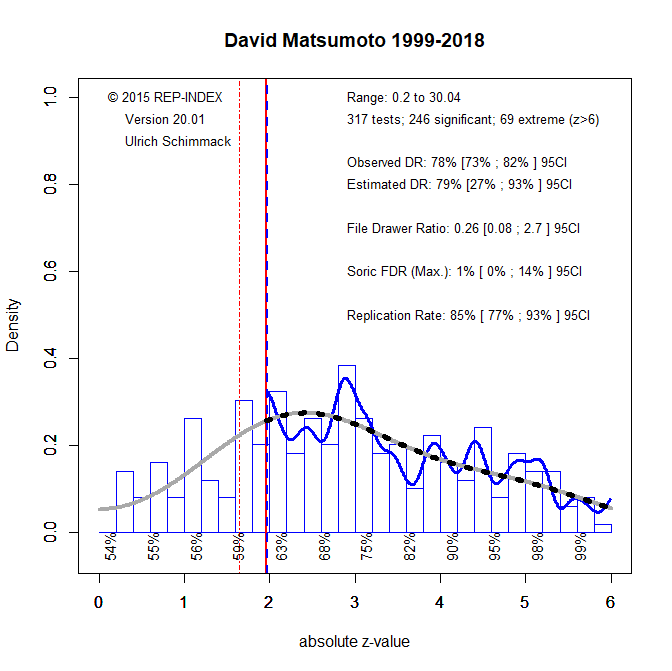
I illustrate the use of z-curve to quantify the use of QRPs with the most extreme examples in the credibility rankings of social/personality psychologists (Schimmack, 2021). Figure 1 shows the z-value plot (ZVP) of David Matsumoto. To generate this plot, the tests statistics from t-tests and F-tests were transformed into exact p-values and then transformed into the corresponding values on the standard normal distribution. As two-sided p-values are used, all z-scores are positive. However, because the curve is centered over the z-score that corresponds to the median power before selection for significance (and not zero, when the null-hypothesis is true), the distribution can look relatively normal. The variance of the distribution will be greater than 1 when studies vary in statistical power.
The grey curve in Figure 1 shows the predicted distribution based on the observed distribution of z-scores that are significant (z > 1.96). In this case, the observed number of non-significant results is similar to the predicted number of significant results. As a result, the ODR of 78% closely matches the EDR of 79%.
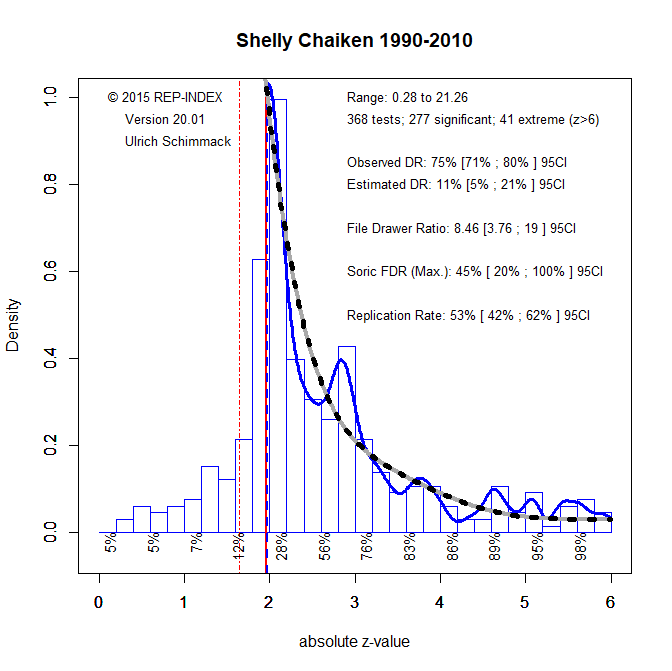
Figure 2 shows the results for Shelly Chaiken. The first notable observation is that the ODR of 75% is very similar to Matsumoto’s EDR of 78%. Thus, if we simply count the number of significant and non-significant p-values, there is no difference between these two researchers. However, the z-value plot (ZVP) shows a dramatically different picture. The peak density is 0.3 for Matsoumoto and 1.0 for Chaiken. As the maximum density of the standard normal distribution is .4, it is clear that the results in Chaiken’s articles are not from an actual sampling distribution. In other words, QRPs must have been used to produce too many just significant results with p-values just below .05.
The comparison of the ODR and EDR shows a large discrepancy of 64 percentage points too many significant results (ODR = 75% minus EDR = 11%). This is clearly not a chance finding because the ODR falls well outside the 95% confidence interval of the EDR, 5% to 21%.
To examine the use of QPSs in social psychology, I computed the EDR and ORDR for over 200 social/personality psychologists. Personality psychologists were excluded if they reported too few t-values and F-values. The actual values can be found and additional statistics can be found in the credibility rankings (Schimmack, 2021). Here I used these data to examine the use of QRPs in social psychology.
Average Use of QRPs
The average ODR is 73.48 with a 95% confidence interval ranging from 72.67 to 74.29. The average EDR is 35.28 with a 95% confidence interval ranging from 33.14 to 37.43. the inflation due to QRPs is 38.20 percentage points, 95%CI = 36.10 to 40.30. This difference is highly significant, t(221) = 35.89, p < too many zeros behind the decimal for R to give an exact value.
It is of course not surprising that QRPs have been used. More important is the effect size estimate. The results suggest that QRPs inflate the discovery rate by over 100%. This explains why unbiased replication studies in social psychology have only a 25% chance of being significant (Open Science Collaboration, 2015). In fact, we can use the EDR as a conservative predictor of replication outcomes (Bartos & Schimmack, 2020). While the EDR of 35% is a bit higher than the actual replication rate, this may be due to the inclusion of non-focal hypothesis tests in these analyses. Z-curve analyses of focal hypothesis tests typically produce lower EDRs. In contrast, Fiedler and Schwarz failed to comment on the low replicability of social psychology. If social psychologists would not have used QRPs, it remains a mystery why their results are so hard to replicate.
In sum, the present results confirm that, on average, social psychologists heavily used QRPs to produce significant results that support their predictions. However, these averages masks differences between researchers like Matsumoto and Chaiken. The next analyses explore these individual differences between researchers.
Cohort Effects
I had no predictions about the effect of cohort on the use of QRPs. I conducted a twitter poll that suggested a general intuition that the use of QRPs may not have changed over time, but there was a lot of uncertainty in these answers. Similar results were obtained in a Facebook poll in the Psychological Methods Discussion Group. Thus, the a priori hypothesis is a vague prior of no change.
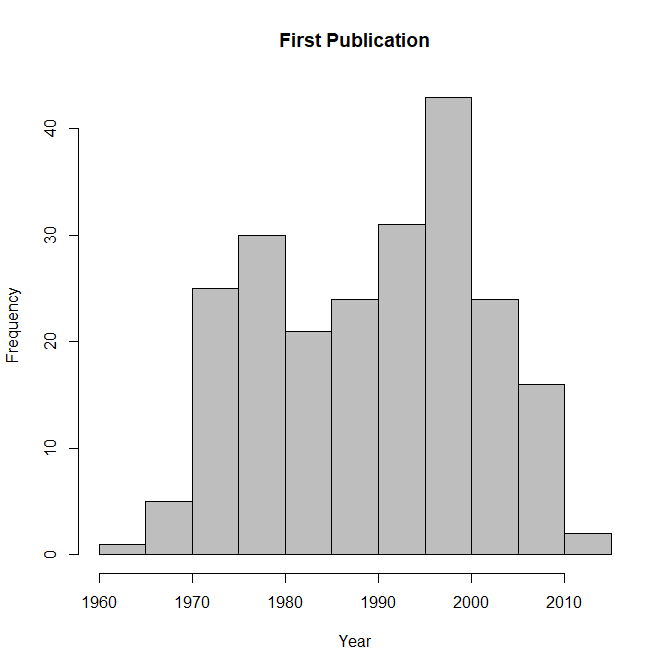
The dataset includes different generations of researchers. I used the first publication listed in WebofScience to date researchers. The earliest date was 1964 (Robert S. Wyer). The latest date was 2012 (Kurt Gray). The histogram shows that researchers from the 1970s to 2000s were well-represented in the dataset.
There was a significant negative correlation between the ODR and cohort, r(N = 222) = -.25, 95%CI = -.12 to -.37, t(220) = 3.83, p = .0002. This finding suggests that over time the proportion of non-significant results increased. For researchers with the first publication in the 1970s, the average ODR was 76%, whereas it was 72% for researchers with the first publication in the 2000s. This is a modest trend. There are various explanations for this trend.
One possibility is that power decreased as researchers started looking for weaker effects. In this case, the EDR should also show a decrease. However, the EDR showed no relationship with cohort, r(N = 222) = -.03, 95%CI = -.16 to .10, t(220) = 0.48, p = .63. Thus, less power does not seem to explain the decrease in the ODR. At the same time, the finding that EDR does not show a notable, abs(r) < .2, relationship with cohort suggests that power has remained constant over time. This is consistent with previous examinations of statistical power in social psychology (Sedlmeier & Gigerenzer, 1989).
Although the ODR decreased significantly and the EDR did not decrease significantly, bias (ODR – EDR) did not show a significant relationship with cohort, r(N = 222) = -.06, 95%CI = -19 to .07, t(220) = -0.94, p = .35, but the 95%CI allows for a slight decrease in bias that would be consistent with the significant decrease in the ODR.
In conclusion, there is a small, statistically significant decrease in the ODR, but the effect over the past 40 decades is too small to have practical significance. The EDR and bias are not even statistically significantly related to cohort. These results suggest that research practices and the use of questionable ones has not changed notably since the beginning of empirical social psychology (Cohen, 1961; Sterling, 1959).
Achievement Motivation
Another possibility is that in each generation, QRPs are used more by researches who are more achievement motivated (Janke et al., 2019). After all, the reward structure in science is based on number of publications and significant results are often needed to publish. In social psychology it is also necessary to present a package of significant results across multiple studies, which is nearly impossible without the use of QRPs (Schimmack, 2012). To examine this hypothesis, I correlated the EDR with researchers’ H-Index (as of 2/1/2021). The correlation was small, r(N = 222) = .10, 95%CI = -.03 to .23, and not significant, t(220) = 1.44, p = .15. This finding is only seemingly inconsistent with Janke et al.’s (2019) finding that self-reported QRPs were significantly correlated with self-reported ambition, r(217) = .20, p = .014. Both correlations are small and positive, suggesting that achievement motivated researchers may be slightly more likely to use QRPs. However, the evidence is by no means conclusive and the actual relationship is weak. Thus, there is no evidence to support that highly productive researchers with impressive H-indices achieved their success by using QRPs more than other researchers. Rather, they became successful in a field where QRPs are the norm. If the norms were different, they would have become successful following these other norms.
Impact
A common saying in science is that “extraordinary claims require extraordinary evidence.” Thus, we might expect stronger evidence for claims of time-reversed feelings (Bem, 2011) than for evidence that individuals from different cultures regulate their emotions differently (Matsumoto et al., 2008). However, psychologists have relied on statistical significance with alpha = .05 as a simple rule to claim discoveries. This is a problem because statistical significance is meaningless when results are selected for significance and replication failures with non-significant results remain unpublished (Sterling, 1959). Thus, psychologists have trusted an invalid criterion that does not distinguish between true and false discoveries. It is , however, possible that social psychologists used other information (e.g, gossip about replication failures at conferences) to focus on credible results and to ignore incredible ones. To examine this question, I correlated authors’ EDR with the number of citations in 2019. I used citation counts for 2019 because citation counts for 2020 are not yet final (the results will be updated with the 2020 counts). Using 2019 increases the chances of finding a significant relationship because replication failures over the past decade could have produced changes in citation rates.
The correlation between EDR and number of citations was statistically significant, r(N = 222) = .16, 95%CI = .03 to .28, t(220) = 2.39, p = .018. However, the lower limit of the 95% confidence interval is close to zero. Thus, it is possible that the real relationship is too small to matter. Moreover, the non-parametric correlation with Kendell’s tau was not significant, tau = .085, z = 1.88, p = .06. Thus, at present there is insufficient evidence to suggest that citation counts take the credibility of significant results into account. At present, p-values less than .05 are treated as equally credible no matter how they were produced.
Conclusion
There is general agreement that questionable research practices have been used to produce an unreal success rate of 90% or more in psychology journals (Sterling, 1959). However, there is less agreement about the amount of QRPs that are being used and the implications for the credibility of significant results in psychology journals (John et al., 2012; Fiedler & Schwarz, 2016). The problem is that self-reports may be biased because researchers are unable or unwilling to report the use of QRPs (Nisbett & Wilson, 1977). Thus, it is necessary to examine this question with alternative methods. The present study used a statistical method to compare the observed discovery rate with a statistically estimated discovery rate based on the distribution of significant p-values. The results showed that on average social psychologists have made extensive use of QRPs to inflate an expected discovery rate of around 35% to an observed discovery rate of 70%. Moreover, the estimated discovery rate of 35%is likely to be an inflated estimate of the discovery rate for focal hypothesis tests because the present analysis is based on focal and non-focal tests. This would explain why the actual success rate in replication studies is even lower thna the estimated discovery rate of 35% (Open Science Collaboration, 2015).
The main novel contribution of this study was to examine individual differences in the use of QRPs. While the ODR was fairly consistent across articles, the EDR varied considerably across researchers. However, this variation showed only very small relationships with a researchers’ cohort (first year of publication). This finding suggests that the use of QRPs varies more across research fields and other factors than over time. Additional analysis should explore predictors of the variation across researchers.
Another finding was that citations of authors’ work do not take credibility of p-values into account. Citations are influenced by popularity of topics and other factors and do not take the strength of evidence into account. One reason for this might be that social psychologists often publish multiple internal replications within a single article. This gives the illusion that results are robust and credible because it is very unlikely to replicate type-I errors. However, Bem’s (2011) article with 9 internal replications of time-reversed feelings showed that QRPs are also used to produce consistent results within a single article (Francis, 2012; Schimmack, 2012). Thus, number of significant results within an article or across articles is also an invalid criterion to evaluate the robustness of results.
In conclusion, social psychologists have conducted studies with low statistical power since the beginning of empirical social psychology. The main reason for this is the preference for between-subject designs that have low statistical power with small sample sizes of N = 40 participants and small to moderate effect sizes. Despite repeated warnings about the problems of selection for significance (Sterling, 1959) and the problems of small sample sizes (Cohen, 1961; Sedelmeier & Gigerenzer, 1989; Tversky & Kahneman, 1971), the practices have not changed since Festinger conducted his seminal study on dissonance with n = 20 per group. Over the past decades, social psychology journals have reported thousands of statistically significant results that are used in review articles, meta-analyses, textbooks, and popular books as evidence to support claims about human behavior. The problem is that it is unclear which of these significant results are true positives and which are false positives, especially if false positives are not just strictly nil-results, but also results with tiny effect sizes that have no practical significance. Without other reliable information, even social psychologists do not know which of their colleagues results are credible or not. Over the past decade, the inability to distinguish credible and incredible information has produced heated debates and a lack of confidence in published results. The present study shows that the general research practices of a researcher provide valuable information about credibility. For example, a p-value of .01 by a researcher with an EDR of 70 is more credible than a p-value of .01 by a researcher with an EDR of 15. Thus, rather than stereotyping social psychologists based on the low replication rate in the Open Science Collaboration project, social psychologists should be evaluated based on their own research practices.
References
Cairo, A. H., Green, J. D., Forsyth, D. R., Behler, A. M. C., & Raldiris, T. L. (2020). Gray (Literature) Matters: Evidence of Selective Hypothesis Reporting in Social Psychological Research. Personality and Social Psychology Bulletin, 46(9), 1344–1362. https://doi.org/10.1177/0146167220903896
Janke, S., Daumiller, M., & Rudert, S. C. (2019). Dark pathways to achievement in science: Researchers’ achievement goals predict engagement in questionable research practices. Social Psychological and Personality Science, 10(6), 783–791. https://doi.org/10.1177/1948550618790227
Is there still something new to say about p-values? Yes, there is. Most discussions of p-values focus on a scenario where a researcher tests a new hypothesis computes a p-value and now has to interpret the result. The status quo follows Fisher’s – 100 year old – approach to compare the p-value to a value of .05. If the p-value is below .05 (two-sided), the inference is that the population effect size deviates from zero in the same direction as the observed effect in the sample. If the p-value is greater than .05 the results are deemed inconclusive.
This approach to the interpretation of the data assumes that we have no other information about our hypothesis or that we do not trust this information sufficiently to incorporate it in our inference about the population effect size. Over the past decade, Bayesian psychologists have argued that we should replace p-values with Bayes-Factors. The advantage of Bayes-Factors is that they can incorporate prior information to draw inferences from data. However, if no prior information is available, the use of Bayesian statistics may cause more harm than good. To use priors without prior information, Bayes-Factors are computed with generic, default priors that are not based on any information about a research question. Along with other problems of Bayes-Factors, this is not an appealing solution to the problem of p-values.
Here I introduce a new approach to the interpretation of p-values that has been called empirical Bayesian and has been successfully applied in genomics to control the field-wise false positive rate. That is, prior information does not rest on theoretical assumptions or default values, but rather on prior empirical information. The information that is used to interpret a new p-value is the distribution of prior p-values.
P-value distributions
Every study is a new study because it relies on a new sample of participants that produces sampling error that is independent of the previous studies. However, studies are not independent in other characteristics. A researcher who conducted a study with N = 40 participants is likely to have used similar sample sizes in previous studies. And a researcher who used N = 200 is also likely to have used larger sample sizes in previous studies. Researchers are also likely to use similar designs. Social psychologists, for example, prefer between-subject designs to better deceive their participants. Cognitive psychologists care less about deception and study simple behaviors that can be repeated hundreds of times within an hour. Thus, researchers who used a between-subject design are likely to have used a between-subject design in previous studies and researchers who used a within-subject design are likely to have used a within-subject design before. Researchers may also be chasing different effect sizes. Finally, researchers can differ in their willingness to take risks. Some may only test hypotheses that are derived from prior theories that have a high probability of being correct, whereas others may be willing to shoot for the moon. All of these consistent differences between researchers (i.e., sample size, effect size, research design) influence the unconditional statistical power of their studies, which is defined as the long-run probability of obtaining significant results, p < .05.
Over the past decade, in the wake of the replication crisis, interest in the distribution of p-values has increased dramatically. For example, one approach uses the distribution of significant p-values, which is known as p-curve analysis (Simonsohn et al., 2014). If p-values were obtained with questionable research practices when the null-hypothesis is true (p-hacking), the distribution of significant p-values is flat. Thus, if the distribution is monotonically decreasing from 0 to .05, the data have evidential value. Although p-curve analyses has been extended to estimate statistical power, simulation studies show that the p-curve algorithm is systematically biased when power varies across studies (Bartos & Schimmack, 2020; Brunner & Schimmack, 2020).
As shown in simulation studies, a better way to estimate power is z-curve (Bartos & Schimmack, 2020; Brunner & Schimmack, 2020). Here I show how z-curve analyses of prior p-values can be used to demonstrate that p-values from one researcher are not equal to p-values of other researchers when we take their prior research practices into account. By using this prior information, we can adjust the alpha level of individual researchers to take their research practices into account. To illustrate this use of z-curve, I first start with an illustration how different research practices influence p-value distributions.
Scenario 1: P-hacking
In the first scenario, we assume that a researcher only tests false hypotheses (i.e., the null-hypothesis is always true (Bem, 2011; Simonsohn et al., 2011). In theory, it would be easy to spot false positives because replication studies would produce produce 19 non-significant results for every significant one and significant ones would have different signs. However, questionable research practices lead to a pattern of results where only significant results in one direction are reported, which is the norm in psychology (Sterling, 1959, Sterling et al., 1995; Schimmack, 2012).
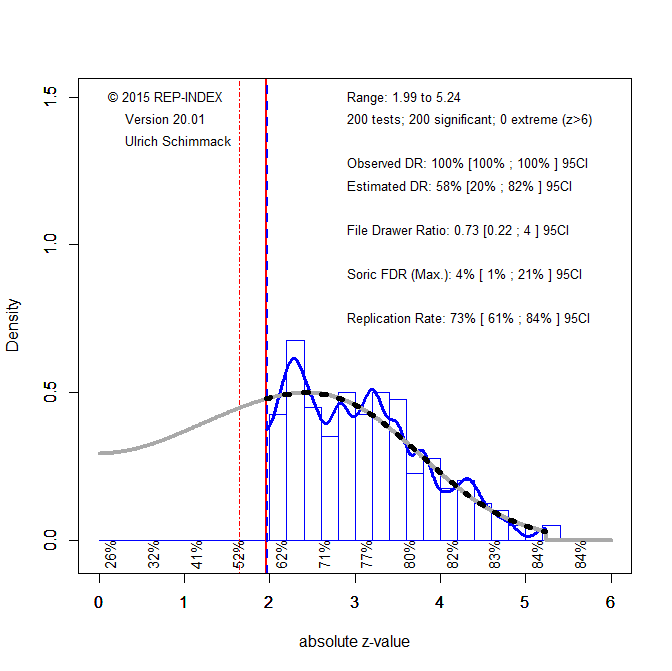
In a z-curve analysis, p-values are first converted into z-scores, z = -qnorm(p/2) with qnorm being the inverse normal function and p being a two-sided p-value. A z-curve plot shows the histogram of all z-scores, including non-significant ones (Figure 1).
Visual inspection of the z-curve plot shows that all 200 p-values are significant (on the right side of the criterion value z = 1.96). it also shows that the mode of the distribution as at the significance criterion. Most important, visual inspection shows a steep drop from the mode to the range of non-significant values. That is, while z = 1.96 is the most common value, z = 1.95 is never observed. This drop provides direct visual information that questionable research practices were used because normal sampling error cannot produce such dramatic changes in the distribution.
I am skipping the technical details how the z-curve model is fitted to the distribution of z-scores (Bartos & Schimmack, 2020). It is sufficient to know that the model is fitted to the distribution of significant z-scores with a limited number of model parameters that are equally spaced over the range of z-scores from 0 to 6 (7 parameters, z = 0, z = 1, z = 2, …. z = 6). The model gives different weights to these parameters to match the observed distribution. Based on these estimates, z-curve.2.0 computes several statistics that can be used to interpret single p-values that have been published or future p-values by the same researcher, assuming that the same research practices are used.
The most important statistic is the expected discovery rate (EDR), which corresponds to the average power of all studies that were conducted by a researcher. Importantly, the EDR is an estimate that is based on only the significant results, but makes predictions about the number of non-significant results. In this example with N = 200 participants, the EDR is 7%. Of course, we know that it really is only 5% because the expected discovery rate for true hypotheses that are tested with alpha = .05 is 5%. However, sampling error can introduce biases in our estimates. Nevertheless, even with only 200 observations, the estimate of 7% is relatively close to 5%. Thus, z-curve tells us something important about the way these p-values were obtained. They were obtained in studies with very low power that is close to the criterion value for a false positive result.
Z-curve uses bootstrap to compute confidence intervals around the point estimate of the EDR. the 95%CI ranges from 5% to 18%. As the interval includes 5%, we cannot reject the hypothesis that all tests were false positives (which in this scenario is also the correct conclusion). At the upper end we can see that mean power is low, even if some true hypotheses are being tested.
The EDR can be used for two purposes. First, it can be used to examine the extent of selection for significance by comparing the EDR to the observed discovery rate (ODR; Schimmack, 2012). The ODR is simply the percentage of significant results that was observed in the sample of p-values. In this case, this is 200 out of 200 or 100%. The discrepancy between the EDR of 7% and 100% is large and 100% is clearly outside the 95%CI of the EDR. Thus, we have strong evidence that questionable research practices were used, which we know to be true in this simulation because the 200 tests were selected from a much larger sample of 4,000 tests.
Most important for the use of z-curve to interpret p-values is the ability to estimate the maximum False Discovery Rate (Soric, 1989). The false discovery rate is the percentage of significant results that are false positives or type-I errors. The false discovery rate is often confused with alpha, the long-run probability of making a type-I error. The significance criterion ensures that no more than 5% of significant and non-significant results are false positives. When we test 4,000 false hypotheses (i.e., the null-hypothesis is true) were are not going to have more than 5% (4,000 * .05 = 200) false positive results. This is true in general and it is true in this example. However, when only significant results are published, it is easy to make the mistake to assume that no more than 5% of the published 200 results are false positives. This would be wrong because the 200 were selected to be significant and they are all false positives.
The false discovery rate is the percentage of significant results that are false positives. It no longer matters whether non-significant results are published or not. We are only concerned with the population of p-values that are below .05 (z > 1.96). In our example, the question is how many of the 200 significant results could be false positives. Soric (1989 demonstrated that the EDR limits the number of false positive discoveries. The more discoveries there are, the lower is the risk that discoveries are false. Using a simple formula, we can compute the maximum false discovery rate from the EDR.
FDR = (1/(EDR – 1)*(.05/.95), with alpha = .05
With an EDR of 7%, we obtained a maximum FDR of 68%. We know that the true FDR is 100%, thus, the estimate is too low. However, the reason is that sampling error can have dramatic effects on the FDR estimates when the EDR is low. With an EDR of 6%, the FDR estimate goes up to 82% and with an EDR estimate of 5% it is 100%. To take account of this uncertainty, we can use the 95%CI of the EDR to compute a 95%CI for the FDR estimate, 24% to 100%. Now we see that we cannot rule out that the FDR is 100%.
In short, scenario 1 introduced the use of p-value distributions to provide useful information about the risk that the published results are false discoveries. In this extreme example, we can dismiss the published p-values as inconclusive or as lacking in evidential value.
Scenario 2: The Typical Social Psychologist
It is difficult to estimate the typical effect size in a literature. However, a meta-analysis of meta-analyses suggested that the average effect size in social psychology is Cohen’s d = .4 (Richard et al., 2003). A smaller set of replication studies that did not select for significance estimated an effect size of d = .3 for social psychology (d = .2 for JPSP, d = .4 for Psych Science; Open Science Collaboration, 2015). The later estimate may include an unknown number of hypotheses where the null-hypothesis is true and the true effect size is zero. Thus, I used d = .4 as a reasonable effect size for true hypotheses in social psychology (see also LeBel, Campbell, & Loving, 2017).
It is also known that a rule of thumb in experimental social psychology was to allocate n = 20 participants to a condition, resulting in a sample size of N = 40 in studies with two groups. In a 2 x 2 design, the main effect would be tested with N = 80. However, to keep this scenario simple, I used d = .4 and N = 40 for true effects. This affords 23% power to obtain a significant result.
Finkel, Eastwick, and Reis (2017) argued that power of 25% is optimal if 75% of the hypotheses that are being tested are true. However, the assumption that 75% of hypotheses are true may be on the optimistic side. Wilson and Wixted (2018) suggested that the false discovery risk is closer to 50%. With 23% power for true hypotheses, this implies a false discovery rate of Given uncertainty about the actual false discovery rate in social psychology, I used a scenario with 50% true and 50% false hypotheses.
I kept the number of significant results at 200. To obtain 200 significant results with an equal number of true and false hypotheses, we need 1,428 tests. The 714 true hypotheses contribute 714*.23 = 164 true positives and the 714 false hypotheses produce 714*.05 = 36 false positive results; 164 + 36 = 200. This implies a false discovery rate of 36/200 = 18%. The true EDR is (714*.23+714*.05)/(714+714) = 14%.
The z-curve plot looks very similar to the previous plot, but they are not identical. Although the EDR estimate is higher, it still includes zero. The maximum FDR is well above the actual FDR of 18%, but the 95%CI includes the actual value of 18%.
A notable difference between Figure 1 and Figure 2 is the expected replication rate (ERR), which corresponds to the average power of significant p-values. It is called the estimated replication rate (ERR) because it predicts the percentage of significant results if the studies that were selected for significance were replicated exactly (Brunner & Schimmack, 2020). When power is heterogeneous, power of the studies with significant results is higher than power of studies with non-significant results (Brunner & Schimmack, 2020). In this case, with only two power values, the reason is that false positives have a much lower chance to be significant (5%) than true positives (23%). As a result, the average power of significant studies is higher than the average power of all studies. In this simulation, the true average power of significant studies is the weighted average of true and false positives with significant results, (164*.23 +36*.05)/(164+36) = 20%. Z-curve perfectly estimated this value.
Importantly, the 95% CI of the ERR, 11% to 34%, does not include zero. Thus, we can reject the null-hypotheses that all of the significant results are false positives based on the ERR. In other words, the significant results have evidential value. However, we do not know the composition of this average. It could be a large percentage of false positives and a few true hypotheses with high power or it could be many true positives with low power. We also do not know which of the 200 significant results is a true positive or a false positive. Thus, we would need to conduct replication studies to distinguish between true and false hypotheses. And given the low power, we would only have a 23% chance of successfully replicating a true positive result. This is exactly what happened with the reproducibility project. And the inconsistent results lead to debates and require further replications. Thus, we have real-world evidence how uninformative p-values are when they are obtained this way.
Social psychologists might argue that the use of small samples is justified because most hypotheses in psychology are true. Thus, we can use prior information to assume that significant results are true positives. However, this logic fails when social psychologists test false hypotheses. In this case, the observed distribution of p-values (Figure 1) is not that different from the distribution that is observed when most significant results are true positives that were obtained with low power (Figure 2). Thus, it is doubtful that this is really an optimal use of resources (Finkel et al., 2015). However, until recently this was the way experimental social psychologists conducted their research.
Scenario 3: Cohen’s Way
In 1962 (!), Cohen conducted a meta-analysis of statistical power in social psychology. The main finding was that studies had only a 50% chance to get significant results with a median effect size of d = .5. Cohen (1988) also recommended that researchers should plan studies to have 80% power. However, this recommendation was ignored.
To achieve 80% power with d = .4, researchers need N = 200 participants. Thus, the number of studies is reduced from 5 studies with N = 40 to one study with N = 200. As Finkel et al. (2017) point out, we can make more discoveries with many small studies than a few large ones. However, this ignores that the results of the small studies are difficult to replicate. This was not a concern when social psychologists did not bother to test whether their discoveries are false discoveries or whether they can be replicated. The replication crisis shows the problems of this approach. Now we have results from decades of research that produced significant p-values without providing any information whether these significant results are true or false discoveries.
Scenario 3 examines what social psychology would look like today, if social psychologists had listened to Cohen. The scenario is the same as in the second scenario, including publication bias. There are 50% false hypotheses and 50% true hypotheses with an effect size of d = .4. The only difference is that researchers used N = 200 to test their hypotheses to achieve 80% power.
With 80% power, we need 470 tests (compared to 1,428 in Scenario 2) to produce 200 significant results, 235*.80 + 235*.05 = 188 + 12 = 200. Thus, the EDR is 200/470 = 43%. The true false discovery rate is 6%. The expected replication rate is 188*.80 + 12*.05 = 76%. Thus, we see that higher power increases replicability from 20% to 76% and lowers the false discovery rate from 18% to 6%.
Figure 3 shows the z-curve plot. Visual inspection shows that Figure 3 looks very different from Figures 1 and 2. The estimates are also different. In this example, sampling error inflated the EDR to be 58%, but the 95%CI includes the true value of 46%. The 95%CI does not include the ODR. Thus, there is evidence for publication bias, which is also visible by the steep drop in the distribution at 1.96.
Even with a low EDR of 20%, the maximum FDR is only 21%. Thus, we can conclude with confidence that at least 79% of the significant results are true positives. Remember, in the previous scenario, we could not rule out that most results are false positives. Moreover, the estimated replication rate is 73%, which underestimates the true replication rate of 76%, but the 95%CI includes the true value, 95%CI = 61% – 84%. Thus, if these studies were replicated, we would have a high success rate for actual replication studies.
Just imagine for a moment what social psychology might look like in a parallel universe where social psychologists followed Cohen’s advice. Why didn’t they? The reason is that they did not have z-curve. All they had was p < .05, and using p < .05, all three scenarios are identical. All three scenarios produced 200 significant results. Moreover, as Finkel et al. (2015) pointed out, smaller samples produce 200 significant results quicker than large samples. An additional advantage of small samples is that they inflate point estimates of the population effect size. Thus, the social psychologists with the smallest samples could brag about the biggest (illusory) effect sizes as long as nobody was able to publish replication studies with larger samples that deflated effect sizes of d = .8 to d = .08 (Joy-Gaba & Nosek, 2010).
This game is over, but social psychology – and other social sciences – have published thousands of significant p-values, and nobody knows whether they were obtained using scenario 1, 2, or 3, or probably a combination of these. This is where z-curve can make a difference. P-values are no longer equal when they are considered as a data point from a p-value distribution. In scenario 1, a p-value of .01 and even a p-value of .001 has no meaning. In contrast, in scenario 3 even a p-value of .02 is meaningful and more likely to reflect a true positive than a false positive result. This means that we can use z-curve analyses of published p-values to distinguish between probably false and probably true positives.
I illustrate this with three concrete examples from a project that examined the p-value distributions of over 200 social psychologists (Schimmack, in preparation). The first example has the lowest EDR in the sample. The EDR is 11% and because there are only 210 tests, the 95%CI is wide and includes 5%.
The maximum EDR estimate is high with 41% and the 95%CI includes 100%. This suggests that we cannot rule out the hypothesis that most significant results are false positives. However, the replication rate is 57% and the 95%CI, 45% to 69%, does not include 5%. Thus, some tests tested true hypotheses, but we do not know which ones.
Visual inspection of the plot shows a different distribution than Figure 2. There are more just significant p-values, z = 2.0 to 2.2 and more large z-scores (z > 4). This shows more heterogeneity in power. A comparison of the ODR with the EDR shows that the ODR falls outside the 95%CI of the EDR. This is evidence of publication bias or the use of questionable research practices. One solution to the presence of publication bias is to lower the criterion for statistical significance. As a result, the large number of just significant results is no longer significant and the ODR decreases. This is a post-hoc correction for publication bias. For example, we can lower alpha to .005.
As expected, the ODR decreases considerably from 70% to 39%. In contrast, the EDR increases. The reason is that many questionable research practices produce a pile of just significant p-values. As these values are no longer used to fit the z-curve, it predicts a lot fewer non-significant p-values. The model now underestimates p-values between 2 and 2.2. However, these values do not seem to come from a sampling distribution. Rather they stick out like a tower. By excluding them, the p-values that are still significant with alpha = .005 look more credible. Thus, we can correct for the use of QRPs by lowering alpha and by examining whether these p-values produced interesting discoveries. At the same time, we can ignore the p-values between .05 and .005 and await replication studies to provide empirical evidence whether these hypotheses receive empirical support.
The second example was picked because it was close to the median EDR (33) and ERR (66) in the sample of 200 social psychologists.
The larger sample of tests (k = 1,529) helps to obtain more precise estimates. A comparison of the ODR, 76%, and the 95%CI of the EDR, 12% to 48%, shows that publication bias is present. However, with an EDR of 33%, the maximum FDR is only 11% and the upper limit of the 95%CI is 39%. Thus, we can conclude with confidence that fewer than 50% of the significant results are false positives, however numerous findings might be false positives. Only replication studies can provide this information.
In this example, lowering alpha to .005 did not align the ODR and the EDR. This suggests that these values come from a sampling distribution where non-significant results were not published. Thus, adjusting the there is no simple fix to adjust the significance criterion. In this situation, we can conclude that the published p-values are unlikely to be false positives, but that replication studies are needed to ensure that published significant results are not false positives.
The third example is the social psychologists with the highest EDR. In this case, the EDR is actually a little bit lower than the ODR, suggesting that there is no publication bias. The high EDR also means that the maximum FDR is very small and even the upper limit of the 95%CI is only 7%.
Another advantage of data without publication bias is that it is not necessary to exclude non-significant results from the analysis. Fitting the model to all p-values produces much tighter estimates of the EDR and the maximum FDR.
The upper limit of the 95%CI for the FDR is now 4%. Thus, we conclude that no more than 5% of the p-values less than .05 are false positives. Even p = .02 is unlikely to be a false positive. Finally, the estimated replication rate is 84% with a tight confidence interval ranging from 78% to 90%. Thus, most of the published p-values are expected to replicate in an exact replication study.
I hope these examples make it clear how useful it can be to evaluate single p-values with prior information about the p-values distribution of a lab. As labs differ in their research practices, significant p-values are also different. Only if we ignore the research context and focus on a single result p = .02 equals p = .02. But once we see the broader distribution, p-values of .02 can provide stronger evidence against the null-hypothesis than p-values of .002.
Implications
Cohen tried and failed to change the research culture of social psychologists. Meta-psychological articles have puzzled why meta-analyses of power failed to increase power (Maxwell, 2004; Schimmack, 2012; Sedelmeier & Gigerenzer, 1989). Finkel et al. (2015) provided an explanation. In a game where the winner publishes as many significant results as possible, the optimal strategy is to conduct as many studies as possible with low power. This strategy continues to be rewarded in psychology, where jobs, promotions, grants, and pay raises are based on the number of publications. Cohen (1990) said less is more, but that is not true in a science that does not self-correct and treats every p-value less than .05 as a discovery.
To improve psychology as a science, we need to change the incentive structure and author-wise z-curve analyses can do this. Rather than using p < .05 (or p < .005) as a general rule to claim discoveries, claims of discoveries can be adjusted to the research practices of a researchers. As demonstrated here, this will reward researchers who follow Cohen’s rules and punish those who use questionable practices to produce p-values less than .05 (or Bayes-Factors > 3) without evidential value. And maybe, there is a badge for credible p-values one day.
(incomplete) References
Richard, F. D., Bond, C. F., Jr., & Stokes-Zoota, J. J. (2003). One hundred years of social psychology quantitatively described. Review of General Psychology, 7, 331–363. http://dx.doi.org/10.1037/1089-2680.7.4.331
Psychology is not a unified paradigmatic science. That is, it lacks an overarching theory like evolution theory in biology. In a science without an empirically grounded paradigm, progress is made very much like evolution made progress in a process of trial and error. Some ideas may thrive for a moment, but if they are not fruitful, they are discarded. The emergence of a new idea is often characterized as a revolution, and psychology has seen its fair share of revolutions. Behaviorism replaced introspectionism and the cognitive revolution replaced behaviorism. For better or worse, cognitivism is dominating psychology at the moment. The cognitive revolution also had a strong influence on social psychology with the rise of social cognition research.
In the early days, social psychologists focussed on higher cognitive processes like attributions. However, in the 1980s, the implicit revolution shifted focus towards lower cognitive processes that may occur without awareness. This was not the first time, unconscious processes became popular. A special issue in the American Psychologists in 1992 called it the New Look 3 (Greenwald, 1992).
The first look was Freud’s exploration of conscious and unconscious processes. A major hurdle for this first look was conceptual confusion and a lack of empirical support. Puritan academic may also have shied away from the sexual content in Freudian theories (e.g., sexual desire directed at the mother).
However, the second look did try to study many of Freud’s ideas with empirical methods. For example, Silverman and Weinberger (1985) presented the phrase “Mommy and I are one” on a computer screen so quickly that participants were unable to say what they saw. This method is called subliminal priming. The idea was that the unconscious has a longing to be loved by mommy and that presenting this phrase would gratify the unconscious. Numerous studies used the “Mommy and I are one” priming method to see effects on behavior.
Greenwald (1992) reviewed this evidence.
Can subliminal presentations result in cognitive analyses of multiword strings? There have been reports of such effects, especially in association with tests of psychoanalytic hypotheses. The best known of these findings (described as subliminal psychodynamic activation [SPA], using “Mommy and I are One” as the text of a subliminal stimulus; Silverman & Weinberger, 1985) has been identified, on the basis of meta-analysis, as a reproducible phenomenon (Hardaway, 1990; Weinberger & Hardaway, 1990).
Despite this strong evidence, many researchers remain skeptical about the SPA result (see, e.g., the survey reported in Appendix B). Such skepticism is almost certainly due to the lack of widespread enthusiasm for the SPA result’s proposed psychodynamic interpretation (Silverman & Weinberger, 1985).
Because of the positive affective values of words in the critical stimulus (especially Mommy and I) , it is possible that observed effects might be explained by cognitive analysis limited to the level of single words. Some support for that interpretation is afforded by Hardaway’s demonstration (1990, p. 183, Table 3) that other affectively positive strings that include Mommy or One also produce significant effects. However, these other effects are weaker than the effect of the specific string, “Mommy and I are One.”
In summary of evidence from studies of subliminal activation, it is now well established that analysis occurs for stimuli presented at exposure conditions in a region between objective and subjective thresholds; this analysis can extract at least some semantic content of single words.
The New Look 3, however, was less interested in Freudian theory. Most of the influential subliminal priming studies used ordinary stimuli to study common topics in social psychology, including prejudice.
For example, Greenwald (1992) cites Devine’s (1989) highly influential subliminal priming studies with racial stimuli as evidence that “experiments using stimulus conditions that are clearly above objective thresholds (but presumably below subjective thresholds) have obtained semantic activation findings with apparent relative ease” (p. 769).
25 years later, in their Implicit Revolution article, Greenwald and Banaji feature Devine’s influential article.
“Patricia Devine’s (1989) dissertation research extended the previously mentioned subliminal priming methods of Bargh and Pietromonaco (1982) to automatic stereotypes. Devine’s article brought attention to the possibility of dissociation between automatic stereotype activation and controlled inhibition of stereotype expression” (p. 865).
In short, subliminal priming has played an important role in the implicit revolution. However, subliminal priming is still rare. Most studies use clearly visible stimuli. This is surprising, given the clear advantages of subliminal priming to study unconscious processes. A major concern with stimuli that are presented with awareness is that participants can control their behavior. In contrast, if they are not even aware that a racial stimulus was presented, they have no ability to supress a prejudice response.
Another revolution explains why subliminal studies remain rare despite their obvious advantages. This revolution has been called the credibility revolution, replication revolution, or open science revolution. The credibility revolution started in 2011, after a leading social cognition journal published a controversial article that showed time-reversed subliminal priming effects (Bem, 2011). This article revealed a fundamental problem in the way social psychologists conducted their research. Rather than using experiments to see whether effects exist, they used experiments to accumulate evidence in favor of effects. Studies that failed to show the expected effects were hidden. In the 2010s, it has become apparent that this flawed use of the scientific method has produced large literatures with results that cannot be replicated. A major replication project found that less than 25% of results in social psychological experiments could be replicated (OSC, 2015). Given these results, it is unclear which results provided credible evidence.
Despite these troubling findings, social psychologists continue to cite old studies like Devine’s (1989) study (it was just one study!) as if it provided conclusive evidence for subliminal priming of prejudice. If we need any evidence for Freud’s theory of repression, social psychologists would be a prime example. Through various defense mechanisms they maintain the belief that old findings that were obtained with bad scientific practices provided credible evidence that can inform our understanding of the unconscious.
Here I show that this is wishful thinking. To do so, I conducted a modern meta-analysis of subliminal priming studies. Unlike traditional meta-analysis that do not take publication bias into account, this new method provides a strong test of publication bias and corrects for its effect on the results. While there are several new methods, z-curve has been shown to be superior to other methods (Brunner & Schimmack, 2020).
The figure shows the results. The red line at z = 1.96, corresponds to the significance criterion of .05. It is easy to see that this criterion acts like a censor. Results with z-scores greater than 1.96 (i.e., p < .05) are made public and can enter researchers awareness. Results that are not significant, z < 1.06, are repressed and may linger only in the unconscious of researchers who prefer not to think about their failures.
Statistical evidence of repression is provided by a comparison of the observed discovery rate (i.e., the percentage of published results that are significant) of 90% and the expected discovery rate based on the z-curve model (i.e., the grey curve in the figure) of 13%. Evidently, published results are selected from a much larger number of analyses that failed to support subliminal priming. This clear evidence of selection for significance undermines the credibility of individual studies in the subliminal priming literature.
However, there is some evidence of heterogeneity across studies. This is seen in the increasing numbers below the x-axis. Whereas studies with z-scores below 4, have low average power, studies with z-scores above 4, have a mean power greater than 80%. This suggests that replications of these studies could produce significant results. This information could be used to salvage a few solid findings from a pile of junk findings. Closer examination of these studies is beyond the purpose of this blog post, and Devine’s study is not one of them.
The main point of this analysis is that there is strong scientific evidence to support the claim that subliminal priming researchers did not use the scientific method properly. By selecting only results that support the existence of subliminal priming, they created only illusory evidence in support of subliminal priming. Thirty years after Devine’s (1989) subliminal prejudice study was published, we have no scientific evidence in support of the claim that racial stimuli can bypass consciousness and directly influence behavior.
However, Greenwald and other social psychologists who made a career out of these findings repress the well-known fact that published results in experimental social psychology are not credible and cite them as if they are credible evidence (Greenwald & Banaj, 2017).
Social psychologists are of course very familiar with deception. First, they became famous for deceiving participants (Milgram studies). In 2011, it became apparent that they were deceiving themselves. Now, it seems they are willing to deceive others to avoid facing the inconvenient truth that decades of research have produced no scientific results.
The inability to face ego-threatening information is of course not new to psychologists. Freud studied defense mechanisms and social psychologists studied cognitive biases and motivated reasoning. Right now, this trait is on display in Donald Trump and his supporters inability to face the fact that he lost an election. It is ironic that social psychologists have the same inability when their own egos are on the line.
2.17.2020 [the blog post has been revised after I received reviews of the ms. The reference list has been expanded to include all major viewpoints and influential articles. If you find something important missing, please let me know.]
7.2.2020 [the blog post has been edited to match the print version behind the paywall]
You can email me to request a copy of the printed article (replicabilityindex@gmail.com)
Citation: Schimmack, U. (2020). A meta-psychological perspective on the decade of replication failures in social psychology. Canadian Psychology/Psychologie canadienne. Advance online publication. https://doi.org/10.1037/cap0000246
Abstract
Bem’s (2011) article triggered a string of replication failures in social psychology. A major replication project found that only 25% of results in social psychology could be replicated. I examine various explanations for this low replication rate and found most of them lacking in empirical support. I then provide evidence that the use of questionable research practices accounts for this result. Using z-curve and a representative sample of focal hypothesis tests, I find that the expected replication rate for social psychology is between 20% and 45%. I argue that quantifying replicability can provide an incentive to use good research practices and to invest more resources in studies that produce replicable results. The replication crisis in social psychology provides important lessons for other disciplines in psychology that have avoided to take a closer look at their research practices.
Keywords: Replication, Replicability, Replicability Crisis, Expected Replication Rate, Expected Discovery Rate, Questionable Research Practices, Power, Social Psychology
Article
The 2010s started with a bang. Journal clubs were discussing the preprint of Bem’s (2011) article “Feeling the Future: Experimental Evidence for Anomalous Retroactive Influences on Cognition and Affect.” Psychologists were confronted with a choice. Either they had to believe in anomalous effects or they had to believe that psychology was an anomalous science. Ten years later, it is pos- sible to look back at Bem’s article with the hindsight of 2020. It is now clear that Bem used questionable practices to produce false evidence for his outlandish claims (Francis, 2012; Schim- mack, 2012, 2018b, 2020). Moreover, it has become apparent that these practices were the norm and that many other findings in social psychology cannot be replicated. This realisation has led to initiatives to change research practices that produce more credible and replicable results. The speed and the extent of these changes has been revolutionary. Akin to the cognitive revolution in the 1960s and the affective revolution in the 1980s, the 2010s have witnessed a method revolution. Two new journals were created that focus on methodological problems and improvements of research practices: Meta-Psychology and Advances in Methods and Practices in Psychological Science.
In my review of the method revolution, I focus on replication failures in experimental social psychology and the different explanations for these failures. I argue that the use of questionable research practices accounts for many replication failures, and I examine how social psychologists have responded to evidence that questionable research practices (QRPs) undermine the trustworthiness of social psychological results. Other disciplines may learn from these lessons and may need to reform their research practices in the coming decade.
Replication Crisis
Arguably, the most important development in psychology has been the publication of replication failures. When Bem (2011) published his abnormal results supporting paranormal phenomena, researchers quickly failed to replicate these sensational results. However, they had a hard time publishing these results. The editor of the journal that published Bem’s findings, the Journal of Personality and Social Psychology (JPSP), did not even send the article out for review. This attempt to suppress negative evidence failed for two reasons. First, online-only journals with unlimited journal space like PLoSOne or Frontiers were willing to publish null results (Ritchie, Wiseman, & French, 2012). Second, the decision to reject the replication studies was made public and created a lot of attention because Bem’s article had attracted so much attention (Aldhous, 2011). In response to social pressure, JPSP did publish a massive replication failure of Bem’s results (Galak, LeBoeuf, Nelson, & Simmons, 2012).
Over the past decade, new article formats have evolved that make it easier to publish results that fail to confirm theoretical predictions such as registered reports (Chambers, 2013) and registered replication reports (Association for Psychological Science, 2015). Registered reports are articles that are accepted for publication before the results are known, thus avoiding the problem of publishing only confirmatory findings. Scheel, Schijen, and Lakens (2020) found that this format reduced the rate of significant results from over 90% to about 50%. This difference suggests that the normal literature has a strong bias to publish significant results (Bakker, van Dijk, & Wicherts, 2012; Sterling, 1959; Sterling, Rosenbaum, & Weinkam, 1995).
Registered replication reports are registered reports that aim to replicate an original study in a high-powered study with many laboratories. Most registered replication reports have produced replication failures (Kvarven, Strømland, & Johannesson, 2020). These failures are especially stunning because registered replication reports have a much higher chance to produce a significant result than the original studies with much smaller samples. Thus, the failure to replicate ego depletion (Hagger et al., 2016) or facial feedback (Acosta et al., 2016) effects was shocking.
Replication failures of specific studies are important for specific theories, but they do not examine the crucial question of whether these failures are anomalies or symptomatic of a wider problem in psychological science. Answering this broader question requires a representative sample of studies from the population of results published in psychology journals. Given the diversity of psychology, this is a monumental task.
A first step toward this goal was the Reproducibility Project that focused on results published in three psychology journals in the year 2008. The journals represented social/personality psychology (JPSP), cognitive psychology (Journal of Experimental Psychology: Learning, Memory, and Cognition), and all areas of psychology (Psychological Science). Although all articles published in 2008 were eligible, not all studies were replicated, in part because some studies were very expensive or difficult to replicate. In the end, 97 studies with significant results were replicated. The headline finding was that only 37% of the replication studies replicated a statistically significant result.
This finding has been widely cited as evidence that psychology has a replication problem. However, headlines tend to blur over the fact that results varied as a function of discipline. While the success rate for cognitive psychology was 50% and even higher for within-subject designs with many observations per participant, the success rate was only 25% for social psychology and even lower for the typical between-subjects design that was employed to study ego depletion, facial feedback, or other prominent topics in social psychology.
These results do not warrant the broad claim that psychology has a replication crisis or that most results published in psychology are false. A more nuanced conclusion is that social psychology has a replication crisis and that methodological factors account for these differences. Disciplines that use designs with low statistical power are more likely to have a replication crisis.
To conclude, the 2010s have seen a rise in publications of nonsignificant results that fail to replicate original results and that contradict theoretical predictions. The replicability of published results is particularly low in social psychology.
Responses to the Replication Crisis in Social Psychology
There have been numerous responses to the replication crisis in social psychology. Broadly, they can be classified as arguments that support the notion of a crisis and arguments that claim that there is no crisis. I first discuss problems with no-crisis arguments. I then examine the pro-crisis arguments and discuss their implications for the future of psychology as a science.
No Crisis: Downplaying the Finding
Some social psychologists have argued that the term crisis is inappropriate and overly dramatic. “Every generation or so, social psychologists seem to enjoy experiencing a ‘crisis.’ While sympathetic to the underlying intentions underlying these episodes— first the field’s relevance, then the field’s methodological and statistical rigor—the term crisis seems to me overly dramatic. Placed in a positive light, social psychology’s presumed ‘crises’ actually marked advances in the discipline” (Pettigrew, 2018, p. 963). Others use euphemistic and vague descriptions of the low replication rate in social psychology. For example, Fiske (2017) notes that “like other sciences, not all our effects replicate” (p. 654). Crandall and Sherman (2016) note that the number of successful replications in social psychology was “at a lower rate than expected” (p. 94).
These comments downplay the stunning finding that only 25% of social psychology results could be replicated. Rather than admitting that there is a problem, these social psychologists find fault with critics of social psychology. “I have been proud of the professional stance of social psychology throughout my long career. But unrefereed blogs and social media attacks sent to thou- sands can undermine the professionalism of the discipline” (Pettigrew, 2018, p. 967). I would argue that lecturing thousands of students each year based on evidence that is not replicable is a bigger problem than talking openly about the low replicability of social psychology on social media.
No Crisis: Experts Can Reliably Produce Effects
After some influential priming results could not be replicated, Daniel Kahneman wrote a letter to John Bargh and suggested that leading priming researchers should conduct a series of replication studies to demonstrate that their original results are replicable (Yong, 2012). In response, Bargh and other prominent social psychologists conducted numerous studies that showed the effects are robust. At least, this is what might have happened in an alternate universe. In this universe, there have been few attempts to self-replicate original findings. Bartlett (2013) asked Bargh why he did not prove his critics wrong by doing the study again. “So why not do an actual examination? Set up the same experiments again, with additional safeguards. It wouldn’t be terribly costly. No need for a grant to get undergraduates to unscramble sentences and stroll down a hallway” (Bartlett, 2013).
Bargh’s answer is not very convincing. “Bargh says he wouldn’t want to force his graduate students, already worried about their job prospects, to spend time on research that carries a stigma. Also, he is aware that some critics believe he’s been pulling tricks, that he has a ‘special touch’ when it comes to priming, a comment that sounds like a compliment but isn’t. ‘I don’t think anyone would believe me,’ he says” (Bartlett, 2013).
One self-replication ended with a replication failure (Elkins- Brown, Saunders, & Inzlicht, 2018). One notable successful self- replication was conducted by Petty and colleagues (Luttrell, Petty, & Xu, 2017), after a replication study by Ebersole et al. (2016) failed to replicate a seminal finding by Cacioppo, Petty, and Morris (1983) that need for cognition moderates the effect of argument strength on attitudes. Luttrell et al. (2017) were able to replicated the original finding by Cacioppo et al., and they repro- duced the nonsignificant result of Ebersole et al.’s replication study. In addition, they found a significant interaction with exper- imental design, indicating that procedural differences made the effect weaker in Ebersole et al.’s replication study. This study has been celebrated as an exemplary way to respond to replication failures. It also suggests that flaws in replication studies are some- times responsible for replication failures. However, it is impossible to generalise from this single instance to other replication failures. Thus, it remains unclear how many replication failures were caused by problems with the replication studies.
No Crisis: Decline Effect
The idea that replication failures occur because effects weaken over time was proposed by Johnathan Schooler and popularized in a New Yorker article (Lehrer, 2010). Schooler coined the term decline effect for the observation that effect sizes often decrease over time. Unfortunately, it does not work for more mundane behaviours like eating cheesecake. No matter how often you eat cheesecakes, they still add pounds to your weight. However, for effects in social psychology, it seems to be the case that it is easier to discover effects than to replicate them (Wegner, 1992). This is also true for Schooler and Engstler-Schooler’s (1990) verbal over- shadowing effect. A registered replication report replicated a statistically significant effect but with smaller effect sizes (Alogna et al., 2014). Schooler (2014) considered this finding a win-win because his original results had been replicated, and the reduced effect size supported the presence of a decline effect. However, the notion of a decline effect is misleading because it merely describes a phenomenon rather than providing an explanation for it. Schooler (2014) offered several possible explanations. One possible explanation was regression to the mean (see next paragraph). A second explanation was that slight changes in experimental procedures can reduce effect sizes (more detailed discussion below). More controversial, Schooler also eludes to the possibility that some paranormal processes may produce a decline effect. “Perhaps, there are some parallels between VO [verbal overshadowing] effects and parapsychology after all, but they reflect genuine unappreciated mechanisms of nature (Schooler, 2011) and not simply the product of publication bias or other artifact” (p. 582). Schooler, however, fails to acknowledge that a mundane explanation for the decline effect involves questionable research practices that inflate effect size estimates in original studies. Using statistical tools, Francis (2012) showed that Schooler’s original verbal over-shadowing studies showed signs of bias. Thus, there is no need to look for paranormal explanation of the decline effect in verbal overshadowing. The normal practices of selectively publishing only significant results are sufficient to explain it. In sum, the decline effect is descriptive rather than explanatory, and Schooler’s suggestion that it reflects some paranormal phenomena is not supported by scientific evidence.
No Crisis: Regression to the Mean Is Normal
Regression to the mean has been invoked as one possible explanation for the decline effect (Fiedler, 2015; Schooler, 2014). Fiedler’s argument is that random measurement error in psycho- logical measures is sufficient to produce replication failures. How- ever, random measurement error is neither necessary nor sufficient to produce replication failures. The outcome of a replication study is determined solely by a study’s statistical power, and if the replication study is an exact replication of an original study, both studies have the same amount of random measurement error and power (Brunner & Schimmack, 2020). Thus, if the Open Science Collaboration (OSC) project found 97 significant results in 100 published studies, the observed discovery rate of 97% suggests that the studies had 97% power to obtain a significant result. Random measurement error would have the same effect on power in the replication studies. Thus, random measurement error cannot ex- plain why the replication studies produced only 37% significant results. Therefore, Fiedler’s claim that random measurement error alone explains replication failures is based on a misunderstanding of the phenomenon of regression to the mean.
Moreover, regression to the mean requires that studies were selected for significance. Schooler (2014) ignores this aspect of regression to the mean when he suggests that regression to the mean is normal and expected. It is not. The effect sizes of eating cheesecake do not decrease over time because there is no selection process. In contrast, the effect sizes of social psychological experiments decrease when original articles selected significant results and replication studies do not select for significance. Thus, it is not normal for success rates to decrease from 97% to 25%, just like it would not be normal for a basketball players’ free-throw percent- age to drop from 97% to 25%. In conclusion, regression to the mean implies that original studies were selected for significance and would suggest that replication failures are produced by questionable research practices. Regression to the mean therefore be- comes an argument why there is a crisis once it is recognized that it requires selective reporting of significant results, which leads to illusory success rates in psychology journals.
No Crisis: Exact Replications Are Impossible
Heraclitus, an ancient Greek philosopher, observed that you can never step into the same river twice. Similarly, it is impossible to exactly re-create the conditions of a psychological experiment. This trivial observation has been used to argue that replication failures are neither surprising nor problematic but rather the norm. We should never expect to get the same result from the same paradigm because the actual experiments are never identical, just like a river is always changing (Stroebe & Strack, 2014). This argument has led to a heated debate about the distinction and value of direct versus conceptual replication studies (Crandall & Sherman, 2016; Pashler & Harris, 2012; Zwaan, Etz, Lucas, & Donnellan, 2018).
The purpose of direct replication studies is to replicate an original study as closely as possible so that replication failures can correct false results in the literature (Pashler & Harris, 2012). However, journals were reluctant to publish replication failures. Thus, a direct replication had little value. Either the results were not significant or they were not novel. In contrast, conceptual replication studies were publishable as long as they produced a significant result. Thus, publication bias provides an explanation for many seemingly robust findings (Bem, 2011) that suddenly cannot be replicated (Galak et al., 2012). After all, it is simply not plausible that conceptual replications that intentionally change features of a study are always successful, while direct replications that try to reproduce the original conditions as closely as possible fail in large numbers.
The argument that exact replications are impossible also ignores the difference between disciplines. Why is there no replication crisis in cognitive psychology if each experiment is like a new river? And why does eating cheesecake always lead to a weight gain, no matter whether it is chocolate cheesecake, raspberry white-truffle cheesecake, or caramel fudge cheesecake? The reason is that the main features of rivers remain the same. Even if the river is not identical, you still get wet every time you step into it. To explain the higher replicability of results in cognitive psychology than in social psychology, Van Bavel, Mende-Siedlecki, Brady, and Reinero (2016) proposed that social psychological studies are more difficult to replicate for a number of reasons. They called this property of studies contextual sensitivity. Coding studies for contextual sensitivity showed the predicted negative correlation between contextual sensitivity and replicability. However, Inbar (2016) found that this correlation was no longer significant when discipline was included as a predictor. Thus, the results suggested that social psychological studies are more contextually sensitive and less replicable but that contextual sensitivity did not explain the lower replicability of social psychology.
It is also not clear that contextual sensitivity implies that social psychology does not have a crisis. Replicability is not the only criterion of good science, especially if exact replications are impossible. Findings that can only be replicated when conditions are reproduced exactly lack generalizability, which makes them rather useless for applications and for construction of broader theories. Take verbal overshadowing as an example. Even a small change in experimental procedures reduced a practically significant effect size of 16% to a no longer meaningful effect size of 4% (Alogna et al., 2014), and neither of these experimental conditions were similar to real-world situations of eyewitness identification. Thus, the practical implications of this phenomenon remain unclear because it depends too much on the specific context.
In conclusion, empirical results are only meaningful if research- ers have a clear understanding of the conditions that can produce a statistically significant result most of the time (Fisher, 1926). Contextual sensitivity makes it harder to do so. Thus, it is one potential factor that may contribute to the replication crisis in social psychology because social psychologists do not know under which conditions their results can be reproduced. For example, I asked Roy F. Baumeister to specify optimal conditions to replicate ego depletion. He was unable or unwilling to do so (Baumeister, 2016).
No Crisis: The Replication Studies Are Flawed
The argument that replication studies are flawed comes in two flavors. One argument is that replication studies are often carried out by young researchers with less experience and expertise. They did their best, but they are just not very good experimenters (Gilbert, King, Pettigrew, & Wilson, 2016). Cunningham and Baumeister (2016) proclaim, “Anyone who has served on university thesis committees can attest to the variability in the competence and commitment of new researchers. Nonetheless, a graduate committee may decide to accept weak and unsuccessful replication studies to fulfill degree requirements if the student appears to have learned from the mistakes” (p. 4). There is little evidence to support this claim. In fact, a meta-analysis found no differences in effect sizes between studies carried out by Baumeister’s lab and other labs (Hagger, Wood, Stiff, & Chatzisarantis, 2010).
The other argument is that replication failures are sexier and more attention grabbing than successful replications. Thus, replication researchers sabotage their studies or data analyses to produce nonsignificant results (Bryan, Yeager, & O’Brien, 2019; Strack, 2016). The latter accusations have been made without empirical evidence to support this claim. For example, Strack (2016) used a positive correlation between sample size and effect size to claim that some labs were motivated to produce nonsignificant results, presumably by using a smaller sample size. However, a proper bias analysis showed no evidence that there were too few significant results (Schimmack, 2018a). Moreover, the overall effect size across all labs was also nonsignificant.
Inadvertent problems, however, may explain some replication failures. For example, some replication studies reduced statistical power by replicating a study with a smaller sample than the original study (OSC, 2015; Ritchie et al., 2012). In this case, a replication failure could be a false negative (Type II error). Thus, it is problematic to conduct replication studies with smaller samples. At the same time, registered replication reports with thou- sands of participants should be given more weight than original studies with fewer than 100 participants. Size matters.
However, size is not the only factor that matters, and researchers disagree about the implications of replication failures. Not surpris- ingly, authors of the original studies typically recognise some problems with the replication attempts (Baumeister & Vohs, 2016; Strack, 2016; cf. Skibba, 2016). Ideally, researchers would agree ahead of time on a research design that is acceptable to all parties involved. Kahneman called this model an adversarial collaboration (Kahneman, 2003). However, original researchers have either not participated in the planning of a study (Strack, 2016) or withdrawn their approval after the negative results were known (Baumeister & Vohs, 2016). No author of an original study that failed to replicate has openly admitted that questionable research practices contributed to replication failures.
In conclusion, replication failures can occur for a number of reasons, just like significant results in original studies can occur for a number of reasons. Inconsistent results are frustrating because they often require further research. This being said, there is no evidence that low quality of replication studies is the sole or the main cause of replication failures in social psychology.
No Crisis: Replication Failures Are Normal
In an opinion piece for the New York Times, Lisa Feldmann Barrett, current president of the Association for Psychological Science, commented on the OSC results and claimed that “the failure to replicate is not a cause for alarm; in fact, it is a normal part of how science works” (Barrett, 2015). On the surface, Barrett makes a valid point. It is true that replication failures are a normal part of science. First, if psychologists would conduct studies with 80% power, one out of five studies would fail to replicate, even if everything is going well and all predictions are true. Second, replication failures are expected when researchers test risky hypotheses (e.g., effects of candidate genes on personality) that have a high probability of being false. In this case, a significant result may be a false-positive result and replication failures demonstrate that it was a false positive. Thus, honest reporting of replication failures plays an integral part in normal science, and the success rate of replication studies provides valuable information about the empirical support for a hypothesis. However, a success rate of 25% or less for social psychology is not a sign of normal science, especially when social psychology journals publish over 90% significant results (Motyl et al., 2017; Sterling, 1959; Sterling et al., 1995). This discrepancy suggests that the problem is not the low success rate in replication studies but the high success rate in psychology journals. If social psychologists tested risky hypotheses that have a high probability of being false, journals should report a lot of nonsignificant results, especially in articles that report multiple tests of the same hypothesis, but they do not (cf. Schimmack, 2012).
Crisis: Original Studies Are Not Credible Because They Used Null-Hypothesis Significance Testing
Bem’s anomalous results were published with a commentary by Wagenmakers, Wetzels, Borsboom, and van der Maas (2011). This commentary made various points that are discussed in more detail below, but one unique and salient point of Wagenmakers et al.’s comment concerned the use of null-hypothesis significance testing (NHST). Bem presented nine results with p values below .05 as evidence for ESP. Wagenmakers et al. object to the use of a significance criterion of .05 and argue that this criterion makes it too easy to publish false-positive results (see also Benjamin et al., 2016).
Wagenmakers et al. (2011) claimed that this problem can be avoided by using Bayes factors. When they used Bayes factors with default priors, several of Bem’s studies no longer showed evidence for ESP. Based on these findings, they argued that psychologists must change the way they analyse their data. Since then, Wagenmakers has worked tirelessly to promote Bayes factors as an alternative to NHST. However, Bayes factors have their own problems. The biggest problem is that they depend on the choice of a prior.
Bem, Utts, and Johnson (2011) pointed out that Wagenmakers et al.’s (2011) default prior assumed that there is a 50% probability that ESP works in the opposite direction (below chance accuracy) and a 25% probability that effect sizes are greater than one stan- dard deviation (Cohen’s d > 1). Only 25% of the prior distribution was allocated to effect sizes in the predicted direction between 0
No Crisis: Replication Failures Are Normal
In an opinion piece for the New York Times, Lisa Feldmann Barrett, current president of the Association for Psychological Science, commented on the OSC results and claimed that “the failure to replicate is not a cause for alarm; in fact, it is a normal part of how science works” (Barrett, 2015). On the surface, Barrett makes a valid point. It is true that replication failures are a normal part of science. First, if psychologists would conduct studies with 80% power, one out of five studies would fail to replicate, even if everything is going well and all predictions are true. Second, replication failures are expected when researchers test risky hy- potheses (e.g., effects of candidate genes on personality) that have a high probability of being false. In this case, a significant result may be a false-positive result and replication failures demonstrate that it was a false positive. Thus, honest reporting of replication failures plays an integral part in normal science, and the success rate of replication studies provides valuable information about the empirical support for a hypothesis. However, a success rate of 25% or less for social psychology is not a sign of normal science, especially when social psychology journals publish over 90% significant results (Motyl et al., 2017; Sterling, 1959; Sterling et al., 1995). This discrepancy suggests that the problem is not the low success rate in replication studies but the high success rate in psychology journals. If social psychologists tested risky hypothe- ses that have a high probability of being false, journals should report a lot of nonsignificant results, especially in articles that report multiple tests of the same hypothesis, but they do not (cf. Schimmack, 2012).
Crisis: Original Studies Are Not Credible Because They Used Null-Hypothesis Significance Testing
Bem’s anomalous results were published with a commentary by Wagenmakers, Wetzels, Borsboom, and van der Maas (2011). This commentary made various points that are discussed in more detail below, but one unique and salient point of Wagenmakers et al.’s comment concerned the use of null-hypothesis significance testing (NHST). Bem presented nine results with p values below .05 as evidence for extrasensory perception (ESP). Wagenmakers et al. object to the use of a significance criterion of .05 and argue that this criterion makes it too easy to publish false-positive results (see also Benjamin et al., 2016).
Wagenmakers et al. (2011) claimed that this problem can be avoided by using Bayes factors. When they used Bayes factors with default priors, several of Bem’s studies no longer showed evidence for ESP. Based on these findings, they argued that psychologists must change the way they analyse their data. Since then, Wagenmakers has worked tirelessly to promote Bayes factors as an alternative to NHST. However, Bayes factors have their own problems. The biggest problem is that they depend on the choice of a prior.
Bem, Utts, and Johnson (2011) pointed out that Wagenmakers et al.’s (2011) default prior assumed that there is a 50% probability that ESP works in the opposite direction (below chance accuracy) and a 25% probability that effect sizes are greater than one standard deviation (Cohen’s d > 1). Only 25% of the prior distribution was allocated to effect sizes in the predicted direction between 0 and 1. This prior makes no sense for research on ESP processes that are expected to produce small effects.
When Bem et al. (2011) specified a more reasonable prior, Bayes factors actually showed more evidence for ESP than NHST. Moreover, the results of individual studies are less important than the combined evidence across studies. A meta-analysis of Bem’s studies shows that even with the default prior, Bayes factors reject the null hypothesis with an odds ratio of 1 billion to 1. Thus, if we trust Bem’s data, Bayes factors also suggest that Bem’s results are robust, and it remains unclear why Galak et al. (2012) were unable to replicate Bem’s results.
Another argument in favour of Bayes-Factors is that NHST is one-sided. Significant results are used to reject the null-hypothesis, but nonsignificant results cannot be used to affirm the null- hypothesis. This makes nonsignificant results difficult to publish, which leads to publication bias. The claim is that Bayes factors solve this problem because they can provide evidence for the null hypothesis. However, this claim is false (Tendeiro & Kiers, 2019). Bayes factors are odds ratios between two alternative hypotheses. Unlike in NHST, these two competing hypotheses are not mutually exclusive. That is, an infinite number of additional hypotheses are not tested. Thus, if the data favour the null hypothesis, they do not provide support for the null hypothesis. They merely provide evidence against one specified alternative hypothesis. There is always another possible alternative hypothesis that fits the data better than the null hypothesis. As a result, even Bayes factors that strongly favour H0 fail to provide evidence that the true effect size is exactly zero.
The solution to this problem is not new but unfamiliar to many psychologists. To demonstrate the absence of an effect, it is necessary to specify a region of effect sizes around zero and to demonstrate that the population effect size is likely to be within this region. This can be achieved using NHST (equivalence tests; Lakens, Scheel, & Isager, 2018) or Bayesian statistics (Kruschke & Liddell, 2018). The main reason why psychologists are not familiar with tests that demonstrate the absence of an effect may be that typical sample sizes in psychology are too small to produce precise estimates of effect sizes that could justify the conclusion that the population effect size is too close to zero to be meaningful.
An even more radical approach was taken by the editors of Basic and Applied Social Psychology (Trafimow & Marks, 2015), who claimed that NHST is logically invalid (Trafimow, 2003). Based on this argument, the editors banned p values from publications, which solves the problem of replication failures because there are no formal inferential tests. However, authors continue to draw causal inferences that are in line with NHST but simply omit statements about p values. It is not clear that this cosmetic change in the presentation of results is a solution to the replication crisis.
In conclusion, Wagenmakers et al. and others have blamed the use of NHST for the replication crisis, but this criticism ignores the fact that cognitive psychology also uses NHST and does not suffer a replication crisis. The problem with Bem’s results was not the use of NHST but the use of questionable research practices to produce illusory evidence (Francis, 2012; Schimmack, 2012, 2018b, 2020).
Crisis: Original Studies Report Many False Positives
An influential article by Ioannidis (2005) claimed that most published research findings are false. This eye-catching claim has been cited thousands of times. Few citing authors have bothered to point out that the claim is entirely based on hypothetical scenarios rather than empirical evidence. In psychology, fear that most published results are false positives was stoked by Simmons, Nelson, and Simonsohn’s (2011) “False-Positive Psychology” ar- ticle that showed with simulation studies that the aggressive use of questionable research practices can dramatically increase the prob- ability that a study produces a significant result without a real effect. These articles shifted concerns about false negatives in the 1990s (e.g., Cohen, 1994) to concerns about false positives.
The problem with the current focus on false-positive results is that it implies that replication failures reveal false-positive results in original studies. This is not necessarily the case. There are two possible explanations for a replication failure. Either the original study had low power to show a true effect (the nil hypothesis is false) or the original study reported a false-positive result and the nil hypothesis is true. Replication failures do not distinguish be- tween true and false nil hypothesis, but they are often falsely interpreted as if replication failures reveal that the original hypothesis was wrong. For example, Nelson, Simmons, and Simonsohn (2018) write, “Experimental psychologists spent several decades relying on methods of data collection and analysis that make it too easy to publish false-positive, nonreplicable results. During that time, it was impossible to distinguish between findings that are true and replicable and those that are false and not replicable” (p. 512). This statement ignores that results can be true but difficult to replicate and that the nil hypothesis is often unlikely to be true.
The false assumption that replication failures reveal false- positive results has created a lot of confusion in the interpretation of replication failures (Maxwell, Lau, & Howard, 2015). For example, Gilbert et al. (2016) attribute the low replication rate in the reproducibility project to low power of the replication studies. This does not make sense when the replication studies had the same or sometimes even larger sample sizes than the original studies. As a result, the replication studies had as much or more power than the original studies. So, how could low power explain that discrepancy between the 97% success rate in original studies and the 25% success rate in replication studies? It cannot.
Gilbert et al.’s (2016) criticism only makes sense if replication failures in the replication studies are falsely interpreted as evidence that the original results were false positives. Now it makes sense to argue that both the original studies and the replication studies had low power to detect true effects and that replication failures are expected when true effects are tested in studies with low power. The only question that remains is why original studies all reported significant results when they had low power, but Gilbert et al. (2016) do not address this question.
Aside from Simmons et al.’s (2011) simulation studies, a few articles tried to examine the rate of false-positive results empirically. One approach is to examine sign changes in replication studies. If 100 true null hypotheses are tested, 50 studies are expected to show a positive sign and 50 studies are expected to show a negative sign due to random sampling error. If these 100 studies are replicated, this will happen again. Just like two coin flips, we would therefore expect 50 studies with the same outcome(both positive or both negative) and 50 studies with different outcomes (one positive, one negative).
Wilson and Wixted (2018) found that 25% of social psychological results in the OSC project showed a sign reversal. This would suggest that 50% of the studies tested a true null hypothesis. Of course, sign reversals are also possible when the effect size is not strictly zero. However, the probability of a sign reversal decreases as effect sizes increase. Thus, it is possible to say that about 50% of the replicated studies had an effect size close to zero. Unfortunately, this estimate is imprecise due to the small sample size.
Gronau, Duizer, Bakker, and Wagenmakers (2017) attempted to estimate the false discovery rate using a statistical model that is fitted to the exact p values of original studies. The applied this model to three data sets and found false discovery rates (FDRs) of 34-46% for cognitive psychology, 40 – 60% for social psychology in general, and 48-88% for social priming. However, Schimmack and Brunner (2019) discovered a statistical flaw in this model that leads to the overestimation of the FDR. They also pointed out that it is impossible to provide exact estimates of the FDR because the distinction between absolutely no effect and a very small effect is arbitrary.
Bartoš and Schimmack (2020) developed a statistical model, called z-curve.2.0, that makes it possible to estimate the maximum FDR. If this maximum is low, it suggests that most replication failures are due to low power. Applying z-curve2.0 to Gronau et al.’s (2017) data sets yields FDRs of 9% (95% CI [2%, 24%]) for cognitive psychology, 26% (95% CI [4%, 100%]) for social psychology, and 61% (95% CI [19%, 100%]) for social priming. The z-curve estimate that up to 61% of social priming results could be false positives justifies Kahneman’s letter to Bargh that called out social priming research as the “poster child for doubts about the integrity of psychological research” (cf. Yong, 2012). The difference between 9% for cognitive psychology and 61% for social priming makes it clear that it is not possible to generalize from the replication crisis in social psychology to other areas of psychology. In conclusion, it is impossible to specify exactly whether an original finding was a false-positive result or not. There have been several attempts to estimate the number of false-positive results in the literature, but there is no consensus about the proper method to do so. I believe that the distinction between false and true positives is not particularly helpful if the null hypothesis is specified as a value of zero. An effect size of d = .0001 is not any more meaningful than an effect size of d = 0000. To be meaningful, published results should be replicable given the same sample sizes as used in original research. Demonstrating a significant result in the same direction in a much larger sample with a much smaller effect size should not be considered a successful replication.
Crisis: Original Studies Are Selected for Significance
The most obvious explanation for the replication crisis is the well-known bias to publish only significant results that confirm theoretical predictions. As a result, it is not necessary to read the results section of a psychological article. It will inevitably report confirmatory evidence, p < .05. This practice is commonly known as publication bias. Concerns about publication bias are nearly as old as empirical psychology (Rosenthal, 1979; Sterling, 1959). Kerr (1998) published his famous “HARKing” (hypothesising after results are known) article to explain how social psychologists were able to report mostly significant results. Social psychology journals responded by demanding that researchers publish multiple replication studies within a single article (cf. Wegner, 1992). These multiple-study articles created a sense of rigor and made false- positive results extremely unlikely. With five significant results with p < .05, the risk of a false-positive result is smaller than the criterion used by particle physicists to claim a discovery (cf. Schimmack, 2012). Thus, Bem’s (2011) article that contained nine successful studies exceeded the stringent criterion that was used to claim the discovery of the Higgs-Boson particle, the most celebrated findings in physics in the 2010s. The key difference be- tween the discovery of the Higgs-Boson particle in 2012 and Bem’s discovery of mental time travel is that physicists conducted a single powerful experiment to test their predictions, while Bem conducted many studies and selectively published results that supported his claim (Schimmack, 2018b). Bem (2012) even admitted that he ran many small studies that were not included in the article. At the same time, he was willing to combine several small studies with promising trends into a single data set. For example, Study 6 was really four studies with Ns = 50, 41, 19, and 40 (cf. Schimmack, Schultz, Carlsson, & Schmukle, 2018). These questionable, to say the least, practices were so common in social psychology that leading social psychologists were unwilling to retract Bem’s article because this practice was considered acceptable (Kitayama, 2018).
There have been three independent approaches to examine the use of questionable research practices. All three approaches show converging evidence that questionable practices inflate the rate of significant results in social psychology journals. Cairo, Green, Forsyth, Behler, and Raldiris (2020) demonstrated that published articles report more significant results than dissertations. John et al. (2012) found evidence for the use of questionable practices with a survey of research practices. The most widely used QRPs were not reporting all dependent variables (65%), collecting more data after snooping (57%), and selectively reporting studies that worked (48%). Moreover, researchers found these QRPs acceptable with defensibility ratings (0 –2) of 1.84, 1.79, and 1.66, respectively. Thus, researchers are using questionable practices because they do not consider them to be problematic. It is unclear whether attitudes toward questionable research practices have changed in response to the replication crisis.
Social psychologists have responded to John et al.’s (2012) article in two ways. One response was to question the importance of the findings. Stroebe and Strack (2014) argued that these practices may not be questionable, but they do not counter Sterling’s argument that these practices invalidate the meaning of significance testing and p values. Fiedler and Schwarz (2016) argue that John et al.’s (2012) survey produced inflated estimates of the use of QRPs. However, they fail to provide an alternative explanation for the low replication rate of social psychological research.
Statistical methods that can reveal publication bias provide additional evidence about the use of QRPs. Although these tests often have low power in small sets of studies (Renkewitz & Keiner, 2019), they can provide clear evidence of publication bias when bias is large (Francis, 2012; Schimmack, 2012) or when the set of studies is large (Carter, Kofler, Forster, & McCullough, 2015; Carter & McCullough, 2013, 2014). One group of bias tests compares the success rate to estimates of mean power. The advantage of these tests is that they provide clear evidence of QRPs. Francis used this approach to demonstrate that 82% of articles with four or more studies that were published between 2009 and 2012 in Psychological Science showed evidence of bias. Given the small set of studies, this finding implies that selection for significance was severe (Schimmack, 2020).
Social psychologists have mainly ignored evidence that QRPs were used to produce significant results. John et al.’s article has been cited over 500 times, but it has not been cited by social psychologists who commented on the replication crisis like Fiske, Baumeister, Gilbert, Wilson, or Nisbett. This is symptomatic of the response by some eminent social psychologists to the replication crisis. Rather than engaging in a scientific debate about the causes of the crisis, they have remained silent or dismissed critics as unscientific. “Some critics go beyond scientific argument and counterargument to imply that the entire field is inept and misguided (e.g., Gelman, 2014; Schimmack, 2014)” (Fiske, 2017, p. 653). Yet, Fiske fails to explain why social psychological results cannot be replicated.
Others have argued that Francis’s work is unnecessary because the presence of publication bias is a well-known fact. Therefore, “one is guaranteed to eventually reject a null we already know is false” (Simonsohn, 2013, p. 599). This argument ignores that bias tests can help to show that social psychology is improving. For example, bias tests show no bias in registered replication reports, indicating that this new format produces more credible results (Schimmack, 2018a).
Murayama, Pekrun, and Fiedler (2014) noted that demonstrating the presence of bias does not justify the conclusion that there is no effect. This is true but not very relevant. Bias undermines the credibility of the evidence that is supposed to demonstrate an effect. Without credible evidence, it remains uncertain whether an effect is present or not. Moreover, Murayama et al. acknowledge that bias always inflates effect size estimates, which makes it more difficult to assess the practical relevance of published results.
A more valid criticism of Francis’s bias analyses is that they do not reveal the amount of bias (Simonsohn, 2013). That is, when we see 95% significant results in a journal and there is bias, it is not clear whether mean power was 75% or 25%. To be more useful, bias tests should also provide information about the amount of bias.
In conclusion, selective reporting of significant results inflates effect sizes, and the observed discovery rate in journals gives a false impression of the power and replicability of published results. Surveys and bias tests show that the use of QRPs in social psychology were widespread. However, bias tests merely show that QRPs were used. They do not show how much QRPs influenced reported results.
z-Curve: Quantifying the Crisis
Some psychologists developed statistical models that can quantify the influence of selection for significance on replicability. Brunner and Schimmack (2020) compared four methods to estimate the expected replication rate (ERR), including the popular p-curve method (Brunner, 2018; Simonsohn, Nelson, & Simmons, 2014; Ulrich & Miller, 2018). They found that p-curve overestimated replicability when effect sizes vary across studies. In contrast, a new method called z-curve performed well across many scenarios, especially when heterogeneity was present.
Bartoš and Schimmack (2020) validated an extended version of z-curve (z-curve2.0) that provides confidence intervals and pro- vides estimates of the expected discovery rate, that is, the percent- age of observed significant results for all tests that were conducted, even if they were not reported. To do so, z-curve estimates the size of the file drawer of unpublished studies with nonsignificant results. The z-curve has already been applied to various data sets of results in social psychology (see R-Index blog for numerous examples).
The most important data set was created by Motyl et al. (2017), who used representative sampling of social psychology journals to examine the credibility of social psychology. The data set was also much larger than the 100 studies of the actual replication project (OSC, 2015). The main drawback of Motyl et al.’s audit of social psychology was that they did not have a proper statistical tool to estimate replicability. I used this data set to estimate the replica- bility of social psychology based on a representative sample of studies. To be included in the z-curve analysis, a study had to use a t test or F test with no more than four numerator degrees of freedom. I excluded studies from the journal Psychological Science to focus on social psychology. This left 678 studies for analysis. The set included 450 between-subjects studies, 139 mixed designs, and 67 within-subject designs. The preponderance of between-subjects designs is typical of social psychology and one of the reasons for the low power of studies in social psychology.
Figure 1. z-Curve of Motyl et al.’s (2017) representative sample of focal tests in social psychology.
Figure 1 was created with the R-package zcurve. The figure shows a histogram of test statistics converted into z-scores. The red line shows statistical significance at z = 1.96, which corresponds to p < .05 (two-tailed). The blue line shows the predicted values based on the best-fitting mixture model that is used to estimate the expected replication rate and the expected discovery rate. The dotted lines show 95% confidence intervals.
The results in Figure 1 show an expected replication rate of 43% (95% CI [36%, 52%]). This result is a bit better than the 25% estimate obtained in the OSC project. There are a number of possible explanations for the discrepancy between the OSC estimate and the z-curve estimate. First of all, the number of studies in the OSC project is very small and sampling error alone could explain some of the differences. Second, the set of studies in the OSC project was not representative and may have selected studies with lower replicability. Third, some actual replication studies may have modified procedures in ways that lowered the chance of obtaining a significant result. Finally, it is never possible to exactly replicate a study (Stroebe & Strack, 2014; Van Bavel et al., 2016). Thus, z-curve estimates are overly optimistic because they assume exact replications. If there is contextual sensitivity, selection for significance will produce additional regression to the mean, and a better estimate of the actual replication rate is the expected discovery rate, EDR (Bartoš & Schimmack, 2020). The estimated EDR of 21% is close to the 25% estimate based on actual replication studies. In combination, the existing evidence suggests that the replicability of social psychological research is somewhere be- tween 20% and 50%, which is clearly unsatisfactory and much lower than the observed discovery rate of 90% or more in social psychology journals.
Figure 1 also clearly shows that questionable research practices explain the gap between success rates in laboratories and success rates in journals. The z-curve estimate of nonsignificant results shows that a large proportion of nonsignificant results is expected, but hardly any of these expected studies ever get published. This is reflected in an observed discovery rate of 90% and an expected discovery rate of 21%. The confidence intervals do not overlap, indicating that this discrepancy is statistically significant. Given such extreme selection for significance, it is not surprising that published effect sizes are inflated and replication studies fail to reproduce significant results. In conclusion, out of all explanations for replication failures in psychology, the use of questionable research practices is the main factor.
The z-curve can also be used to examine the power of subgroups of studies. In the OSC project, studies with a z-score greater than 4 had an 80% chance to be replicated. To achieve an ERR of 80% with Motyl et al.’s (2017) data, z-scores have to be greater than 3.5. In contrast, studies with just significant results (p < .05 and p > .01) have an ERR of only 28%. This information can be used to reevaluate published results. Studies with p values between .05 and .01 should not be trusted unless other information suggests otherwise (e.g., a trustworthy meta-analysis). In contrast, results with z-scores greater than 4 can be used to plan new studies. Unfortunately, there are much more questionable results with p values greater than .01 (42%) than trustworthy results with z > 4 (17%), but at least there are some findings that are likely to replicate even in social psychology.
An Inconvenient Truth
Every crisis is an opportunity to learn from mistakes. Lending practices were changed after the financial crisis in the 2000s. Psychologists and other sciences can learn from the replication crisis in social psychology, but only if they are honest and upfront about the real cause of the replication crisis. Social psychologists did not use the scientific method properly. Neither Fisher nor Neyman and Pearson, who created NHST, proposed that nonsignificant results are irrelevant or that only significant results should be published. The problems of selection for significance is evident and has been well known (Rosenthal, 1979; Sterling, 1959). Cohen (1962) warned about low power, but the main concern was a large file drawer filled with Type II errors. Nobody could imagine that whole literatures with hundreds of studies are built on nothing but sampling error and selection for significance. Bem’s article and replication failures in the 2010s showed that the abuse of questionable research practices was much more excessive than any- body was willing to believe.
The key culprit were conceptual replication studies. Even social psychologists were aware that it is unethical to hide replication failures. For example, Bem advised researchers to use questionable research practices to find significant results in their data. “Go on a fishing expedition for something—anything—interesting, even if this meant to ‘err on the side of discovery’” (Bem, 2000). However, even Bem made it clear that “this is not advice to suppress negative results. If your study was genuinely designed to test hypotheses that derive from a formal theory or are of wide general interest for some other reason, then they should remain the focus of your article. The integrity of the scientific enterprise requires the reporting of disconfirming results.”
How did social psychologists justify to themselves that it is OK to omit nonsignificant results? One explanation is the distinction between direct and conceptual replications. Conceptual replications always vary at least a small detail of a study. Thus, a nonsignificant result is never a replication failure of a previous study. It is just a failure of a specific study to show a predicted effect. Graduate students were explicitly given the advice to “never do a direct replication; that way, if a conceptual replication doesn’t work, you maintain plausible deniability” (Anonymous, cited in Spellman, 2015). This is also how Morewedge, Gilbert, and Wilson (2014) explain why they omitted nonsignificant results from a publication:
Let us be clear: We did not run the same study over and over again until it yielded significant results and then report only the study that “worked.” Doing so would be clearly unethical. Instead, like most researchers who are developing new methods, we did some preliminary studies that used different stimuli and different procedures and that showed no interesting effects. Why didn’t these studies show interesting effects? We’ll never know.
It was only in 2012 that psychologists realized that changing results in their studies were heavily influenced by sampling error and not by some minor changes in the experimental procedure. Only a few psychologists have been open about this. In a commendable editorial, Lindsay (2019) talks about his realization that his research practices were suboptimal:
Early in 2012, Geoff Cumming blew my mind with a talk that led me to realize that I had been conducting underpowered experiments for decades. In some lines of research in my lab, a predicted effect would come booming through in one experiment but melt away in the next. My students and I kept trying to find conditions that yielded consistent statistical significance—tweaking items, instructions, exclusion rules— but we sometimes eventually threw in the towel because results were maddeningly inconsistent.
Rather than invoking some supernatural decline effect, Lindsay realized that his research practices were suboptimal. A first step for social psychologists is to acknowledge their past mistakes and to learn from their mistakes. Making mistakes is a fact of life. What counts is the response to a mistake. So far, the response by social psychologists has been underwhelming. It is time for some leaders to step up or to step down and make room for a new generation of social psychologists who follow open and transparent practices.
The Way Out of the Crisis
A clear analysis of the replication crisis points toward a clear path out of the crisis. Given that “lax data collection, analysis, and reporting” standards (Carpenter, 2012, p. 1558) allowed for the use of QRPs that undermine the credibility of social psychology, the most obvious solution is to ban the use of questionable research practices and to treat them like other types of unethical behaviours (Engel, 2015). However, no scientific organisation has clearly
stated which practices are acceptable and which practices are not, and prominent social psychologists oppose clear rules of scientific misconduct (Fiske, 2016).
At present, the enforcement of good practices is left to editors of journals who can ask pertinent questions during the submission process (Lindsay, 2019). Another solution has been to ask re- searchers to preregister their studies, which limits researchers’ freedom to go on a fishing expedition (Nosek, Ebersole, DeHaven, & Mellor, 2018). Some journals reward preregistering with badges (JESP), but some social psychology journals do not (PSPB, SPPS). There has been a lot of debate about the value of preregistration and concerns that it may reduce creativity. However, preregistra- tion does not imply that all research has to be confirmatory. It merely makes it possible to distinguish clearly between explor- atory and confirmatory research.
It is unlikely that preregistration alone will solve all problems, especially because there are no clear standards about preregistra- tions and how much they constrain the actual analyses. For exam- ple, Noah, Schul, and Mayo (2018) preregistered the prediction of an interaction between being observed and a facial feedback ma- nipulation. Although the predicted interaction was not significant, they interpreted the nonsignificant pattern as confirming their prediction rather than stating that there was no support for their preregistered prediction of an interaction effect. A z-curve analysis of preregistered studies in JESP still found evidence of QRPs, although less so than for articles that were not preregistered (Schimmack, 2020). To improve the value of preregistration, so- cieties should provide clear norms for research ethics that can be used to hold researchers accountable when they try to game preregistration (Yamada, 2018).
Preregistration of studies alone will only produce more nonsig- nificant results and not increase the replicability of significant results because studies are underpowered. To increase replicabil- ity, social psychologists finally have to conduct power analysis to plan studies that can produce significant results without QRPs. This also means they need to publish less because more resources are needed for a single study (Schimmack, 2012).
To ensure that published results are credible and replicable, I argue that researchers should be rewarded for conducting high- powered studies. As a priori power analyses are based on estimates of effect sizes, they cannot provide information about the actual power of studies. However, z-curve can provide information about the typical power of studies that are conducted within a lab. This information provides quantitative information about the research practices of a lab.
This can be useful information to evaluate the contribution of a research to psychological science. Imagine an eminent scholar [I had to delete the name of this imaginary scholar in the published version, I used the R-Index of Roy F. Baumeister for this example] with an H-index of 100, but assume that this H-index was achieved by publishing many studies with low power that are difficult to replicate. A z-curve analysis might produce an estimate of 25%. This information can be integrated with the H-index to produce a replicability-weighted H-index of RH = 100 * .25 = 25. Another researcher may be less prolific and only have an H-index of 50. A z-curve analysis shows that these studies have a replicability of 80%. This yields an RH-index of 40, which is higher than the RH index of the prolific researcher. By quantifying replicability, we can reward researchers who make replicable contributions to psychological science.
By taking replicability into account, the incentive to publish as many discoveries as possible without concerns about their truth- value (i.e., “to err on the side of discovery”) is no longer the best strategy to achieve fame and recognition in a field. The RH-index could also motivate researchers to retract articles that they no longer believe in, which would lower the H-index but increase the R-index. For highly problematic studies, this could produce a net gain in the RH-index.
Conclusion
Social psychology is changing in response to a replication crisis. To (re)gain trust in social psychology as a science, social psychol- ogists need to change their research practices. The problem of low power has been known since Cohen (1962), but only in recent years, power of social psychological studies has increased (Schim- mack, 2020). Aside from larger samples, social psychologists are also starting to use within-subject designs that increase power (Lin, Saunders, Friese, Evans, & Inzlicht, 2020). Finally, social psychologists need to change the way they report their results. Most important, they need to stop reporting only results that confirm their predictions. Fiske (2016) recommended that scientists keep track of their questionable practices, and Wicherts et al. (2016) provided a checklist to do so. I think it would be better to ban these practices altogether. Most important, once a discovery has been made, failures to replicate this finding provide valuable, new information and need to be published (Galak et al., 2012), and theories that fail to provide consistent support need to be abandoned or revised (Ferguson & Heene, 2012).
My personal contribution to improving science has been the development of tools that make it possible to examine whether reported results are credible or not (Bartoš & Schimmack, 2020; Schimmack, 2012; Brunner & Schimmack, 2020). I agree with Fiske (2017) that science works better when we can trust scientists, but a science with a replication rate of 25% is not trustworthy. Ironically, the same tool that reveals shady practices in the past can also demonstrate that practices in social psychology are improving (Schimmack, 2020). Hopefully, z-curve analyses of social psychology will eventually show that social psychology has become a trustworthy science.
References
Acosta, A., Adams, R. B., Jr., Albohn, D. N., Allard, E. S., Beek, T., Benning, S. D., . . . Zwaan, R. A. (2016). Registered replication report: Strack, Martin, & Stepper (1988). Perspectives on Psychological Sci- ence, 11, 917–928. http://dx.doi.org/10.1177/1745691616674458
Alogna, V. K., Attaya, M. K., Aucoin, P., Bahník, Š., Birch, S., Birt, A. R.,. . . Zwaan, R. A. (2014). Registered replication report: Schooler & Engstler-Schooler (1990). Perspectives on Psychological Science, 9, 556 –578. http://dx.doi.org/10.1177/1745691614545653
Bakker, M., van Dijk, A., & Wicherts, J. M. (2012). The Rules of the Game Called Psychological Science. Perspectives on Psychological Science, 7(6), 543–554. https://doi.org/10.1177/1745691612459060
Bartlett, T. (2013). Power of suggestion: The amazing influence of uncon- scious cues is among the most fascinating discoveries of our time—That is, if it’s true. The Chronicle of Higher Education. Retrieved from https://www.chronicle.com/article/Power-of-Suggestion/136907
Bartoš, F., & Schimmack, U. (2020). z-curve.2.0: Estimating replication and discovery rates. Unpublished manuscript.
Baumeister, R. F., & Vohs, K. D. (2016). Misguided Effort With Elusive Implications. Perspectives on Psychological Science, 11(4), 574–575. https://doi.org/10.1177/1745691616652878
Bem, D. J. (2000). Writing an empirical article. In R. J. Sternberg (Ed.), Guide to publishing in psychological journals (pp. 3–16). Cambridge, UK: Cambridge University Press. http://dx.doi.org/10.1017/CBO9780511807862.002
Bem, D. J. (2011). Feeling the future: Experimental evidence for anoma- lous retroactive influences on cognition and affect. Journal of Person- ality and Social Psychology, 100, 407– 425. http://dx.doi.org/10.1037/a0021524
Bem, D. J., Utts, J., & Johnson, W. O. (2011). Must psychologists change the way they analyze their data? Journal of Personality and Social Psychology, 101, 716 –719. http://dx.doi.org/10.1037/a0024777
Benjamin, D.J., Berger, J.O., Johannesson, M. et al. Redefine statistical significance. Nature Human Behaviour 2, 6–10 (2018). https://doi.org/10.1038/s41562-017-0189-z
Brunner, J., & Schimmack, U. (2020). Estimating population mean power under conditions of heterogeneity and selection for significance. Meta- Psychology. MP.2018.874, https://doi.org/10.15626/MP.2018.874
Bryan, C. J., Yeager, D. S., & O’Brien, J. M. (2019). Replicator degrees of freedom allow publication of misleading failures to replicate. Proceed- ings of the National Academy of Sciences USA, 116, 25535–25545. http://dx.doi.org/10.1073/pnas.1910951116
Cacioppo, J. T., Petty, R. E., & Morris, K. (1983). Effects of need for cognition on message evaluation, recall, and persuasion. Journal of Personality and Social Psychology, 45, 805– 818. http://dx.doi.org/10.1037/0022-3514.45.4.805
Cairo, A. H., Green, J. D., Forsyth, D. R., Behler, A. M. C., & Raldiris, T. L. (2020). Gray (literature) mattes: Evidence of selective hypothesis reporting in social psychological research. Personality and Social Psy- chology Bulletin. Advance online publication. http://dx.doi.org/10.1177/ 0146167220903896
Carter, E. C., Kofler, L. M., Forster, D. E., & McCullough, M. E. (2015). A series of meta-analytic tests of the depletion effect: Self-control does not seem to rely on a limited resource. Journal of Experimental Psy- chology: General, 144, 796 – 815. http://dx.doi.org/10.1037/xge0000083 Carter, E. C., & McCullough, M. E. (2013). Is ego depletion too incredible? Evidence for the overestimation of the depletion effect. Behavioraland Brain Sciences, 36, 683– 684. http://dx.doi.org/10.1017/S0140525X13000952
Carter, E. C., & McCullough, M. E. (2014). Publication bias and the limited strength model of self-control: Has the evidence for ego depletion been overestimated? Frontiers in Psychology, 5, 823.http://dx.doi.org/10.3389/fpsyg.2014.00823
Cohen, J. (1962). The statistical power of abnormal-social psychological research: A review. Journal of Abnormal and Social Psychology, 65, 145–153. http://dx.doi.org/10.1037/h0045186
Crandall, C. S., & Sherman, J. W. (2016). On the scientific superiority of conceptual replications for scientific progress. Journal of Experimental Social Psychology, 66, 93–99. http://dx.doi.org/10.1016/j.jesp.2015.10.002
Cunningham, M. R., & Baumeister, R. F. (2016). How to make nothing out of something: Analyses of the impact of study sampling and statistical interpretation in misleading meta-analytic conclusions. Frontiers in Psy- chology, 7, 1639. http://dx.doi.org/10.3389/fpsyg.2016.01639
Ebersole, C. R., Atherton, O. E., Belanger, A. L., Skulborstad, H. M., Allen, J. M., Banks, J. B., . . . Nosek, B. A. (2016). Many Labs 3: Evaluating participant pool quality across the academic semester via replication. Journal of Experimental Social Psychology, 67, 68 – 82. http://dx.doi.org/10.1016/j.jesp.2015.10.012
Elkins-Brown, N., Saunders, B., & Inzlicht, M. (2018). The misattribution of emotions and the error-related negativity: A registered report. Cortex, 109, 124 –140. http://dx.doi.org/10.1016/j.cortex.2018.08.017
Ferguson, C. J., & Heene, M. (2012). A vast graveyard of undead theories: Publication bias and psychological science’s aversion to the null. Per- spectives on Psychological Science, 7, 555–561. http://dx.doi.org/10.1177/1745691612459059
Fiedler, K., & Schwarz, N. (2016). Questionable research practices revis- ited. Social Psychological & Personality Science, 7, 45–52. http://dx.doi.org/10.1177/1948550615612150
Fisher, R. A. (1926). The arrangement of field experiments. Journal of the Ministry of Agriculture, 33, 503–513.
Fiske, S. T. (2016). How to publish rigorous experiments in the 21st century. Journal of Experimental Social Psychology, 66, 145–147. http://dx.doi.org/10.1016/j.jesp.2016.01.006
Francis, G. (2012). Too good to be true: Publication bias in two prominent studies from experimental psychology. Psychonomic Bulletin & Review, 19, 151–156. http://dx.doi.org/10.3758/s13423-012-0227-9
Galak, J., LeBoeuf, R. A., Nelson, L. D., & Simmons, J. P. (2012). Correcting the past: Failures to replicate. Journal of Personality andSocial Psychology, 103, 933–948. http://dx.doi.org/10.1037/a0029709
Gilbert, D. T., King, G., Pettigrew, S., & Wilson, T. D. (2016). Comment on “Estimating the reproducibility of psychological science.” Science, 351, 1037–1103. http://dx.doi.org/10.1126/science.aad7243
Gronau, Q. F., Duizer, M., Bakker, M., & Wagenmakers, E.-J. (2017). Bayesian mixture modeling of significant p values: A meta-analytic method to estimate the degree of contamination from Ho. Journal of Experimental Psychology: General, 146, 1223–1233. http://dx.doi.org/10.1037/xge0000324
Hagger, M. S., Chatzisarantis, N. L. D., Alberts, H., Anggono, C. O., Batailler, C., Birt, A. R., . Zwienenberg, M. (2016). A multilab preregistered replication of the ego-depletion effect. Perspectives on Psychological Science, 11, 546 –573. http://dx.doi.org/10.1177/1745691616652873
Hagger, M. S., Wood, C., Stiff, C., & Chatzisarantis, N. L. D. (2010). Ego depletion and the strength model of self-control: A meta-analysis. Psychological Bulletin, 136, 495–525. http://dx.doi.org/10.1037/a0019486
Inbar, Y. (2016). Association between contextual dependence and replicability in psychology may be spurious. Proceedings of the National Academy of Sciences, 113(34):E4933-9334, doi.org/10.1073/pnas.1608676113
John, L. K., Loewenstein, G., & Prelec, D. (2012). Measuring the Prevalence of Questionable Research Practices With Incentives for Truth Telling. Psychological Science, 23(5), 524–532. https://doi.org/10.1177/0956797611430953
Kerr, N. L. (1998). HARKing: Hypothesizing After the Results are Known. Personality and Social Psychology Review, 2(3), 196–217. https://doi.org/10.1207/s15327957pspr0203_4
Kruschke, J. K., & Liddell, T. M. (2018). The Bayesian new statistics: Hypothesis testing, estimation, meta-analysis, and power analysis from a Bayesian perspective. Psychonomic Bulletin & Review, 25, 178 –206. http://dx.doi.org/10.3758/s13423-016-1221-4
Kvarven, A., Strømland, E. & Johannesson, M. (2020). Comparing meta-analyses and preregistered multiple-laboratory replication projects. Nature Human Behaviour 4, 423–434 (2020). https://doi.org/10.1038/s41562-019-0787-z
Lakens, D., Scheel, A. M., & Isager, P. M. (2018). Equivalence testing for psychological research: A tutorial. Advances in Methods and Practices in Psychological Science, 1, 259 –269. http://dx.doi.org/10.1177/2515245918770963
Luttrell, A., Petty, R. E., & Xu, M. (2017). Replicating and fixing failed replications: The case of need for cognition and argument quality. Journal of Experimental Social Psychology, 69, 178 –183. http://dx.doi.org/10.1016/j.jesp.2016.09.006
Maxwell, S. E., Lau, M. Y., & Howard, G. S. (2015). Is psychology suffering from a replication crisis? What does “failure to replicate” really mean? American Psychologist, 70, 487– 498. http://dx.doi.org/10.1037/a0039400
Motyl, M., Demos, A. P., Carsel, T. S., Hanson, B. E., Melton, Z. J., Mueller, A. B., . . . Skitka, L. J. (2017). The state of social and personality science: Rotten to the core, not so bad, getting better, or getting worse? Journal of Personality and Social Psychology, 113, 34 –58. http://dx.doi.org/10.1037/pspa0000084
Murayama, K., Pekrun, R., & Fiedler, K. (2014). Research practices that can prevent an inflation of false-positive rates. Personality and Social Psychology Review, 18, 107–118. http://dx.doi.org/10.1177/1088868313496330
Noah, T., Schul, Y., & Mayo, R. (2018). When both the original study and its failed replication are correct: Feeling observed eliminates the facial- feedback effect. Journal of Personality and Social Psychology, 114, 657– 664. http://dx.doi.org/10.1037/pspa0000121
Nosek, B. A., Ebersole, C. R., DeHaven, A. C., & Mellor, D. T. (2018). The preregistration revolution. Proceedings of the National Academy of Sciences USA, 115, 2600 –2606. http://dx.doi.org/10.1073/pnas.1708274114
Pashler, H., & Harris, C. R. (2012). Is the replicability crisis overblown? Three arguments examined. Perspectives on Psychological Science, 7, 531–536. http://dx.doi.org/10.1177/1745691612463401
Pettigrew, T. F. (2018). The emergence of contextual social psychology. Personality and Social Psychology Bulletin, 44, 963–971. http://dx.doi.org/10.1177/0146167218756033
Renkewitz, F., & Keiner, M. (2019). How to detect publication bias in psychological research: A comparative evaluation of six statistical methods. Zeitschrift für Psychologie, 227(4), 261-279. http://dx.doi.org/10.1027/2151-2604/a000386
Ritchie, S. J., Wiseman, R., & French, C. C. (2012). Failing the future: Three unsuccessful attempts to replicate Bem’s ‘retroactive facilitation of recall’ effect. PLoS One, 7, e33423. http://dx.doi.org/10.1371/journal.pone.0033423
Scheel, A. M., Schijen, M., & Lakens, D. (2020). An excess of positive results: Comparing the standard psychology literature with registered reports. Retrieved from https://psyarxiv.com/p6e9c
Schimmack, U. (2012). The ironic effect of significant results on the credibility of multiple-study articles. Psychological Methods, 17, 551– 566. http://dx.doi.org/10.1037/a0029487
Schimmack, U. (2018b). Why the Journal of Personality and Social Psychology Should Retract Article DOI:10.1037/a0021524 “Feeling the future: Experimental evidence for anomalous retroactive influences on cognition and affect” by Daryl J. Bem. Retrieved January 6, 2020, from https://replicationindex.com/2018/01/05/bem-retraction
Schooler, J. W. (2014). Turning the lens of science on itself: Verbal overshadowing, replication, and metascience. Perspectives on Psycho- logical Science, 9, 579 –584. http://dx.doi.org/10.1177/1745691614547878
Schooler, J. W., & Engstler-Schooler, T. Y. (1990). Verbal overshadowing of visual memories: Some things are better left unsaid. Cognitive Psy- chology, 22, 36 –71. http://dx.doi.org/10.1016/0010-0285(90)90003-M
Simmons, J. P., Nelson, L. D., & Simonsohn, U. (2011). False-positive psychology: Undisclosed flexibility in data collection and analysis allows presenting anything as significant. Psychological Science, 22, 1359 –1366. http://dx.doi.org/10.1177/0956797611417632
Simonsohn, U. (2013). It does not follow: Evaluating the one-off publication bias critiques by Francis (2012a, 2012b, 2012c, 2012d, 2012e, in press). Perspective on Psychological Science, 7, 597–599. http://dx.doi.org/10.1177/1745691612463399
Simonsohn, U., Nelson, L. D., & Simmons, J. P. (2014). P-curve and effect size: Correcting for publication bias using only significant results. Perspectives on Psychological Science, 9, 666 – 681. http://dx.doi.org/10.1177/1745691614553988
Sterling, T. D. (1959). Publication decision and the possible effects on inferences drawn from tests of significance— or vice versa. Journal of the American Statistical Association, 54, 30 –34.
Sterling, T. D., Rosenbaum, W. L., & Weinkam, J. J. (1995). Publication decisions revisited: The effect of the outcome of statistical tests on the decision to publish and vice versa. The American Statistician, 49, 108 –112.
Strack, F. (2016). Reflection on the smiling registered replication report. Perspectives on Psychological Science, 11, 929 –930. http://dx.doi.org/10.1177/1745691616674460
Stroebe, W., & Strack, F. (2014). The alleged crisis and the illusion of exact replication. Perspectives on Psychological Science, 9, 59 –71. http://dx.doi.org/10.1177/1745691613514450
Tendeiro, J. N., & Kiers, H. A. L. (2019). A review of issues about null hypothesis Bayesian testing. Psychological Methods, 24, 774 –795. http://dx.doi.org/10.1037/met0000221
Trafimow, D. (2003). Hypothesis testing and theory evaluation at the boundaries: Surprising insights from Bayes’s theorem. Psychological Review, 110, 526 –535. http://dx.doi.org/10.1037/0033-295X.110.3.526 Trafimow, D., & Marks, M. (2015). Editorial. Basic and Applied Social Psychology, 37, 1–2. http://dx.doi.org/10.1080/01973533.2015.1012991 Ulrich, R., & Miller, J. (2018). Some properties of p-curves, with an application to gradual publication bias. Psychological Methods, 23, 546 –560. http://dx.doi.org/10.1037/met0000125
Van Bavel, J. J., Mende-Siedlecki, P., Brady, W. J., & Reinero, D. A. (2016). Contextual sensitivity in scientific reproducibility. Proceedings of the National Academy of Sciences USA, 113, 6454 – 6459. http://dx.doi.org/10.1073/pnas.1521897113
Wagenmakers, E. J., Wetzels, R., Borsboom, D., & van der Maas, H. L. (2011). Why psychologists must change the way they analyze their data: The case of psi: Comment on Bem (2011). Journal of Personality and Social Psychology, 100, 426 – 432. http://dx.doi.org/10.1037/a0022790
Wagenmakers, E.-J., Beek, T., Dijkhoff, L., Gronau, Q. F., Acosta, A., Adams, R. B., … Zwaan, R. A. (2016). Registered Replication Report: Strack, Martin, & Stepper (1988). Perspectives on Psychological Science, 11(6), 917–928. https://doi.org/10.1177/1745691616674458
Wicherts, J. M., Veldkamp, C. L. S., Augusteijn, H. E. M., Bakker, M., van Aert, R. C. M., & van Assen, M. A. L. M. (2016). Degrees of freedom in planning, running, analyzing, and reporting psychological studies: A checklist to avoid p-hacking. Frontiers in Psychology, 7, 1832.http://dx.doi.org/10.3389/fpsyg.2016.01832
Wilson, B. M., & Wixted, J. T. (2018). The prior odds of testing a true effect in cognitive and social psychology. Advances in Methods and Practices in Psychological Science, 1, 186 –197. http://dx.doi.org/10.1177/2515245918767122
Zwaan, R. A., Etz, A., Lucas, R. E., & Donnellan, M. B. (2018). Improving social and behavioral science by making replication mainstream: A response to commentaries. Behavioral and Brain Sciences, 41, e157. http://dx.doi.org/10.1017/S0140525X18000961
Social psychologists have responded differently to the replication crisis. Some eminent social psychologists were at the end of their careers when the crisis started in 2011. Their research output in the 2010s is too small for quantitative investigations. Thus, it makes sense to look at the younger generation of future leaders in the field.
A prominent social psychologist is Mickey Inzlicht. Not only is he on the path to becoming an eminent social psychologist (current H-Index in WebOfScience 40, over 1,000 citations in 2018), he is also a prominent commentator on the replication crisis. Most notable are Mickey’s blog posts that document his journey from believing in social psychology to becoming a skeptic, if not nihilist as more and more studies failed to replicate, including his areas of research (ego-depletion, stereotype threat; Inzlicht, 2016). Mickey is also one of the few researchers who has expressed doubts about his own findings that were obtained with methods that are now considered questionable and are difficult to replicate (Inzlicht, 2015).
He used some bias-detection tools on older and newer articles and found that the older articles showed clear evidence that questionable practices were used. His critical self-analysis was meant to stimulate more critical self-examinations, but it remains a rare example of honesty among social psychologists.
In 2016, Mickey did another self-examination that showed some positive trends in research practices. However, 2016 leaves little time for improvement and the tools were not the best tools. Here I use the most powerful method to examine questionable research practices and replicability, z-curve (Brunner & Schimmack, 2019). Following another case-study (Adam D. Galinsky), I divide the time periods into before and including 2012 and the years after 2012.
One notable difference between the two time periods is that the observed discovery rate decreased from 64% , 95%CI 59%-69%), to 49%, 95%CI = 44%-55%. This change shows that there is less selection for significance after 2012. There is also positive evidence that results before 2012 were selected for significance. The Observed Discovery Rate of 64% is higher than the expected discovery rate based on z-curve, EDR = 26%, 95%CI = 7% to 41%. However, the results after 2012 show no significant evidence that results are selected for significance because the ODR = 49% is within the 95%CI of the EDR, 7% to 64%. Visual inspection suggests a large file-drawer but that is caused by the blip of p-values just below .05 (z = 2 to z = 2.2). If these values are excluded and z-curve is fitted to z-values greater than 2.2, the model even suggests that there are more non-significant results than expected (Figure 2).
Overall, these results show that the reported results after 2013 are more trustworthy, in part because more non-significant results are reported.
Honest reporting of non-significant results is valuable, but these results are inconclusive. Thus, another important question is whether power has increased to produce more credible significant results. This is evaluated by examining the replicability of significant results. Replicability increased from 47%, 95%CI = 36% to 59%, to 68%, 95% 57% to 78%. This shows that significant results published after 2012 are more likely to replicate. However, an average replicability of 68% is still a bit short of the recommended level of 80%. Moreover, this estimate includes focal and non-focal tests and there is heterogeneity. For p-values in the range between .05 and .01, replicability is estimated to be only 30%. However, this estimate increases to 56% for the model in Figure 2. Thus, there is some uncertainty about the replicability of just significant p-values. For p-values beween .01 and .001 replicabilty is about 50%, which is acceptable but not ideal.
In conclusion, Mickey Inzlicht has been more self-critical about his past research practices than other social psychologists who have used the same questionable research practices to produce publishable significant results. Consistent with his own self-analysis, these results show that research practices changed mostly by reporting more non-significant results, but also by increasing power of studies.
I hope these positive results make Mickey revise his opinion about the value of z-curve results (Inzlicht, 2015). In 2015, Mickey argued that z-curve results are not ready for prime time. Meanwhile, z-curve has been vetted in simulation studies and is in press in Meta-Psychology. The present results show that z-curve is a valuable tool to reward the use of open science practices that lead to the publication of more credible results.
Social psychologists have responded differently to the replication crisis. Some eminent social psychologists were at the end of their careers when the crisis started in 2011. Their research output in the 2010s is too small for quantitative investigations. Thus, it makes sense to look at the younger generation of future leaders in the field.
By quantitative measures one of the leading social psychologists with an active lab in the 2010s is Adam D. Galinsky. Web of Science shows that he is on track to become a social psychologists with an H-Index of 100. He currently has 213 articles with 14,004 citations and an H-Index of 62.
Several of Adam D. Galinsky’s Psychological Science articles published between 2009-2012 were examined by Greg Francis and showed signs of questionable research practices. This is to be expected because the use of QRPs was the norm in social psychology. The more interesting question is how a productive and influential social psychologists like Adam D. Galinsky responded to the replication crisis. Given his large number of articles, it is possible to examine this quantiatively by z-curving the automatically extracted test-statistics of the articles. Although automatic extraction has the problem that it does not distinguish between focal and non-focal tests, it has the advantage that it is 100% objective and can reveal changes in research practices over time.
The good news is that results have become more replicable. The average replicability for all tests was 48% (95%CI = 42%-57%) before 2012 and 61% (95%CI = 54%-69%) since then. Zooming in on p-values between .05 and .01, replicability increased from 23% to 38%.
The observed discovery rate has not changed (71% vs. 69%). Thus, articles do not report more non-significant results, although it is not clear whether articles report more non-significant focal (and fewer non-significant non-focal tests). This observed discovery rates are significantly higher than the estimated discovery rates before 2012, 26% (9%-36%) and after 2012, 40% (18%-59%). Thus, there is evidence of selection bias; that is published results are selected for significance. The extend of selection bias can be seen visually by comparing the histogram of observed non-significant results to the predicted densities shown by the grey line. This ‘file-drawer’ has decreased but is still clearly visible after 2012.
Conclusion
Social psychology is a large field and the response to the replication crisis has been mixed. Whereas some social psychologists are leaders in open science practices and have changed their research practices considerably, others have not. At present, journals still reward significant results and researchers who continue to use questionable research practices continue to have an advantage. The good news is that it is now possible to examine and quantify the use of questionable research practices and to take this information into account. The 2020s will show whether the field will finally take information about replicability into account and reward slow and solid results more than fast and wobbly results.
Citation: Francis G., (2014). The frequency of excess success for articles in Psychological Science. Psychon Bull Rev (2014) 21:1180–1187 DOI 10.3758/s13423-014-0601-x
Introduction
The Open Science Collaboration article in Science has over 1,000 articles (OSC, 2015). It showed that attempting to replicate results published in 2008 in three journals, including Psychological Science, produced more failures than successes (37% success rate). It also showed that failures outnumbered successes 3:1 in social psychology. It did not show or explain why most social psychological studies failed to replicate.
Since 2015 numerous explanations have been offered for the discovery that most published results in social psychology cannot be replicated: decline effect (Schooler), regression to the mean (Fiedler), incompetent replicators (Gilbert), sabotaging replication studies (Strack), contextual sensitivity (vanBavel). Although these explanations are different, they share two common elements, (a) they are not supported by evidence, and (b) they are false.
A number of articles have proposed that the low replicability of results in social psychology are caused by questionable research practices (John et al., 2012). Accordingly, social psychologists often investigate small effects in between-subject experiments with small samples that have large sampling error. A low signal to noise ratio (effect size/sampling error) implies that these studies have a low probability of producing a significant result (i.e., low power and high type-II error probability). To boost power, researchers use a number of questionable research practices that inflate effect sizes. Thus, the published results provide the false impression that effect sizes are large and results are replicated, but actual replication attempts show that the effect sizes were inflated. The replicability projected suggested that effect sizes are inflated by 100% (OSC, 2015).
In an important article, Francis (2014) provided clear evidence for the widespread use of questionable research practices for articles published from 2009-2012 (pre crisis) in the journal Psychological Science. However, because this evidence does not fit the narrative that social psychology was a normal and honest science, this article is often omitted from review articles, like Nelson et al’s (2018) ‘Psychology’s Renaissance’ that claims social psychologists never omitted non-significant results from publications (cf. Schimmack, 2019). Omitting disconfirming evidence from literature reviews is just another sign of questionable research practices that priorities self-interest over truth. Given the influence that Annual Review articles hold, many readers maybe unfamiliar with Francis’s important article that shows why replication attempts of articles published in Psychological Science often fail.
Francis (2014) “The frequency of excess success for articles in Psychological Science”
Francis (2014) used a statistical test to examine whether researchers used questionable research practices (QRPs). The test relies on the observation that the success rate (percentage of significant results) should match the mean power of studies in the long run (Brunner & Schimmack, 2019; Ioannidis, J. P. A., & Trikalinos, T. A., 2007; Schimmack, 2012; Sterling et al., 1995). Statistical tests rely on the observed or post-hoc power as an estimate of true power. Thus, mean observed power is an estimate of the expected number of successes that can be compared to the actual success rate in an article.
It has been known for a long time that the actual success rate in psychology articles is surprisingly high (Sterling, 1995). The success rate for multiple-study articles is often 100%. That is, psychologists rarely report studies where they made a prediction and the study returns a non-significant results. Some social psychologists even explicitly stated that it is common practice not to report these ‘uninformative’ studies (cf. Schimmack, 2019).
A success rate of 100% implies that studies required 99.9999% power (power is never 100%) to produce this result. It is unlikely that many studies published in psychological science have the high signal-to-noise ratios to justify these success rates. Indeed, when Francis applied his bias detection method to 44 studies that had sufficient results to use it, he found that 82 % (36 out of 44) of these articles showed positive signs that questionable research practices were used with a 10% error rate. That is, his method could at most produce 5 significant results by chance alone, but he found 36 significant results, indicating the use of questionable research practices. Moreover, this does not mean that the remaining 8 articles did not use questionable research practices. With only four studies, the test has modest power to detect questionable research practices when the bias is relatively small. Thus, the main conclusion is that most if not all multiple-study articles published in Psychological Science used questionable research practices to inflate effect sizes. As these inflated effect sizes cannot be reproduced, the effect sizes in replication studies will be lower and the signal-to-noise ratio will be smaller, producing non-significant results. It was known that this could happen since 1959 (Sterling, 1959). However, the replicability project showed that it does happen (OSC, 2015) and Francis (2014) showed that excessive use of questionable research practices provides a plausible explanation for these replication failures. No review of the replication crisis is complete and honest, without mentioning this fact.
Limitations and Extension
One limitation of Francis’s approach and similar approaches like my incredibility Index (Schimmack, 2012) is that p-values are based on two pieces of information, the effect size and sampling error (signal/noise ratio). This means that these tests can provide evidence for the use of questionable research practices, when the number of studies is large, and the effect size is small. It is well-known that p-values are more informative when they are accompanied by information about effect sizes. That is, it is not only important to know that questionable research practices were used, but also how much these questionable practices inflated effect sizes. Knowledge about the amount of inflation would also make it possible to estimate the true power of studies and use it as a predictor of the success rate in actual replication studies. Jerry Brunner and I have been working on a statistical method that is able to to this, called z-curve, and we validated the method with simulation studies (Brunner & Schimmack, 2019).
I coded the 195 studies in the 44 articles analyzed by Francis and subjected the results to a z-curve analysis. The results are shocking and much worse than the results for the studies in the replicability project that produced an expected replication rate of 61%. In contrast, the expected replication rate for multiple-study articles in Psychological Science is only 16%. Moreover, given the fairly large number of studies, the 95% confidence interval around this estimate is relatively narrow and includes 5% (chance level) and a maximum of 25%.
There is also clear evidence that QRPs were used in many, if not all, articles. Visual inspection shows a steep drop at the level of significance, and the only results that are not significant with p < .05 are results that are marginally significant with p < .10. Thus, the observed discovery rate of 93% is an underestimation and the articles claimed an amazing success rate of 100%.
Correcting for bias, the expected discovery rate is only 6%, which is just shy of 5%, which would imply that all published results are false positives. The upper limit for the 95% confidence interval around this estimate is 14, which would imply that for every published significant result there are 6 studies with non-significant results if file-drawring were the only QRP that was used. Thus, we see not only that most article reported results that were obtained with QRPs, we also see that massive use of QRPs was needed because many studies had very low power to produce significant results without QRPs.
Conclusion
Social psychologists have used QRPs to produce impressive results that suggest all studies that tested a theory confirmed predictions. These results are not real. Like a magic show they give the impression that something amazing happened, when it is all smoke and mirrors. In reality, social psychologists never tested their theories because they simply failed to report results when the data did not support their predictions. This is not science. The 2010s have revealed that social psychological results in journals and text books cannot be trusted and that influential results cannot be replicated when the data are allowed to speak. Thus, for the most part, social psychology has not been an empirical science that used the scientific method to test and refine theories based on empirical evidence. The major discovery in the 2010s was to reveal this fact, and Francis’s analysis provided valuable evidence to reveal this fact. However, most social psychologists preferred to ignore this evidence. As Popper pointed out, this makes them truly ignorant, which he defined as “the unwillingness to acquire knowledge.” Unfortunately, even social psychologists who are trying to improve it wilfully ignore Francis’s evidence that makes replication failures predictable and undermines the value of actual replication studies. Given the extent of QRPs, a more rational approach would be to dismiss all evidence that was published before 2012 and to invest resources in new research with open science practices. Actual replication failures were needed to confirm predictions made by bias tests that old studies cannot be trusted. The next decade should focus on using open science practices to produce robust and replicable findings that can provide the foundation for theories.
Cookie Consent
We use cookies to improve your experience on our site. By using our site, you consent to cookies.