Category Archives: Replicability Rankings

Replicability Report for the Journal ‘Evolutionary Psychology’

Authors: Maria Soto and Ulrich Schimmack

Citation: Soto, M. & Schimmack, U. (2024, June, 24/06/24).  2024 Replicability Report for the Journal 'Evolutionary Psychology'.  Replicability Index. 
https://replicationindex.com/2024/06/24/rr24-evopsy/

Introduction

In the 2010s, it became apparent that empirical psychology had a replication problem. When psychologists tested the replicability of 100 results, they found that only 36% of the 97 significant results in original studies could be reproduced (Open Science Collaboration, 2015). In addition, several prominent cases of research fraud further undermined trust in published results. Over the past decade, several proposals were made to improve the credibility of psychology as a science. Replicability Reports aim to improve the credibilty of psychological science by examining the amount of publication bias and the strength of evidence for empirical claims in psychology journals.

The main problem in psychological science is the selective publishing of statistically significant results and the blind trust in statistically significant results as evidence for researchers’ theoretical claims. Unfortunately, psychologists have been unable to self-regulate their behaviour and continue to use unscientific practices to hide evidence that disconfirms their predictions. Moreover, ethical researchers who do not use unscientific practices are at a disadvantage in a game that rewards publishing many articles without concern about these findings’ replicability.

My colleagues and I have developed a statistical tool that can reveal the use of unscientific practices and predict the outcome of replication studies (Brunner & Schimmack, 2021Bartos & Schimmack, 2022). This method is called z-curve. Z-curve cannot be used to evaluate the credibility of a single study. However, it can provide valuable information about the research practices in a particular research domain.

Replicability-Reports (RR) use z-curve to provide information about psychological journal research and publication practices. This information can aid authors choose journals they want to publish in, provide feedback to journal editors who influence selection bias and replicability of published results, and, most importantly, to readers of these journals.

Evolutionary Psychology

Evolutionary Psychology was founded in 2003. The journal focuses on publishing empirical theoretical and review articles investigating human behaviour from an evolutionary perspective. On average, Evolutionary Psychology publishes about 35 articles in 4 annual issues.

As a whole, evolutionary psychology has produced both highly robust and questionable results. Robust results have been found for sex differences in behaviors and attitudes related to sexuality. Questionable results have been reported for changes in women’s attitudes and behaviors as a function of hormonal changes throughout their menstrual cycle.

According to Web of Science, the impact factor of Evolutionary Psychology ranks 88th in the Experimental Psychology category (Clarivate, 2024). The journal has a 48 H-Index (i.e., 48 articles have received 48 or more citations).

In its lifetime, Evolutionary Psychology has published over 800 articles The average citation rate in this journal is 13.76 citations per article. So far, the journal’s most cited article has been cited 210 times. The article was published in 2008 and investigated the influence of women’s mate value on standards for a long-term mate (Buss & Shackelford, 2008).

The current Editor-in-Chief is Professor Todd K. Shackelford. Additionally, the journal has four other co-editors Dr. Bernhard Fink, Professor Mhairi Gibson, Professor Rose McDermott, and Professor David A. Puts.

Extraction Method

Replication reports are based on automatically extracted test statistics such as F-tests, t-tests, z-tests, and chi2-tests. Additionally, we extracted 95% confidence intervals of odds ratios and regression coefficients. The test statistics were extracted from collected PDF files using a custom R-code. The code relies on the pdftools R package (Ooms, 2024) to render all textboxes from a PDF file into character strings. Once converted the code proceeds to systematically extract the test statistics of interest (Soto & Schimmack, 2024). PDF files identified as editorials, review papers and meta-analyses were excluded. Meta-analyses were excluded to avoid the inclusion of test statistics that were not originally published in Evolution & Human Behavior. Following extraction, the test statistics are converted into absolute z-scores.

Results For All Years

Figure 1 shows a z-curve plot for all articles from 2003-2023 (see Schimmack, 2023, for a detailed description of z-curve plots). However, the total available test statistics available for 2003, 2004 and 2005 were too low to be used individually. Therefore, these years were joined to ensure the plot had enough test statistics for each year. The plot is essentially a histogram of all test statistics converted into absolute z-scores (i.e., the direction of an effect is ignored). Z-scores can be interpreted as the strength of evidence against the null hypothesis that there is no statistical relationship between two variables (i.e., the effect size is zero and the expected z-score is zero). A z-curve plot shows the standard criterion of statistical significance (alpha = .05, z = 1.96) as a vertical red dotted line.

Figure 1

Z-curve plots are limited to values less than z = 6. The reason is that values greater than 6 are so extreme that a successful replication is all but certain unless the value is a computational error or based on fraudulent data. The extreme values are still used for the computation of z-curve statistics but omitted from the plot to highlight the shape of the distribution for diagnostic z-scores in the range from 2 to 6. Using the expectation maximization (EM) algorithm, Z-curve estimates the optimal weights for seven components located at z-values of 0, 1, …. 6 to fit the observed statistically significant z-scores. The predicted distribution is shown as a blue curve. Importantly, the model is fitted to the significant z-scores, but the model predicts the distribution of non-significant results. This makes it possible to examine publication bias (i.e., selective publishing of significant results). Using the estimated distribution of non-significant and significant results, z-curve provides an estimate of the expected discovery rate (EDR); that is, the percentage of significant results that were actually obtained without selection for significance. Using Soric’s (1989) formula the EDR is used to estimate the false discovery risk; that is, the maximum number of significant results that are false positives (i.e., the null-hypothesis is true).

Selection for Significance

The extent of selection bias in a journal can be quantified by comparing the Observed Discovery Rate (ODR) of 68%, 95%CI = 67% to 70% with the Expected Discovery Rate (EDR) of 49%, 95%CI = 26%-63%. The ODR is higher than the upper limit of the confidence interval for the EDR, suggesting the presence of selection for publication. Even though the distance between the ODR and the EDR estimate is narrower than those commonly seen in other journals the present results may underestimate the severity of the problem. This is because the analysis is based on all statistical results. Selection bias is even more problematic for focal hypothesis tests and the ODR for focal tests in psychology journals is often close to 90%.

Expected Replication Rate

The Expected Replication Rate (ERR) estimates the percentage of studies that would produce a significant result again if exact replications with the same sample size were conducted. A comparison of the ERR with the outcome of actual replication studies shows that the ERR is higher than the actual replication rate (Schimmack, 2020). Several factors can explain this discrepancy, such as the difficulty of conducting exact replication studies. Thus, the ERR is an optimist estimate. A conservative estimate is the EDR. The EDR predicts replication outcomes if significance testing does not favour studies with higher power (larger effects and smaller sampling error) because statistical tricks make it just as likely that studies with low power are published. We suggest using the EDR and ERR in combination to estimate the actual replication rate.

The ERR estimate of 72%, 95%CI = 67% to 77%, suggests that the majority of results should produce a statistically significant, p < .05, result again in exact replication studies. However, the EDR of 49% implies that there is some uncertainty about the actual replication rate for studies in this journal and that the success rate can be anywhere between 49% and 72%.

False Positive Risk

The replication crisis has led to concerns that many or even most published results are false positives (i.e., the true effect size is zero). Using Soric’s formula (1989), the maximum false discovery rate can be calculated based on the EDR.

The EDR of 49% implies a False Discovery Risk (FDR) of 6%, 95%CI = 3% to 15%, but the 95%CI of the FDR allows for up to 15% false positive results. This estimate contradicts claims that most published results are false (Ioannidis, 2005).

Changes Over Time

One advantage of automatically extracted test-statistics is that the large number of test statistics makes it possible to examine changes in publication practices over time. We were particularly interested in changes in response to awareness about the replication crisis in recent years.

Z-curve plots for every publication year were calculated to examine time trends through regression analysis. Additionally, the degrees of freedom used in F-tests and t-tests were used as a metric of sample size to observe if these changed over time. Both linear and quadratic trends were considered. The quadratic term was included to observe if any changes occurred in response to the replication crisis. That is, there may have been no changes from 2000 to 2015, but increases in EDR and ERR after 2015.

Degrees of Freedom

Figure 2 shows the median and mean degrees of freedom used in F-tests and t-tests reported in Evolutionary Psychology. The mean results are highly variable due to a few studies with extremely large sample sizes. Thus, we focus on the median to examine time trends. The median degrees of freedom over time was 121.54, ranging from 75 to 373. Regression analyses of the median showed a significant linear increase by 6 degrees of freedom per year, b = 6.08, SE = 2.57, p = 0.031. However, there was no evidence that the replication crisis influenced a significant increase in sample sizes as seen by the lack of a significant non-linear trend and a small regression coefficient, b = 0.46, SE = 0.53, p = 0.400.

Figure 2

Observed and Expected Discovery Rates

Figure 3 shows the changes in the ODR and EDR estimates over time. There were no significant linear, b = -0.52 (SE = 0.26 p = 0.063) or non-linear, b = -0.02 (SE = 0.05, p = 0.765) trends observed in the ODR estimate. The regression results for the EDR estimate showed no significant linear, b = -0.66 (SE = 0.64 p = 0.317) or non-linear, b = 0.03 (SE = 0.13 p = 0.847) changes over time. These findings indicate the journal has not increased its publication of non-significant results and continues to report more significant results than one would predict based on the mean power of studies.

Expected Replicability Rates and False Discovery Risks

Figure 4 depicts the false discovery risk (FDR) and the Estimated Replication Rate (ERR). It also shows the Expected Replication Failure rate (EFR = 1 – ERR). A comparison of the EFR with the FDR provides information for the interpretation of replication failures. If the FDR is close to the EFR, many replication failures may be due to false positive results in original studies. In contrast, if the FDR is low, most replication failures will likely be false negative results in underpowered replication studies.

The ERR estimate did not show a significant linear increase over time, b = 0.36, SE = 0.24, p = 0.165. Additionally, no significant non-linear trend was observed, b = -0.03, SE = 0.05, p = 0.523. These findings suggest the increase in sample sizes did not contribute to a statistically significant increase in the power of the published results. These results suggests that replicability of results in this journal has not increased over time and that the results in Figure 1 can be applied to all years.

Figure 4

Visual inspection of Figure 4 depicts the EFR between 30% and 40% and an FDR between 0 and 10%. This suggests that more than half of replication failures are likely to be false negatives in replication studies with the same sample sizes rather than false positive results in the original studies. Studies with large sample sizes and small confidence intervals are needed to distinguish between these two alternative explanations for replication failures.

Adjusting Alpha

A simple solution to a crisis of confidence in published results is to adjust the criterion to reject the null-hypothesis. For example, some researchers have proposed to set alpha to .005 to avoid too many false positive results. With z-curve we can calibrate alpha to keep the false discovery risk at an acceptable level without discarding too many true positive results. To do so, we set alpha to .05, .01, .005, and .001 and examined the false discovery risk.
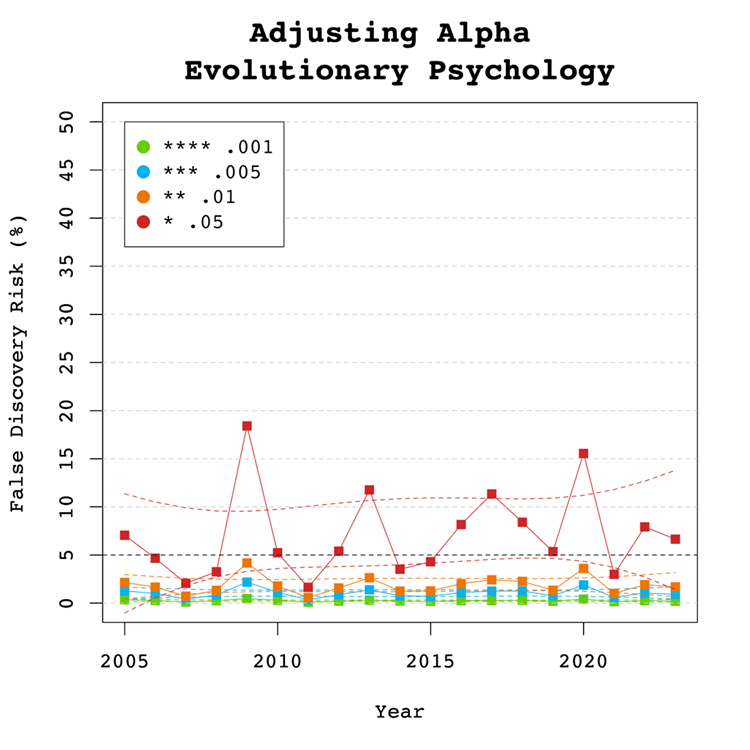
Figure 5

Figure 5 shows that the conventional criterion of p < .05 produces false discovery risks above 5%. The high variability in annual estimates also makes it difficult to provide precise estimates of the FDR. However, adjusting alpha to .01 is sufficient to produce an FDR with tight confidence intervals below 5%. The benefits of reducing alpha further to .005 or .001 are minimal.
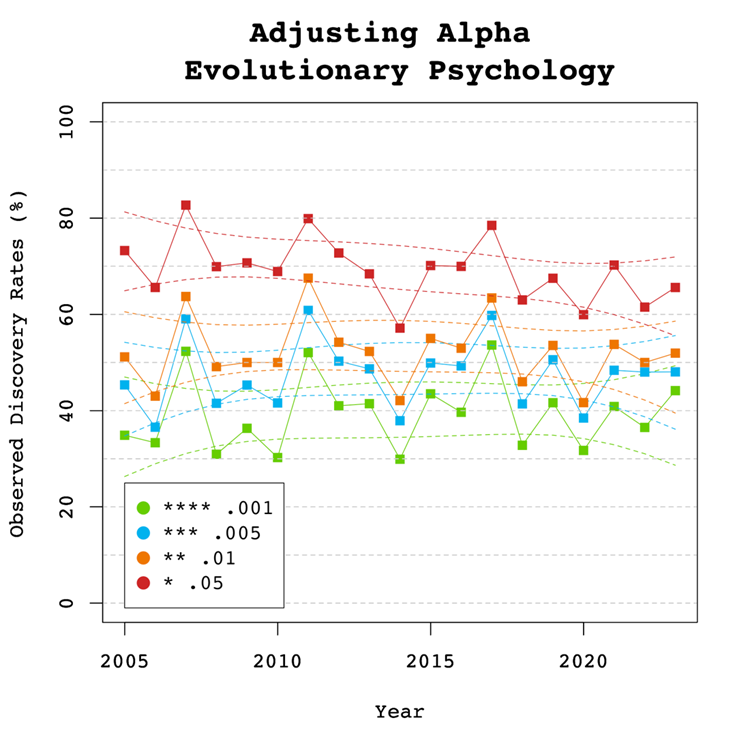
Figure 6

Figure 6 shows the impact of lowering the significance criterion, alpha, on the discovery rate (lower alpha implies fewer significant results). In Evolutionary Psychology lowering alpha to .01 reduces the observed discovery rate by about 20 to 10 percentage points. This implies that 20% of results reported p-values between .05 and .01. These results often have low success rates in actual replication studies (OSC, 2015). Thus, our recommendation is to set alpha to .01 to reduce the false positive risk to 5% and to disregard studies with weak evidence against the null-hypothesis. These studies require actual successful replications with larger samples to provide credible evidence for an evolutionary hypothesis.

There are relatively few studies with p-values between .01 and .005. Thus, more conservative researchers can use alpha = .005 without losing too many additional results.

Limitations

The main limitation of these results is the use of automatically extracted test statistics. This approach cannot distinguish between theoretically important statistical results and other results that are often reported but do not test focal hypotheses (e.g., testing the statistical significance of a manipulation check, reporting a non-significant result for a factor in a complex statistical design that was not expected to produce a significant result).

To examine the influence of automatic extraction on our results, we can compare the results to hand-coding results of over 4,000 hand-coded focal hypotheses in over 40 journals in 2010 and 2020. The ODR was 90% around 2010 and 88% around 2020. Thus, the tendency to report significant results for focal hypothesis tests is even higher than the ODR for all results and there is no indication that this bias has decreased notably over time. The ERR increased a bit from 61% to 67%, but these values are a bit lower than those reported here. Thus, it is possible that focal tests also have lower average power than other tests, but this difference seems to be small. The main finding is that the publishing of non-significant results for focal tests remains an exception in psychology journals and probably also in this journal.

One concern about the publication of our results is that it merely creates a new criterion to game publications. Rather than trying to get p-values below .05, researchers may use tricks to get p-values below .01. However, this argument ignores that it becomes increasingly harder to produce lower p-values with tricks (Simmons et al., 2011). Moreover, z-curve analysis makes it easy to see selection bias for different levels of significance. Thus, a more plausible response to these results is that researchers will increase sample sizes or use other methods to reduce sampling error to increase power.

Conclusion

The replicability report shows that the average power to report a significant result (i.e., a discovery) ranges from 49% to 72% in Evolutionary Psychology. This finding is higher than previous estimates observed in evolutionary psychology journals. However, the confidence intervals are wide and suggest that many published studies remain underpowered. The report did not capture any significant changes over time in the power and replicability as captured by the EDR and the ERR estimates. The false positive risk is modest and can be controlled by setting alpha to .01. Replication attempts of original findings with p-values above .01 should increase sample sizes to produce more conclusive evidence. Lastly, the journal shows clear evidence of selection bias.

There are several ways, the current or future editors of this journal can improve the credibility of results published in this journal. First, results with weak evidence (p-values between .05 and .01) should only be reported as suggestive results that require replication or even request a replication before publication. Second, editors should try to reduce publication bias by prioritizing research questions over results. A well-conducted study with an important question should be published even if the results are not statistically significant. Pre-registration and registered reports can help to reduce publication bias. Editors may also ask for follow-up studies with higher power to follow up on a non-significant result.

Publication bias also implies that point estimates of effect sizes are inflated. It is therefore important to take uncertainty in these estimates into account. Small samples with large sampling errors are usually unable to provide meaningful information about effect sizes and conclusions should be limited to the direction of an effect.

The present results serve as a benchmark for future years to track progress in this journal to ensure trust in research by evolutionary psychologists.

2024 Replicability Report for the Journal ‘Evolution and Human Behavior’

Authors: Maria Soto and Ulrich Schimmack

Citation: Soto, M. & Schimmack, U. (2024, June, 24/06/24).  2024 Replicability Report for the Journal 'Evolution and Human Behavior'.  Replicability Index. 
https://replicationindex.com/2024/06/24/rr24-evohumbeh/

Introduction

In the 2010s, it became apparent that empirical psychology had a replication problem. When psychologists tested the replicability of 100 results, they found that only 36% of the 97 significant results in original studies could be reproduced (Open Science Collaboration, 2015). In addition, several prominent cases of research fraud further undermined trust in published results. Over the past decade, several proposals were made to improve the credibility of psychology as a science. Replicability Reports aim to improve the credibilty of psychological science by examining the amount of publication bias and the strength of evidence for empirical claims in psychology journals.

The main problem in psychological science is the selective publishing of statistically significant results and the blind trust in statistically significant results as evidence for researchers’ theoretical claims. Unfortunately, psychologists have been unable to self-regulate their behaviour and continue to use unscientific practices to hide evidence that disconfirms their predictions. Moreover, ethical researchers who do not use unscientific practices are at a disadvantage in a game that rewards publishing many articles without concern about these findings’ replicability.

My colleagues and I have developed a statistical tool that can reveal the use of unscientific practices and predict the outcome of replication studies (Brunner & Schimmack, 2021Bartos & Schimmack, 2022). This method is called z-curve. Z-curve cannot be used to evaluate the credibility of a single study. However, it can provide valuable information about the research practices in a particular research domain.

Replicability-Reports (RR) use z-curve to provide information about psychological journal research and publication practices. This information can aid authors choose journals they want to publish in, provide feedback to journal editors who influence selection bias and replicability of published results, and, most importantly, to readers of these journals.

Evolution & Human Behavior

Evolution & Human Behavior is the official journal of the Human Behaviour and Evolution Society. It is an interdisciplinary journal founded in 1997. The journal publishes articles on human behaviour from an evolutionary perspective. On average, Evolution & Human Behavior publishes about 70 articles a year in 6 annual issues.

Evolutionary psychology has produced both highly robust and questionable results. Robust results have been found for sex differences in behaviors and attitudes related to sexuality. Questionable results have been reported for changes in women’s attitudes and behaviors as a function of hormonal changes throughout their menstrual cycle.

According to Web of Science, the impact factor of Evolution & Human Behaviour ranks 5th in the Behavioural Sciences category and 2nd in the Psychology, Biological category (Clarivate, 2024). The journal has an H-Index of 122 (i.e., 122 articles have received 122 or more citations).

In its lifetime, Evolution & Human Behavior has published over 1,400. Articles published by this journal have an average citation rate of 46.2 citations. So far, the journal has published 2 articles with more than 1,000 citations. The most highly cited article dates back to 2001 in which the authors argued that prestige evolved as a non-coercive social status to enhance the quality of “information goods” acquired via cultural transmission (Henrich & Gil-White, 2001).

The current Editor-in-Chief is Professor Debra Lieberman. The associate editors are Professor Greg Bryant, Professor Aaron Lukaszewski, and Professor David Puts.

Extraction Method

Replication reports are based on automatically extracted test statistics such as F-tests, t-tests, z-tests, and chi2-tests. Additionally, we extracted 95% confidence intervals of odds ratios and regression coefficients. The test statistics were extracted from collected PDF files using a custom R-code. The code relies on the pdftools R package (Ooms, 2024) to render all textboxes from a PDF file into character strings. Once converted the code proceeds to systematically extract the test statistics of interest (Soto & Schimmack, 2024). PDF files identified as editorials, review papers and meta-analyses were excluded. Meta-analyses were excluded to avoid the inclusion of test statistics that were not originally published in Evolution & Human Behavior. Following extraction, the test statistics are converted into absolute z-scores.

Results For All Years

Figure 1 shows a z-curve plot for all articles from 2000-2023 (see Schimmack, 2023, for a detailed description of z-curve plots). The plot is essentially a histogram of all test statistics converted into absolute z-scores (i.e., the direction of an effect is ignored). Z-scores can be interpreted as the strength of evidence against the null hypothesis that there is no statistical relationship between two variables (i.e., the effect size is zero and the expected z-score is zero). A z-curve plot shows the standard criterion of statistical significance (alpha = .05, z = 1.96) as a vertical red dotted line.

Figure 1

Z-curve plots are limited to values less than z = 6. The reason is that values greater than 6 are so extreme that a successful replication is all but certain unless the value is a computational error or based on fraudulent data. The extreme values are still used for the computation of z-curve statistics but omitted from the plot to highlight the shape of the distribution for diagnostic z-scores in the range from 2 to 6. Using the expectation maximization (EM) algorithm, Z-curve estimates the optimal weights for seven components located at z-values of 0, 1, …. 6 to fit the observed statistically significant z-scores. The predicted distribution is shown as a blue curve. Importantly, the model is fitted to the significant z-scores, but the model predicts the distribution of non-significant results. This makes it possible to examine publication bias (i.e., selective publishing of significant results). Using the estimated distribution of non-significant and significant results, z-curve provides an estimate of the expected discovery rate (EDR); that is, the percentage of significant results that were actually obtained without selection for significance. Using Soric’s (1989) formula the EDR is used to estimate the false discovery risk; that is, the maximum number of significant results that are false positives (i.e., the null-hypothesis is true).

Selection for Significance

The extent of selection bias in a journal can be quantified by comparing the Observed Discovery Rate (ODR) of 64%, 95%CI = 63% to 65% with the Expected Discovery Rate (EDR) of 28%, 95%CI = 17%-42%. The ODR is notably higher than the upper limit of the confidence interval for the EDR, indicating statistically significant publication bias. The ODR is also more than double than the point estimate of the EDR, indicating that publication bias is substantial. Thus, there is clear evidence of the common practice to omit reports of non-significant results. The present results may underestimate the severity of the problem because the analysis is based on all statistical results. Selection bias is even more problematic for focal hypothesis tests and the ODR for focal tests in psychology journals is often close to 90%.

Expected Replication Rate

The Expected Replication Rate (ERR) estimates the percentage of studies that would produce a significant result again if exact replications with the same sample size were conducted. A comparison of the ERR with the outcome of actual replication studies shows that the ERR is higher than the actual replication rate (Schimmack, 2020). Several factors can explain this discrepancy, such as the difficulty of conducting exact replication studies. Thus, the ERR is an optimist estimate. A conservative estimate is the EDR. The EDR predicts replication outcomes if significance testing does not favour studies with higher power (larger effects and smaller sampling error) because statistical tricks make it just as likely that studies with low power are published. We suggest using the EDR and ERR in combination to estimate the actual replication rate.

The ERR estimate of 71%, 95%CI = 66% to 77%, suggests that the majority of results should produce a statistically significant, p < .05, result again in exact replication studies. However, the EDR of 28% implies that there is considerable uncertainty about the actual replication rate for studies in this journal and that the success rate can be anywhere between 28% and 71%.

False Positive Risk

The replication crisis has led to concerns that many or even most published results are false positives (i.e., the true effect size is zero). Using Soric’s formula (1989), the maximum false discovery rate can be calculated based on the EDR.

The EDR of 28% implies a False Discovery Risk (FDR) of 14%, 95%CI = 7% to 26%, but the 95%CI of the FDR allows for up to 26% false positive results. This estimate contradicts claims that most published results are false (Ioannidis, 2005), but the results also create uncertainty about the credibility of results with statistically significant results, if up to 1 out of 4 results can be false positives.

Changes Over Time

One advantage of automatically extracted test-statistics is that the large number of test statistics makes it possible to examine changes in publication practices over time. We were particularly interested in changes in response to awareness about the replication crisis in recent years.

Z-curve plots for every publication year were calculated to examine time trends through regression analysis. Additionally, the degrees of freedom used in F-tests and t-tests were used as a metric of sample size to observe if these changed over time. Both linear and quadratic trends were considered. The quadratic term was included to observe if any changes occurred in response to the replication crisis. That is, there may have been no changes from 2000 to 2015, but increases in EDR and ERR after 2015.

Degrees of Freedom

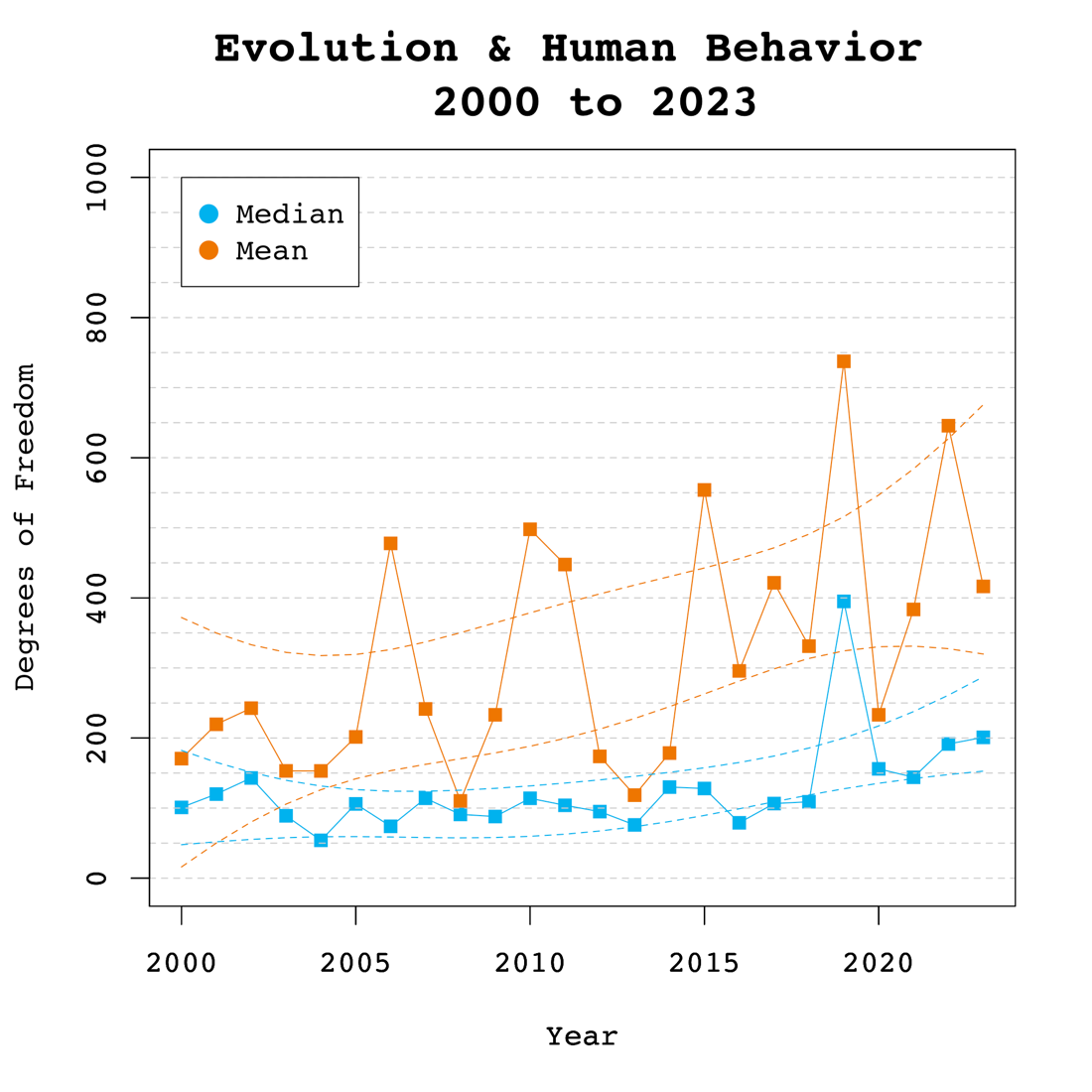
Figure 2 shows the median and mean degrees of freedom used in F-tests and t-tests reported in Evolution & Human Behavior. The mean results are highly variable due to a few studies with extremely large sampel sizes. Thus, we focus on the median to examine time trends. The median degrees of freedom over time was 107.75, ranging from 54 to 395. Regression analyses of the median showed a significant linear increase by 4 to 5 degrees of freedom per year, b = 4.57, SE = 1.69, p = 0.013. However, there was no evidence that the replication crisis influenced a significant increase in sample sizes as seen by the lack of a significant non-linear trend and a small regression coefficient, b = 0.50, SE = 0.27, p = 0.082.

Figure 2

Observed and Expected Discovery Rates

Figure 3 shows the changes in the ODR and EDR estimates over time. There were no significant linear, b = 0.06 (SE = 0.17 p = 0.748) or non-linear,  b = -0.02 (SE = 0.03, p = 0.435) trends observed in the ODR estimate. The regression results for the EDR estimate showed no significant linear, b = 0.75 (SE = 0.51 p = 0.153) or non-linear, b = 0.04 (SE = 0.08 p = 0.630) changes over time. These findings indicate the journal has not increased its publication of non-significant results even though selection bias is heavily present. Furthermore, the lack of changes to the EDR suggests that many studies continue to be statistically underpowered to measure the effect sizes of interest.

Figure 3

Expected Replicability Rates and False Discovery Risks

Figure 4 depicts the false discovery risk (FDR) and the Estimated Replication Rate (ERR). It also shows the Expected Replication Failure rate (EFR = 1 – ERR). A comparison of the EFR with the FDR provides information for the interpretation of replication failures. If the FDR is close to the EFR, many replication failures may be due to false positive results in original studies. In contrast, if the FDR is low, most replication failures will likely be false negative results in underpowered replication studies.

The ERR estimate showed a significant linear increase over time, b = 0.61, SE = 0.26, p = 0.031. No significant non-linear trend was observed, b = 0.07, SE = 0.4, p = 0.127. These findings are consistent with the observed significant increase in sample sizes as the reduction in sampling error increases the likelihood that an effect will replicate.

The significant increase in the ERR without a significant increase in the EDR is partially explained by the higher power of the test for the ERR that can be estimated with higher precision. However, it is also possible that the ERR increases more because there is an increase in the heterogeneity of studies. That is, the number of studies with low power has remained constant, but the number of studies with high power has increased. This would result in a bigger increase in the ERR than the EDR.

Figure 4

Visual inspection of Figure 4 depicts the EFR higher than the FDR over time, suggesting that replication failures of studies in Evolution & Human Behavior are more likely to be false negatives rather than false positives. Up to 30% of the published results might not be replicable, and up to 50% of those results may be false positives.

It is noteworthy that the gap between the EFR and the FDR appears to be narrowing over time. This trend is supported by the significant increase in the Estimated Replicability Rate (ERR), where EFR is defined as 1 – ERR. Meanwhile, the Expected Discovery Rate (EDR) has remained constant, indicating that the FDR has also remained unchanged, given that the FDR is derived from a transformation of the EDR. The findings suggest that while original results have become more likely to replicate, the probability that replication failures are false positives remains unchanged.   

Adjusting Alpha

A simple solution to a crisis of confidence in published results is to adjust the criterion to reject the null-hypothesis. For example, some researchers have proposed to set alpha to .005 to avoid too many false positive results. With z-curve we can calibrate alpha to keep the false discovery risk at an acceptable level without discarding too many true positive results. To do so, we set alpha to .05, .01, .005, and .001 and examined the false discovery risk.

Figure 5

Figure 5 shows that the conventional criterion of p < .05 produces false discovery risks above 5%. The high variability in annual estimates also makes it difficult to provide precise estimates of the FDR. However, adjusting alpha to .01 is sufficient to produce an FDR with tight confidence intervals below 5%. The benefits of reducing alpha further to .005 or .001 are minimal.

Figure 6

Figure 6 shows the impact of lowering the significance criterion, alpha, on the discovery rate (lower alpha implies fewer significant results). In Evolution & Human Behavior lowering alpha to .01 reduces the observed discovery rate by about 20 percentage points. This implies that 20% of results reported p-values between .05 and .01. These results often have low success rates in actual replication studies (OSC, 2015). Thus, our recommendation is to set alpha to .01 to reduce the false positive risk to 5% and to disregard studies with weak evidence against the null-hypothesis. These studies require actual successful replications with larger samples to provide credible evidence for an evolutionary hypothesis.

There are relatively few studies with p-values between .01 and .005. Thus, more conservative researchers can use alpha = .005 without losing too many additional results.

Limitations

The main limitation of these results is the use of automatically extracted test statistics. This approach cannot distinguish between theoretically important statistical results and other results that are often reported but do not test focal hypotheses (e.g., testing the statistical significance of a manipulation check, reporting a non-significant result for a factor in a complex statistical design that was not expected to produce a significant result).

To examine the influence of automatic extraction on our results, we can compare the results to hand-coding results of over 4,000 hand-coded focal hypotheses in over 40 journals in 2010 and 2020. The ODR was 90% around 2010 and 88% around 2020. Thus, the tendency to report significant results for focal hypothesis tests is even higher than the ODR for all results and there is no indication that this bias has decreased notably over time. The ERR increased a bit from 61% to 67%, but these values are a bit lower than those reported here. Thus, it is possible that focal tests also have lower average power than other tests, but this difference seems to be small. The main finding is that publishing of non-significant results for focal tests remains an exception in psychology journals and probably also in this journal.

One concern about the publication of our results is that it merely creates a new criterion to game publications. Rather than trying to get p-values below .05, researchers may use tricks to get p-values below .01. However, this argument ignores that it becomes increasingly harder to produce lower p-values with tricks (Simmons et al., 2011). Moreover, z-curve analysis makes it easy to see selection bias for different levels of significance. Thus, a more plausible response to these results is that researchers will increase sample sizes or use other methods to reduce sampling error to increase power.

Conclusion

The replicability report for Evolution & Human Behavior suggests that the power to obtain a significant result to report a significant result (i.e., a discovery) ranges from 28% to 71%. This finding suggests that many studies are underpowered and require luck to get a significant result. The false positive risk is modest and can be controlled by setting alpha to .01. Replication attempts of original findings with p-values above .01 should increase sample sizes to produce more conclusive evidence. The journal shows clear evidence of selection bias.

There are several ways, the current or future editors of this journal can improve credibility of results published in this journal. First, results with weak evidence (p-values between .05 and .01) should only be reported as suggestive results that require replication or even request a replication before publication. Second, editors should try to reduce publication bias by prioritizing research questions over results. A well-conducted study with an important question should be published even if the results are not statistically significant. Pre-registration and registered reports can help to reduce publication bias. Editors may also ask for follow-up studies with higher power to follow up on a non-significant result.

Publication bias also implies that point estimates of effect sizes are inflated. It is therefore important to take uncertainty in this estimates into account. Small samples with large sampling error are usually unable to provide meaningful information about effect sizes and conclusions should be limited to the direct of an effect.

The present results serve as a benchmark for future years to track progress in this journal to ensure trust in research by evolutionary psychologists.

Are Most Published Results in Psychology False? An Empirical Study

Why Most Published Research Findings  are False by John P. A. Ioannidis

In 2005, John P. A. Ioannidis wrote an influential article with the title “Why Most Published Research Findings are False.” The article starts with the observation that “there is increasing concern that most current published research findings are false” (e124). Later on, however, the concern becomes a fact. “It can be proven that most claimed research findings are false” (e124). It is not surprising that an article that claims to have proof for such a stunning claim has received a lot of attention (2,199 citations and 399 citations in 2016 alone in Web of Science).

Most citing articles focus on the possibility that many or even more than half of all published results could be false. Few articles cite Ioannidis to make the factual statement that most published results are false, and there appears to be no critical examination of Ioannidis’s simulations that he used to support his claim.

This blog post shows that these simulations make questionable assumptions and shows with empirical data that Ioannidis’s simulations are inconsistent with actual data.

Critical Examination of Ioannidis’s Simulations

First, it is important to define what a false finding is. In many sciences, a finding is published when a statistical test produced a significant result (p < .05). For example, a drug trial may show a significant difference between a drug and a placebo control condition with a p-value of .02. This finding is then interpreted as evidence for the effectiveness of the drug.

How could this published finding be false? The logic of significance testing makes this clear. The only inference that is being made is that the population effect size (i.e., the effect size that could be obtained if the same experiment were repeated with an infinite number of participants) is different from zero and in the same direction as the one observed in the study. Thus, the claim that most significant results are false implies that in more than 50% of all published significant results the null-hypothesis was true. That is, a false positive result was reported.

Ioannidis then introduces the positive predictive value (PPV). The positive predictive value is the proportion of positive results (p < .05) that are true positives.

(1) PPV = TP/(TP + FP)

PTP = True Positive Results, FP = False Positive Results

The proportion of true positive results (TP) depends on the percentage of true hypothesis (PTH) and the probability of producing a significant result when a hypothesis is true. This probability is known as statistical power. Statistical power is typically defined as 1 minus the type-II error (beta).

(2) TP = PTH * Power = PTH * (1 – beta)

The probability of a false positive result depends on the proportion of false hypotheses (PFH) and the criterion for significance (alpha).

(3) FP = PFH * alpha

This means that the actual proportion of true significant results is a function of the ratio of true and false hypotheses (PTH:PFH), power, and alpha.

(4) PPV = (PTH*power) / ((PTH*power) + (PFH * alpha))

Ioannidis translates his claim that most published findings are false into a PPV below 50%. This would mean that the null-hypothesis is true in more than 50% of published results that falsely rejected it.

(5) (PTH*power) / ((PTH*power) + (PFH * alpha))  < .50

Equation (5) can be simplied to the inequality equation

(6) alpha > PTH/PFH * power

We can rearrange formula (6) and substitute PFH with (1-PHT) to determine the maximum proportion of true hypotheses to produce over 50% false positive results.

(7a)  =  alpha = PTH/(1-PTH) * power

(7b) = alpha*(1-PTH) = PTH * power

(7c) = alpha – PTH*alpha = PTH * power

(7d) =  alpha = PTH*alpha + PTH*power

(7e) = alpha = PTH(alpha + power)

(7f) =  alpha/(power + alpha) = PTH


Table 1 shows the results.

Power                  PTH / PFH             
90%                       5  / 95
80%                       6  / 94
70%                       7  / 93
60%                       8  / 92
50%                       9  / 91
40%                      11 / 89
30%                       14 / 86
20%                      20 / 80
10%                       33 / 67                     

Even if researchers would conduct studies with only 20% power to discover true positive results, we would only obtain more than 50% false positive results if only 20% of hypothesis were true. This makes it rather implausible that most published results could be false.

To justify his bold claim, Ioannidis introduces the notion of bias. Bias can be introduced due to various questionable research practices that help researchers to report significant results. The main effect of these practices is that the probability of a false positive result to become significant increases.

Simmons et al. (2011) showed that massive use several questionable research practices (p-hacking) can increase the risk of a false positive result from the nominal 5% to 60%. If we assume that bias is rampant and substitute the nominal alpha of 5% with an assumed alpha of 50%, fewer false hypotheses are needed to produce more false than true positives (Table 2).

Power                 PTH/PFH             
90%                     40 / 60
80%                     43 / 57
70%                     46 / 54
60%                     50 / 50
50%                     55 / 45
40%                     60 / 40
30%                     67 / 33
20%                     75 / 25
10%                      86 / 14                    

If we assume that bias inflates the risk of type-I errors from 5% to 60%, it is no longer implausible that most research findings are false. In fact, more than 50% of published results would be false if researchers tested hypothesis with 50% power and 50% of tested hypothesis are false.

However, the calculations in Table 2 ignore the fact that questionable research practices that inflate false positives also decrease the rate of false negatives. For example, a researcher who continues testing until a significant result is obtained, increases the chances of obtaining a significant result no matter whether the hypothesis is true or false.

Ioannidis recognizes this, but he assumes that bias has the same effect for true hypothesis and false hypothesis. This assumption is questionable because it is easier to produce a significant result if an effect exists than if no effect exists. Ioannidis’s assumption implies that bias increases the proportion of false positive results a lot more than the proportion of true positive results.

For example, if power is 50%, only 50% of true hypothesis produce a significant result. However, with a bias factor of .4, another 40% of the false negative results will become significant, adding another .4*.5 = 20% true positive results to the number of true positive results. This gives a total of 70% positive results, which is a 40% increase over the number of positive results that would have been obtained without bias. However, this increase in true positive results pales in comparison to the effect that 40% bias has on the rate of false positives. As there are 95% true negatives, 40% bias produces another .95*.40 = 38% of false positive results. So instead of 5% false positive results, bias increases the percentage of false positive results from 5% to 43%, an increase by 760%. Thus, the effect of bias on the PPV is not equal. A 40% increase of false positives has a much stronger impact on the PPV than a 40% increase of true positives. Ioannidis provides no rational for this bias model.

A bigger concern is that Ioannidis makes sweeping claims about the proportion of false published findings based on untested assumptions about the proportion of null-effects, statistical power, and the amount of bias due to questionable research practices.
For example, he suggests that 4 out of 5 discoveries in adequately powered (80% power) exploratory epidemiological studies are false positives (PPV = .20). To arrive at this estimate, he assumes that only 1 out of 11 hypotheses is true and that for every 1000 studies, bias adds only 1000* .30*.10*.20 = 6 true positives results compared to 1000* .30*.90*.95 = 265 false positive results (i.e., 44:1 ratio). The assumed bias turns a PPV of 62% without bias into a PPV of 20% with bias. These untested assumptions are used to support the claim that “simulations show that for most study designs and settings, it is more likely for a research claim to be false than true.” (e124).

Many of these assumptions can be challenged. For example, statisticians have pointed out that the null-hypothesis is unlikely to be true in most studies (Cohen, 1994). This does not mean that all published results are true, but Ioannidis’ claims rest on the opposite assumption that most hypothesis are a priori false. This makes little sense when the a priori hypothesis is specified as a null-effect and even a small effect size is sufficient for a hypothesis to be correct.

Ioannidis also ignores attempts to estimate the typical power of studies (Cohen, 1962). At least in psychology, the typical power is estimated to be around 50%. As shown in Table 2, even massive bias would still produce more true than false positive results, if the null-hypothesis is false in no more than 50% of all statistical tests.

In conclusion, Ioannidis’s claim that most published results are false depends heavily on untested assumptions and cannot be considered a factual assessment of the actual number of false results in published journals.

Testing Ioannidis’s Simulations

10 years after the publication of “Why Most Published Research Findings Are False,”  it is possible to put Ioannidis’s simulations to an empirical test. Powergraphs (Schimmack, 2015) can be used to estimate the average replicability of published test results. For this purpose, each test statistic is converted into a z-value. A powergraph is foremost a histogram of z-values. The distribution of z-values provides information about the average statistical power of published results because studies with higher power produce higher z-values.
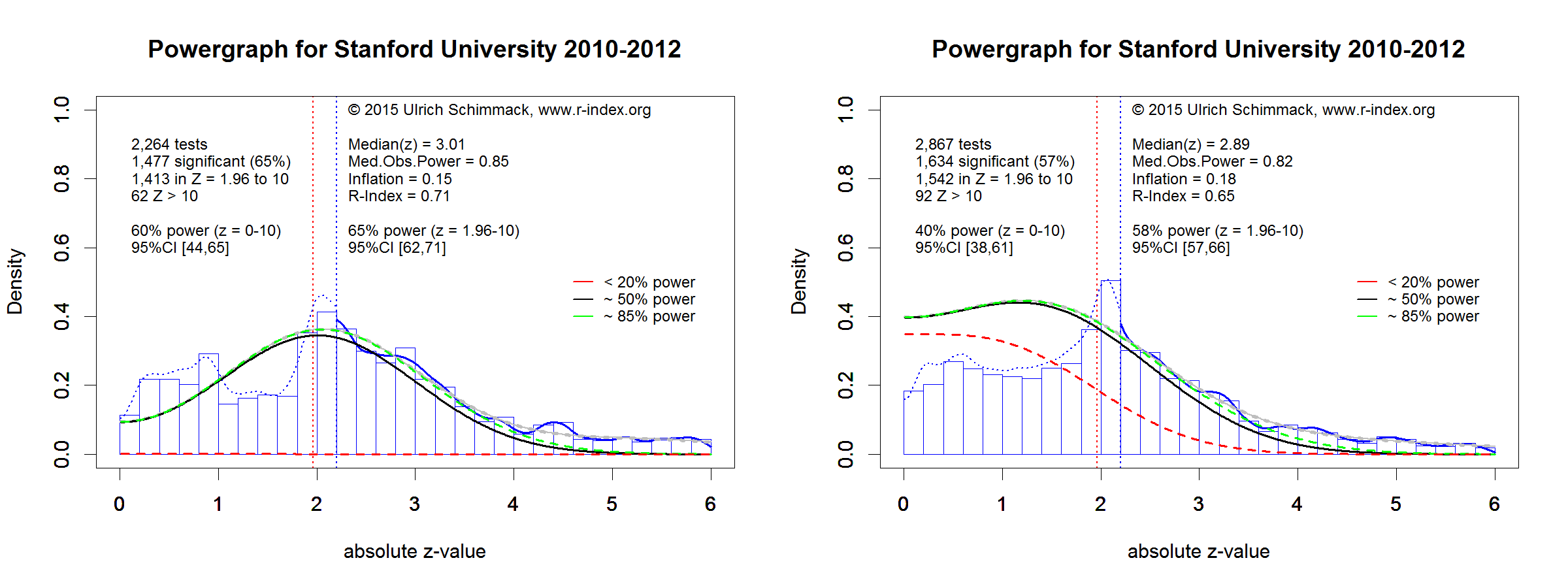
Figure 1 illustrates the distribution of z-values that is expected for Ioanndis’s model for “adequately powered exploratory epidemiological study” (Simulation 6 in Figure 4). Ioannidis assumes that for every true positive, there are 10 false positives (R = 1:10). He also assumed that studies have 80% power to detect a true positive. In addition, he assumed 30% bias.

ioannidis-fig6

A 30% bias implies that for every 100 false hypotheses, there would be 33 (100*[.30*.95+.05]) rather than 5 false positive results (.95*.30+.05)/.95). The effect on false negatives is much smaller (100*[.30*.20 + .80]). Bias was modeled by increasing the number of attempts to produce a significant result so that proportion of true and false hypothesis matched the predicted proportions. Given an assumed 1:10 ratio of true to false hypothesis, the ratio is 335 false hypotheses to 86 true hypotheses. The simulation assumed that researchers tested 100,000 false hypotheses and observed 35000 false positive results and that they tested 10,000 true hypotheses and observed 8,600 true positive results. Bias was simulated by increasing the number of tests to produce the predicted ratio of true and false positive results.

Figure 1 only shows significant results because only significant results would be reported as positive results. Figure 1 shows that a high proportion of z-values are in the range between 1.95 (p = .05) and 3 (p = .001). Powergraphs use z-curve (Schimmack & Brunner, 2016) to estimate the probability that an exact replication study would replicate a significant result. In this simulation, this probability is a mixture of false positives and studies with 80% power. The true average probability is 20%. The z-curve estimate is 21%. Z-curve can also estimate the replicability for other sets of studies. The figure on the right shows replicability for studies that produced an observed z-score greater than 3 (p < .001). The estimate shows an average replicability of 59%. Thus, researchers can increase the chance of replicating published findings by adjusting the criterion value and ignoring significant results with p-values greater than p = .001, even if they were reported as significant with p < .05.

Figure 2 shows the distribution of z-values for Ioannidis’s example of a research program that produces more true than false positives, PPV = .85 (Simulation 1 in Table 4).

ioannidis-fig1

Visual inspection of Figure 1 and Figure 2 is sufficient to show that a robust research program produces a dramatically different distribution of z-values. The distribution of z-values in Figure 2 and a replicability estimate of 67% are impossible if most of the published significant results were false.  The maximum value that could be obtained is obtained with a PPV of 50% and 100% power for the true positive results, which yields a replicability estimate of .05*.50 + 1*.50 = 55%. As power is much lower than 100%, the real maximum value is below 50%.

The powergraph on the right shows the replicability estimate for tests that produced a z-value greater than 3 (p < .001). As only a small proportion of false positives are included in this set, z-curve correctly estimates the average power of these studies as 80%. These examples demonstrate that it is possible to test Ioannidis’s claim that most published (significant) results are false empirically. The distribution of test results provides relevant information about the proportion of false positives and power. If actual data are more similar to the distribution in Figure 1, it is possible that most published results are false positives, although it is impossible to distinguish false positives from false negatives with extremely low power. In contrast, if data look more like those in Figure 2, the evidence would contradict Ioannidis’s bold and unsupported claim that most published results are false.

The maximum replicabiltiy that could be obtained with 50% false-positives would require that the true positive studies have 100% power. In this case, replicability would be .50*.05 + .50*1 = 52.5%.  However, 100% power is unrealistic. Figure 3 shows the distribution for a scenario with 90% power and 100% bias and an equal percentage of true and false hypotheses. The true replicabilty for this scenario is .05*.50 + .90 * .50 = 47.5%. z-curve slightly overestimates replicabilty and produced an estimate of 51%.  Even 90% power is unlikely in a real set of data. Thus, replicability estimates above 50% are inconsistent with Ioannidis’s hypothesis that most published positive results are false.  Moreover, the distribution of z-values greater than 3 is also informative. If positive results are a mixture of many false positive results and true positive results with high power, the replicabilty estimate for z-values greater than 3 should be high. In contrast, if this estimate is not much higher than the estimate for all z-values, it suggest that there is a high proportion of studies that produced true positive results with low power.

ioannidis-fig3

Empirical Evidence

I have produced powergraphs and replicability estimates for over 100 psychology journals (2015 Replicabilty Rankings). Not a single journal produced a replicability estimate below 50%. Below are a few selected examples.

The Journal of Experimental Psychology: Learning, Memory and Cognition publishes results from cognitive psychology. In 2015, a replication project (OSC, 2015) demonstrated that 50% of significant results produced a significant result in a replication study. It is unlikely that all non-significant results were false positives. Thus, the results show that Ioannidis’s claim that most published results are false does not apply to results published in this journal.

Powergraphs for JEP-LMC3.g

The powergraphs further support this conclusion. The graphs look a lot more like Figure 2 than Figure 1 and the replicability estimate is even higher than the one expected from Ioannidis’s simulation with a PPV of 85%.

Another journal that was subjected to replication attempts was Psychological Science. The success rate for Psychological Science was below 50%. However, it is important to keep in mind that a non-significant result in a replication study does not prove that the original result was a false positive. Thus, the PPV could still be greater than 50%.

Powergraphs for PsySci3.g

The powergraph for Psychological Science shows more z-values in the range between 2 and 3 (p > .001). Nevertheless, the replicability estimate is comparable to the one in Figure 2 which simulated a high PPV of 85%. Closer inspection of the results published in this journal would be required to determine whether a PPV below .50 is plausible.

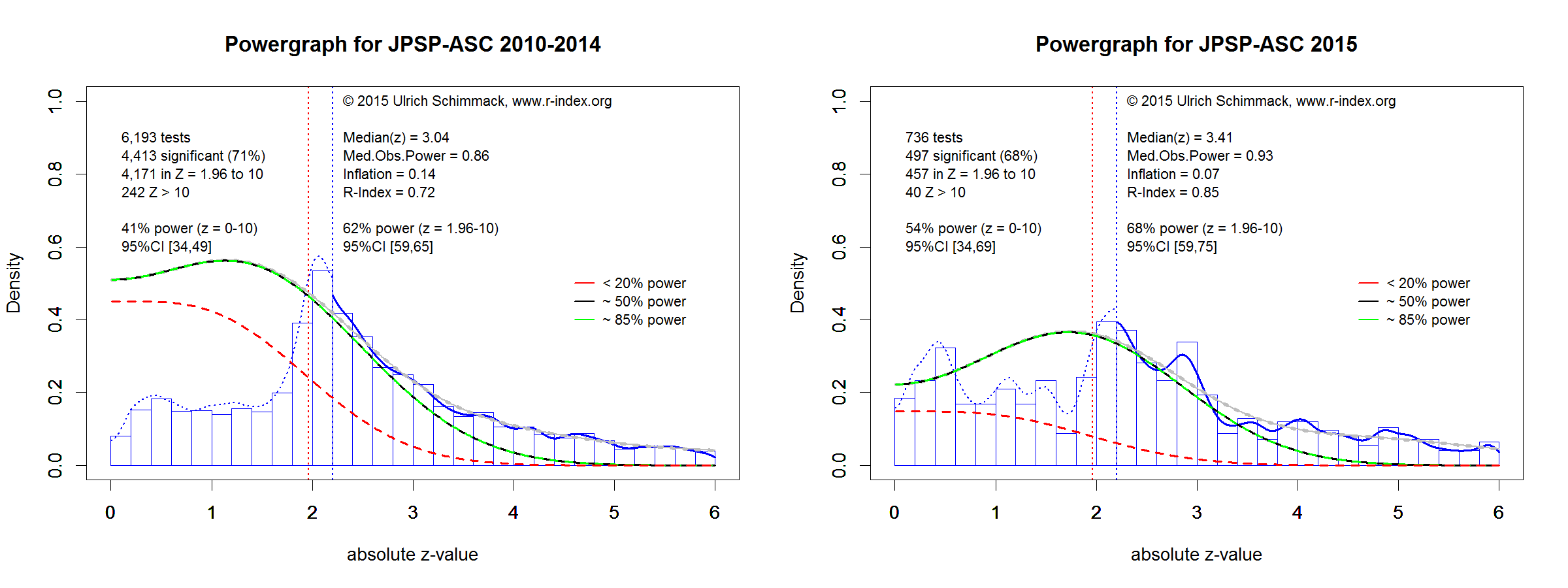
The third journal that was subjected to a replication attempt was the Journal of Personality and Social Psychology. The journal has three sections, but I focus on the Attitude and Social Cognition section because many replication studies were from this section. The success rate of replication studies was only 25%. However, there is controversy about the reason for this high number of failed replications and once more it is not clear what percentage of failed replications were due to false positive results in the original studies.

Powergraphs for JPSP-ASC3.g

One problem with the journal rankings is that they are based on automated extraction of all test results. Ioannidis might argue that his claim focused only on test results that tested an original, novel, or an important finding, whereas articles also often report significance tests for other effects. For example, an intervention study may show a strong decrease in depression, when only the interaction with treatment is theoretically relevant.

I am currently working on powergraphs that are limited to theoretically important statistical tests. These results may show lower replicability estimates. Thus, it remains to be seen how consistent Ioannidis’s predictions are for tests of novel and original hypotheses. Powergraphs provide a valuable tool to address this important question.

Moreover, powergraphs can be used to examine whether science is improving. So far, powergraphs of psychology journals have shown no systematic improvement in response to concerns about high false positive rates in published journals. The powergraphs for 2016 will be published soon. Stay tuned.


Replicability Ranking of Psychology Departments

Evaluations of individual researchers, departments, and universities are common and arguably necessary as science is becoming bigger. Existing rankings are based to a large extent on peer-evaluations. A university is ranked highly if peers at other universities perceive it to produce a steady stream of high-quality research. At present the most widely used objective measures rely on the quantity of research output and on the number of citations. These quantitative indicators of research quality work are also heavily influenced by peers because peer-review controls what gets published, especially in journals with high rejection rates, and peers decide what research they cite in their own work. The social mechanisms that regulate peer-approval are unavoidable in a collective enterprise like science that does not have a simple objective measure of quality (e.g., customer satisfaction ratings, or accident rates of cars). Unfortunately, it is well known that social judgments are subject to many biases due to conformity pressure, self-serving biases, confirmation bias, motivated biases, etc. Therefore, it is desirable to complement peer-evaluations with objective indicators of research quality.

Some aspects of research quality are easier to measure than others. Replicability rankings focus on one aspect of research quality that can be measured objectively, namely the replicability of a published significant result. In many scientific disciplines such as psychology, a successful study reports a statistically significant result. A statistically significant result is used to minimize the risk of publishing evidence for an effect that does not exist (or even goes in the opposite direction). For example, a psychological study that shows effectiveness of a treatment for depression would have to show that the effect in the study reveals a real effect that can be observed in other studies and in real patients if the treatment is used for the treatment of depression.

In a science that produces thousands of results a year, it is inevitable that some of the published results are fluke findings (even Toyota’s break down sometimes). To minimize the risk of false results entering the literature, psychology like many other sciences, adopted a 5% error rate. By using a 5% as the criterion, psychologists ensured that no more than 5% of results are fluke findings. With thousands of results published in each year, this still means that more than 50 false results enter the literature each year. However, this is acceptable because a single study does not have immediate consequences. Only if these results are replicated in other studies, findings become the foundation of theories and may influence practical decisions in therapy or in other applications of psychological findings (at work, in schools, or in policy). Thus, to outside observers it may appear safe to trust published results in psychology and to report about these findings in newspaper articles, popular books, or textbooks.

Unfortunately, it would be a mistake to interpret a significant result in a psychology journal as evidence that the result is probably true.  The reason is that the published success rate in journals has nothing to do with the actual success rate in psychological laboratories. All insiders know that it is common practice to report only results that support a researcher’s theory. While outsiders may think of scientists as neutral observers (judges), insiders play the game of lobbyist, advertisers, and self-promoters. The game is to advance one’s theory, publish more than others, get more citations than others, and win more grant money than others. Honest reporting of failed studies does not advance this agenda. As a result, the fact that psychological studies report nearly exclusively success stories (Sterling, 1995; Sterling et al., 1995) tells outside observers nothing about the replicability of a published finding and the true rate of fluke findings could be 100%.

This problem has been known for over 50 years (Cohen, 1962; Sterling, 1959). So it would be wrong to call the selective reporting of successful studies an acute crisis. However, what changed is that some psychologists have started to criticize the widely accepted practice of selective reporting of successful studies (Asendorpf et al., 2012; Francis, 2012; Simonsohn et al., 2011; Schimmack, 2012; Wagenmakers et al., 2011). Over the past five years, psychologists, particularly social psychologists, have been engaged in heated arguments over the so-called “replication crisis.”

One group argues that selective publishing of successful studies occurred, but without real consequences on the trustworthiness of published results. The other group argues that published results cannot be trusted unless they have been successfully replicated. The problem is that neither group has objective information about the replicability of published results.  That is, there is no reliable estimate of the percentage of studies that would produce a significant result again, if a representative sample of significant results published in psychology journals were replicated.

Evidently, it is not possible to conduct exact replication studies of all studies that have been published in the past 50 years. Fortunately, it is not necessary to conduct exact replication studies to obtain an objective estimate of replicability. The reason is that replicability of exact replication studies is a function of the statistical power of studies (Sterling et al., 1995). Without selective reporting of results, a 95% success rate is an estimate of the statistical power of the studies that achieved this success rate. Vice versa, a set of studies with average power of 50% is expected to produce a success rate of 50% (Sterling, et al., 1995).

Although selection bias renders success rates uninformative, the actual statistical results provide valuable information that can be used to estimate the unbiased statistical power of published results. Although selection bias inflates effect sizes and power, Brunner and Schimmack (forcecoming) developed and validated a method that can correct for selection bias. This method makes it possible to estimate the replicability of published significant results on the basis of the original reported results. This statistical method was used to estimate the replicabilty of research published by psychology departments in the years from 2010 to 2015 (see Methodology for details).

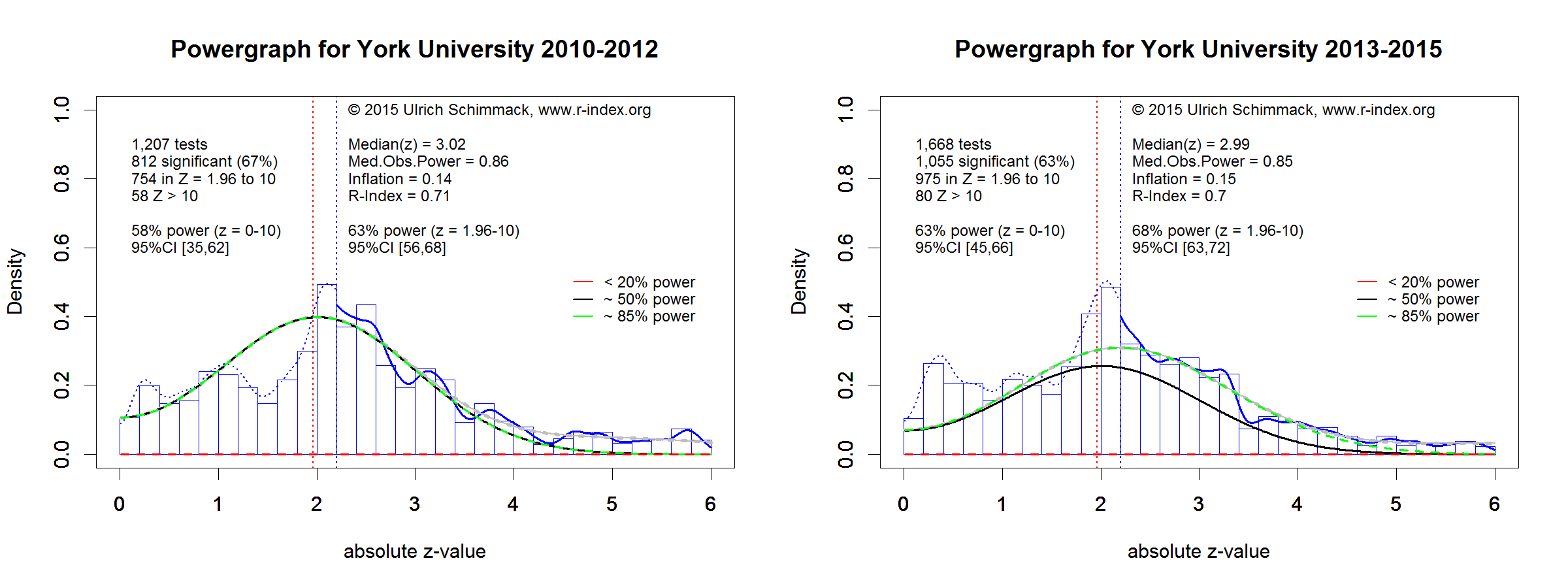
The averages for the 2010-2012 period (M = 59) and the 2013-2015 period (M = 61) show only a small difference, indicating that psychologists have not changed their research practices in accordance with recommendations to improve replicability in 2011  (Simonsohn et al., 2011). For most of the departments the confidence intervals for the two periods overlap (see attached powergraphs). Thus, the more reliable average across all years is used for the rankings, but the information for the two time periods is presented as well.

There are no obvious predictors of variability across departments. Private universities are at the top (#1, #2, #8), the middle (#24, #26), and at the bottom (#44, #47). European universities can also be found at the top (#4, #5), middle (#25) and bottom (#46, #51). So are Canadian universities (#9, #15, #16, #18, #19, #50).

There is no consensus on an optimal number of replicability.  Cohen recommended that researchers should plan studies with 80% power to detect real effects. If 50% of studies tested real effects with 80% power and the other 50% tested a null-hypothesis (no effect = 2.5% probability to replicate a false result again), the estimated power for significant results would be 78%. The effect on average power is so small because most of the false predictions produce a non-significant result. As a result, only a few studies with low replication probability dilute the average power estimate. Thus, a value greater than 70 can be considered broadly in accordance with Cohen’s recommendations.

It is important to point out that the estimates are very optimistic estimates of the success rate in actual replications of theoretically important effects. For a representative set of 100 studies (OSC, Science, 2015), Brunner and Schimmack’s statistical approach predicted a success rate of 54%, but the success rate in actual replication studies was only 37%. One reason for this discrepancy could be that the statistical approach assumes that the replication studies are exact, but actual replications always differ in some ways from the original studies, and this uncontrollable variability in experimental conditions posses another challenge for replicability of psychological results.  Before further validation research has been completed, the estimates can only be used as a rough estimate of replicability. However, the absolute accuracy of estimates is not relevant for the relative comparison of psychology departments.

And now, without further ado, the first objective rankings of 51 psychology departments based on the replicability of published significant results. More departments will be added to these rankings as the results become available.

Rank University 2010-2015 2010-2012 2013-2015
1 U Penn 72 69 75
2 Cornell U 70 67 72
3 Purdue U 69 69 69
4 Tilburg U 69 71 66
5 Humboldt U Berlin 67 68 66
6 Carnegie Mellon 67 67 67
7 Princeton U 66 65 67
8 York U 66 63 68
9 Brown U 66 71 60
10 U Geneva 66 71 60
11 Northwestern U 65 66 63
12 U Cambridge 65 66 63
13 U Washington 65 70 59
14 Carleton U 65 68 61
15 Queen’s U 63 57 69
16 U Texas – Austin 63 63 63
17 U Toronto 63 65 61
18 McGill U 63 72 54
19 U Virginia 63 61 64
20 U Queensland 63 66 59
21 Vanderbilt U 63 61 64
22 Michigan State U 62 57 67
23 Harvard U 62 64 60
24 U Amsterdam 62 63 60
25 Stanford U 62 65 58
26 UC Davis 62 57 66
27 UCLA 61 61 61
28 U Michigan 61 63 59
29 Ghent U 61 58 63
30 U Waterloo 61 65 56
31 U Kentucky 59 58 60
32 Penn State U 59 63 55
33 Radboud U 59 60 57
34 U Western Ontario 58 66 50
35 U North Carolina Chapel Hill 58 58 58
36 Boston University 58 66 50
37 U Mass Amherst 58 52 64
38 U British Columbia 57 57 57
39 The University of Hong Kong 57 57 57
40 Arizona State U 57 57 57
41 U Missouri 57 55 59
42 Florida State U 56 63 49
43 New York U 55 55 54
44 Dartmouth College 55 68 41
45 U Heidelberg 54 48 60
46 Yale U 54 54 54
47 Ohio State U 53 58 47
48 Wake Forest U 51 53 49
49 Dalhousie U 50 45 55
50 U Oslo 49 54 44
51 U Kansas 45 45 44


Replicability Ranking of 27 Psychology Journals (2015)

Click on this link to see the latest rankings for over 100 Psychology Journals for 2015.

The replicability rankings below are based on post-hoc power analyses of published results. The method is explained in more detail elsewhere.  More detailed results and time trends can be found by clicking on the hyperlink of a journal.  The ranking for the average replicability score in 2010-2014 and 2015 is r = .66, indicating that there are reliable differences in replicability between journals.  Movements by more than 10 percentage points are marked with an arrow.

Rank Journal Area 2010-2014 2015 Grade
1 Developmental Psychology DEV 0.63 0.76 B↑
2 Cognitive Psychology COG 0.72 0.74 B
3 JEP: Human Percpetion and Performance COG 0.72 0.71 B
4 Judgment and Decision Making COG 0.66 0.70 B
5 J. Experimental Psych: Learning, Memory, Cognition COG 0.69 0.70 B-
6 JPSP: Personality Process & Individual Differences PER 0.56 0.70 B↑
7 Journal of Memory & Language COG 0.67 0.69 C
8 Social Psychology Personality Science SOC 0.51 0.68 C↑
9 Journal of Experimental Psychology: General GEN 0.63 0.67 C
10 Cognition & Emotion EMO 0.64 0.67 C
11 Social Psychology SOC 0.61 0.66 C
12 Journal of Cross-Cultural Psychology GEN 0.69 0.65 C
13 Journal of Positive Psychology GEN 0.53 0.63 C
14 Psychology and Aging DEV 0.67 0.59 D
15 Child Development DEV 0.63 0.58 D
16 Journal of Experimental Social Psychology SOC 0.48 0.55 D
17 Psychological Science GEN 0.56 0.54 D
18 Developmental Science DEV 0.58 0.53 D
19 European Journal of Social Psychology SOC 0.55 0.52 D
20 Emotion EMO 0.61 0.52 D↓
21 Personal Relationships SOC 0.52 0.52 D
22 JPSP: Attitude & Social Cognition SOC 0.51 0.51 D
23 JPSP:Interpersonal Relationships & Group Processes SOC 0.48 0.50 D
24 British Journal of Social Psychology SOC 0.48 0.50 D
25 Personality & Social Psychology Bulletin SOC 0.50 0.46 F
26 Journal of Social & Personal Relationships SOC 0.56 0.39 F
27 Social Cognition SOC 0.54 0.35 F