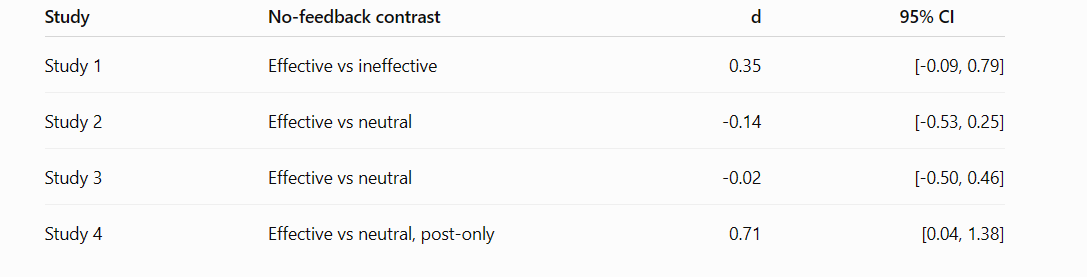
Przybylinski, E. (2026). Whatever you say: Changing transference-based problem behavior with if–then plans. Self and Identity. Advance online publication. https://doi.org/10.1080/15298868.2026.2613846
Przybylinski (2026) reports two experiments examining whether implementation intentions can prevent problematic behaviors triggered by transference. The theoretical logic is straightforward: subtle resemblance to a significant other is assumed to activate that person’s representation automatically, which can then influence memory, goals, and behavior. An if–then plan is proposed to prevent the activated representation from guiding subsequent behavior.
The principal concern is the credibility of the evidence on which this argument rests.
The article treats automatic behavioral priming as a well-established foundation. For example, it cites Bargh et al. (1996), Bargh et al. (2001), Chartrand and Bargh (1999), and related studies as evidence that contextual cues can automatically trigger overt behavior without awareness or intention. Yet behavioral priming is precisely one of the areas most affected by the replication crisis. The article does not discuss this change in evidential status. Thus, evidence that was considered persuasive when these studies were conducted is largely presented in 2026 as though subsequent replication failures had not occurred.
This matters because the two experiments are themselves products of that earlier research era. The author explicitly states that they were conducted as dissertation research in the late 2000s, before preregistration became standard. Study 1 included only 60 participants, or 20 participants in each of the three strategy conditions, despite testing interaction hypotheses. Study 2 included 47 participants. The manuscript provides a power justification, but because the studies were not preregistered, it is unclear whether the reported power analysis reflects a prospectively specified design decision. The reported “post hoc power” provides little additional information.
The results are remarkably successful. The focal interactions involving behavioral readiness, memory, and overt submissive behavior are all statistically significant in the predicted direction. The reported effects are also very large, frequently exceeding d = 1 and reaching d = 1.69 in Study 1. Across the major focal tests, the success rate is effectively 100%, while average observed power based on the reported effects is roughly 80%.
A perfect success rate is not impossible when power is 80%, but it is more successful than expected. Schimmack (2012) emphasized that unusually high success rates relative to estimated power can indicate that published effect sizes and success rates should not be taken at face value. Here, the outcomes within each experiment are dependent, so a simple excess-success or incredibility calculation would not be appropriate. With only two studies, there is no statistical smoking gun. Nevertheless, the combination of small samples, large effects, multiple significant focal outcomes, and absence of preregistration warrants substantial caution.
The historical timing makes this concern more important. These experiments were conducted approximately 15 years before their publication. During that interval, psychology experienced a replication crisis that directly challenged the credibility of the behavioral-priming literature on which the article relies. Yet the 2026 article does not supplement the old experiments with a contemporary, adequately powered, preregistered replication.
This is particularly striking because the central experiment is readily replicable. The author remains at the same institution where the original research was conducted, and the paradigm requires undergraduate participants rather than an unusually difficult population. A preregistered replication with a substantially larger sample could have provided highly informative evidence about whether the large effects observed in the original dissertation studies survive contemporary scrutiny.
The absence of such a replication changes how the evidence should be interpreted. The results are not invalid merely because they were collected before the replication crisis. But neither the reported effect sizes nor the perfect pattern of statistical success should be treated as reliable estimates of the underlying effects without independent replication.
Klein, J. W., & Swann, W. B., Jr. (2026). Social psychology’s empty-self metaphor and the replication crisis. Perspectives on Psychological Science, 21(2), 138–153. https://doi.org/10.1177/17456916251401849.
Klein and Swann (2026) offer an interesting diagnosis of the replication crisis, but the evidence does not support the strength of their theoretical interpretation.
Their central empirical observation is striking. They coded 41 hypotheses from Many Labs 1 and 2 as either consistent with an “empty-self” metaphor or not. None of the nine “empty-self” hypotheses replicated, whereas 26 of 32 “not-empty-self” hypotheses replicated, a difference of 81 percentage points. Given the small number of empty-self studies, however, the estimate is much less precise than the point estimate suggests; an approximate 95% confidence interval for the difference is about 47 to 91 percentage points. The authors appropriately describe the result as preliminary.
The more serious problem is interpretation. The analysis is correlational. Studies were not randomly assigned to use an “empty-self” theory, and the authors did not code plausible confounding variables that could themselves predict replication success. These include the sample size and statistical power of the original study, the strength of the situational manipulation, whether the manipulation was consciously perceived, the causal proximity between manipulation and outcome, and the prior plausibility of the predicted effect. Their own coding examples illustrate the problem. A gray background affecting support for austerity is coded as “empty self,” whereas paying for a workshop affecting attendance is coded as “not empty self.” The latter is still a situational effect. What differs most obviously is that payment is a strong and behaviorally relevant manipulation, whereas background color is a weak and remote one.
Thus, the empirical result may show that studies proposing large effects of weak, incidental situational manipulations replicate poorly. That is interesting, but it is not the same as showing that studies fail because they neglect an enduring self.
The theoretical explanation is also speculative and at times internally strained. Klein and Swann sometimes treat replication failures as evidence that subtle situational manipulations have little or no effect. In the Many Labs studies, this inference can be justified when very large samples produce narrow confidence intervals around zero. But this cannot be generalized to all failed replications. In other literatures, including elderly priming, the available confidence intervals may still be compatible with small effects. Failure to obtain significance is not equivalent to demonstrating an effect of exactly zero.
At the same time, Klein and Swann suggest that subtle situational effects may depend on the person. They argue that people may respond only to cues to which they are “tuned” and that primes may work only when they connect to existing self-representations. That possibility is not new to priming theory. Priming effects have long been assumed to depend on whether participants possess the relevant stereotype or representation, and some priming studies have explicitly predicted interactions—for example, effects of religious primes that depend on participants’ religiosity.
But this moderation account has an important implication. If a prime affects people for whom it is relevant and has little effect on others, the population-average effect should normally be reduced, not eliminated. Unless one assumes theoretically unusual crossover interactions in which the prime produces effects in opposite directions for different people, sufficiently large studies should still detect a small average effect. For elderly priming, for example, it is easy to imagine that some participants might be more responsive to an elderly stereotype than others. It is much harder to explain why the same prime should make another substantial group walk faster.
This creates a useful empirical question that Klein and Swann do not examine. Their 41 hypotheses should be coded not only as “empty self” or “not empty self,” but also according to whether the original hypothesis predicted a main effect or a Person × Situation interaction. If nearly all of the “empty-self” studies in Many Labs tested simple main effects, that matters because the larger priming literature already contains many moderator and interaction hypotheses. The Many Labs sample would then not represent the full theoretical range of priming research. More broadly, the authors should distinguish studies proposing universal effects from studies explicitly predicting conditional effects.
A stronger analysis would therefore code each study independently for situation strength, awareness of the manipulation, personal relevance, causal distance between manipulation and outcome, original sample size and power, prior plausibility, and whether the prediction was a main effect or an interaction. Only then could one determine whether an “empty-self” construct predicts replication after plausible alternative explanations have been taken into account.
The irony is that Klein and Swann criticize social psychology for building theories on weak evidence, but their own “empty-self” explanation is itself a speculative theory supported by weakly diagnostic data. The empirical pattern—0% versus 81% replication—is interesting. The claim that this pattern is caused by neglect of an enduring self is not established.
On a 1-to-5 scale from speculative theory to theory explaining highly credible phenomena, I would rate the article about 2/5. The phenomenon to be explained is credible: some classes of social-psychological findings replicate poorly. The proposed explanation—that they fail because social psychology adopted an “empty-self” metaphor—remains largely speculative.
“Theories are a dime a dozen” (Ed Diener, personal communication)
Bingley, W. J., Worthy, P., Wiles, J., & Haslam, S. A. (2026). A social identity theory of digital identity. Perspectives on Psychological Science, 21(4), 346–382. https://doi.org/10.1177/17456916261419813.
Bingley and colleagues (2026) propose a new “social digital identity theory” (SDIT) to explain how social identities operate across online, offline, and hybrid environments. The theory is unusually explicit: the authors formulate 20 propositions concerning identity salience, digital platforms, embodiment, well-being, group functioning, polarization, culture, and other outcomes.
This is not a judgment that the theory is uninteresting or implausible. A rating of 2 means that much of the distinctive theory remains speculative and that the empirical findings used to motivate it have not been systematically evaluated for credibility.
There are good features. Bingley et al. clearly distinguish established ideas from novel hypotheses. They explicitly acknowledge that many of their propositions—particularly P4 through P11, P18, and P20—have not previously been tested and require empirical evaluation. Other propositions are extensions of the much older social-identity and self-categorization literature. Thus, they do not claim that all 20 propositions are established facts.
The problem is different. When published studies are cited as empirical support, the authors rarely ask how strong that evidence actually is. There is no systematic consideration of statistical power, independent replication, publication bias, or whether an apparently supportive literature consists mainly of selected significant findings.
Embodiment provides a good example
Proposition 5 states that social-identity salience is shaped by embodiment. To motivate this proposition, the authors cite studies suggesting that heat activates anger concepts, social rejection makes rooms feel colder, keeping secrets feels physically burdensome, fist clenching activates related concepts, and facial-muscle activation influences experience. They then extend this reasoning to virtual embodiment and the Proteus effect.
A particularly revealing example concerns elderly priming.
The authors cite a virtual-reality study by Reinhard et al. in which participants embodied an older or younger avatar. Participants who had embodied the older avatar subsequently walked more slowly during the first part of a walking test than participants who embodied the younger avatar, p = .033. However, these differences disappeared during the second half of the walk.
Bingley et al. describe this result as operating similarly to “classic priming studies in social psychology” and cite Bargh, Chen, and Burrows (1996).
That citation is problematic because Bargh et al.’s famous claim that elderly-related primes cause people to walk more slowly became one of the best-known examples of the replication problems in social psychology. Doyen et al. (2012) conducted a larger replication using automated measurement and failed to reproduce the original effect in their first experiment.
None of this replication history is mentioned.
The result is an evidential chain that looks stronger on paper than it really is:
reported embodiment effects → elderly-avatar study → classic elderly priming → support for an embodiment proposition.
There are several citations, but citations are not the same thing as strong evidence.
The elderly-avatar study may be interesting, and the possibility that virtual embodiment affects subsequent behavior certainly deserves further study. But a marginally significant result that is then linked to a famous but poorly replicated priming finding does not provide strong evidence for a broad theoretical proposition about embodiment and social identity.
The same caution applies to meta-analytic evidence. A meta-analysis can summarize a literature very precisely while still giving a misleading estimate if the underlying literature is affected by publication bias and selective reporting. The important question is therefore not simply whether a theory can cite studies—or even a meta-analysis—that support a proposition. The question is whether the phenomenon itself has been demonstrated with credible evidence.
Why 2 rather than 1?
SDIT deserves more than the lowest score because it is not free-form speculation. It builds on established theoretical traditions, makes explicit predictions, distinguishes some novel claims from older ones, and repeatedly identifies propositions that require future empirical tests.
But it does not deserve a middle or high score because much of the distinctive theory is not yet explaining firmly established empirical phenomena. Moreover, the embodiment section demonstrates that the authors sometimes treat published findings as evidence without critically assessing whether those findings survived the replication crisis.
Thus, the 2/5 rating means:
SDIT is a structured and testable theoretical proposal with some grounding in established research, but much of its distinctive content remains speculative, and the empirical literature used to motivate some propositions is treated too uncritically.
The citation of Bargh et al. (1996) is a particularly clear example. In 2026, a theory article should not invoke elderly priming as supportive evidence without informing readers that the original phenomenon itself remains empirically uncertain.
Aytürk, E., & Saribay, S. A. (2026). Neglect of the individual as a neglected problem: The relevance of combined idiographic-nomothetic approaches for social psychology today. Self and Identity. https://doi.org/10.1080/15298868.2026.2697941
Aytürk and Saribay (2026) make a useful methodological argument in “Neglect of the individual as a neglected problem.” Social psychology typically averages across people even though the same situation may have different psychological meanings for different individuals. They advocate greater use of personalized stimuli and intensive repeated-measures designs to identify person-specific processes before generalizing across people.
They also suggest that this problem might help explain replication failures in social priming. For example, “elderly” might evoke a frail grandparent for one person and a vigorous retiree for another. Averaging across these individuals could obscure different or even opposing effects. This is a reasonable hypothesis. It is also useful that the authors explicitly acknowledge low statistical power, questionable research practices, and publication bias as established contributors to replication failures.
The problem is that they nevertheless cite Bargh et al. (1996) rather uncritically. The famous finding that activating the elderly stereotype makes people walk more slowly is treated as an example of a potentially heterogeneous priming effect, without informing readers that the original effect became a prominent example of psychology’s replication problems. Doyen et al. (2012), using a larger sample and automated measurement, failed to reproduce the original effect in their first experiment.
There were earlier attempts to explain the inconsistent findings by invoking individual differences. For example, Cesario et al. (2006) reported that elderly priming slowed participants with relatively positive attitudes toward elderly people but sped up those with negative attitudes. Other studies similarly reported moderator effects. But these small-sample studies do not provide strong evidence that a robust main effect was merely hidden by heterogeneity. Cesario et al.’s study, for example, had only about 67 participants for the relevant analysis and did not obtain a conventionally significant overall priming effect. The evidential burden therefore shifted to an interaction estimated from an even less powerful design.
This is important because interaction effects are generally more difficult to estimate precisely than main effects. Finding a significant personality moderator in a small study does not establish that a failed main effect was really caused by individual differences. The moderator itself needs adequate power and independent replication. A more detailed discussion of these purported replications of elderly priming is available in “Elderly Priming: Did It Ever Work?”
Here Aytürk and Saribay’s methodological proposal may actually provide a better way forward. Intensive repeated measurement can obtain much more information from each participant and therefore can study within-person Person × Situation effects with fewer participants than a conventional design may require. This comes at a cost: many observations per person are needed, and ecological or experience-sampling studies typically sacrifice some of the experimental control available in tightly controlled laboratory experiments. Moreover, any between-person moderator still ultimately depends on having enough individuals.
Thus, the proposal itself is worth pursuing. Low power means that the failed priming literature often provides lack of evidence rather than definitive evidence of absence. Small, conditional, person-specific priming effects remain possible.
But they remain hypotheses to be demonstrated. Individual heterogeneity can explain variation in a real effect; it cannot by itself establish that an unreliable effect is real. A 2026 article explicitly concerned with the replication crisis should therefore not cite Bargh et al. (1996) without acknowledging the replication failures that make the existence of the phenomenon itself uncertain.
Smolinski, J., Smolinski, R., Kesting, P., & Kröcher, F. (2026). Ethical guidelines for designing, developing, and deploying AI negotiation agents. Group Decision and Negotiation, 35, 56. https://doi.org/10.1007/s10726-026-10011-2
One of the article’s central psychological concerns is that AI negotiation agents could exploit human vulnerabilities through sublimiminal or unconscious influence. This possibility sounds alarming because it suggests that an AI agent might manipulate a negotiator without the person even realizing that an influence attempt is taking place.
But the psychological evidence cited for this possibility is surprisingly weak.
The authors cite Bargh et al. (1996), one of the best-known studies of unconscious behavioral priming. Its famous elderly-priming experiments reported that participants exposed to words associated with old age subsequently walked more slowly. Yet the article does not mention that this finding later became a prominent example of psychology’s replication problems. Doyen et al. (2012), using a larger sample and automated measurement, failed to reproduce the original priming effect in their first experiment. The subsequent history of the finding raises further questions about whether elderly priming was ever a reliable phenomenon; I review that evidence in more detail in “Elderly Priming: Did It Ever Work?”
The problem is broader than the Bargh study. Subliminal persuasion has never been shown to be a particularly powerful method for changing consequential consumer choices. An older meta-analysis of subliminal advertising estimated an effect of only r = .059 on consumer choice. Later positive studies suggest that effects depend on restrictive boundary conditions, but even these results are not robust. Thus, it remains scientifically unknown if or when subliminal attempts to manipulate people actually work.
This raises an important question for the ethical analysis. Why would an AI negotiation agent need subliminal manipulation at all?
Ordinary persuasion operates in full awareness and can be far more direct. A seller can explicitly frame an offer as prestigious, scarce, safe, innovative, or socially desirable. A brand can persuade consumers that “Apple is cool,” and a consumer may knowingly pay considerably more for an Apple product because that identity has value to them. Nothing has to be flashed below the threshold of awareness. The person can see the message, understand the message, and still be influenced by it.
That form of influence is potentially much more relevant to AI negotiation agents. An AI can learn what arguments appeal to a particular person, emphasize some information rather than other information, frame alternatives strategically, appeal to identity or social norms, create urgency, flatter, build trust, or exploit known preferences. None of these processes requires a controversial theory of unconscious behavioral priming.
This distinction matters because the paper arguably directs attention toward the more sensational but less empirically credible risk. The image of an AI system exploiting subliminal psychological mechanisms is disturbing, but current psychology provides little evidence that such techniques constitute a powerful means of controlling behavior. More ordinary forms of conscious persuasion are both more plausible and potentially more consequential.
The ethical concern is therefore legitimate, but the psychological rationale should be reformulated. Rather than claiming that AI will be able to exploit “unconscious priming far more precisely” than humans, a more defensible concern is that AI may become exceptionally effective at personalized persuasion using psychological processes that operate with the target’s awareness.
The problem with citing Bargh is that it directs attention to irrational fears about subliminal manipulation, when AI may use much more powerful strategies to manipulate people with information that is in plain sight.
Shimada, S., Tanaka, S., Morioka, S., Rode, G., Roy, J.-M., & Rossetti, Y. (2026). Narrative embodiment: A conceptual framework linking the narrative self and the embodied self. New Ideas in Psychology, 83, 101285. https://doi.org/10.1016/j.newideapsych.2026.101285
Shimada and colleagues (2026) propose “narrative embodiment” as a conceptual framework linking two aspects of the self: the narrative self and the embodied self. Their central proposal is that “character,” borrowed from Paul Ricoeur, functions as an intermediary between narratives about who we are and relatively stable behavioral dispositions. Narratives may therefore alter behavior by changing character, while embodied experiences may feed back into character and ultimately change the narrative self. The authors apply this framework to phenomena ranging from identification with fictional characters and stereotype priming to virtual-reality avatars and rehabilitation.
The article is interesting partly because it raises a broader question about how theoretical articles should be evaluated. Not all theories have the same epistemic status. In particular, it is useful to distinguish speculative theories from explanatory theories.
Speculative and explanatory theories
At one end of a continuum are speculative theories. These theories propose mechanisms or constructs that could potentially explain observations, but the empirical phenomena they are intended to explain have not themselves been firmly established. Freud’s psychoanalytic theories provide a familiar historical example. Concepts such as repression, the id, ego, and superego offered potentially interesting explanations of human behavior, but the empirical foundations for many of these explanations were weak and the theories were sufficiently flexible to accommodate many different observations.
At the other end are theories constructed to explain credible empirical findings. Perception research provides many examples. Psychophysical phenomena can often be demonstrated repeatedly under highly controlled conditions. Researchers may disagree about why a particular perceptual phenomenon occurs, but there is little disagreement that the phenomenon itself occurs. In this situation, theories compete to explain reliable data. The theoretical problem is not “Does this phenomenon really exist?” but “What mechanism explains it?”
This distinction can be represented on a five-point continuum:
Highly speculative — the theory attempts to explain reported findings whose credibility or replicability has not been established.
Mostly speculative — some credible empirical evidence exists, but important parts of the empirical foundation remain uncertain.
Mixed — the theory integrates both well-established findings and substantially less certain findings.
Mostly explanatory — the major empirical phenomena are supported by strong and reasonably replicable evidence.
Explanatory theory of credible findings — the phenomena to be explained are firmly established; the principal uncertainty concerns their explanation rather than their existence.
An important implication of this distinction is that the number of empirical citations in a theoretical article does not necessarily make the theory empirically grounded. A theory can cite dozens of experiments and nevertheless remain highly speculative if those experiments are unreliable. What matters is the credibility of the phenomena that the theory attempts to explain.
Narrative embodiment
On this continuum, I would rate the narrative-embodiment framework 1 out of 5.
This does not mean that the theory is necessarily false. In fact, several aspects of it are intuitively plausible. It seems entirely possible that people’s narratives about themselves influence their behavior and that behavioral experiences subsequently influence how people think about themselves. The authors also make a constructive attempt to translate their framework into empirically measurable variables such as identification, self-efficacy, body image, and behavioral expression.
The problem is that the article does not critically evaluate the credibility of the empirical phenomena used to motivate the theory. Instead, published findings are typically treated as facts that require explanation.
The clearest example appears in the section on stereotype effects. The authors cite the famous study by Bargh, Chen, and Burrows (1996), in which participants exposed to words associated with old age reportedly walked more slowly after leaving the laboratory. Shimada et al. describe the result as follows:
“This demonstrates that stereotypes can shape behavior even without conscious awareness.”
The word “demonstrates” is important. The Bargh finding is not presented as a historically influential but controversial result. It is presented as empirical evidence for the proposed theoretical framework.
Yet the credibility of this finding has been questioned for well over a decade. Doyen et al. (2012) conducted a larger replication using automated measurement of walking speed. Their first experiment found essentially no difference between the elderly-prime and control conditions. The study included 120 participants, compared with 60 across Bargh et al.’s two original elderly-priming experiments, and used infrared sensors rather than manual stopwatch measurements. (PLOS)
Doyen et al.’s second experiment also showed that the outcome depended on experimenters’ expectations. The predicted slowing effect appeared when experimenters had been induced to expect primed participants to walk more slowly. Doyen et al. therefore concluded that priming alone was insufficient to reproduce the original walking-speed effect under their conditions. (PLOS)
Whatever one’s final judgment about behavioral priming, these findings clearly make the empirical status of the Bargh effect relevant to any theoretical review published in 2026. Yet Shimada et al. cite Bargh et al. without mentioning Doyen et al. or the broader controversy surrounding the replicability of behavioral priming.
This is not merely a minor omission in the reference list. It illustrates a fundamental problem in building psychological theories from the published literature. If significant findings are accepted at face value, virtually any collection of published results can provide apparent empirical support for a theoretical framework. After the replication crisis, however, the existence of a published finding cannot be equated with the existence of a credible phenomenon.
A more detailed examination of the history of the elderly-priming effect shows why this distinction matters. The evidence was much less consistent than the textbook version of the finding suggests, and later large preregistered studies provided additional negative evidence. A meta-analysis shows that the existing evidence is so weak and inconsistent that the true effect can range from no effect to a very strong effect without any known moderators (“Elderly Priming: Did It Ever Work?” ReplicabilityIndex)
A theory in search of credible phenomena
The same concern applies more broadly to the article. The authors draw on identification with fictional characters, stereotype effects, the Proteus effect, avatar embodiment, self-efficacy, narrative therapy, and other literatures. Some of these phenomena may ultimately prove more robust than others. Indeed, the authors cite meta-analytic evidence for the Proteus effect and occasionally acknowledge inconsistent findings. But there is no systematic attempt to distinguish highly credible phenomena from literatures characterized by small studies, selective reporting, or replication problems.
Consequently, the empirical literature functions primarily as illustration rather than as a set of established facts that constrain the theory.
This distinction is important because a genuinely explanatory theory should face constraints imposed by reliable observations. Suppose, for example, that repeated high-powered experiments established that identification with a fictional character reliably changed several character-consistent behaviors that had never been directly primed. A theory would then be needed to explain why these effects occur together. Shimada et al.’s concept of “character” might provide one possible explanation.
Indeed, one of the most promising ideas in the article points in precisely this direction. The authors suggest that activating one aspect of a character should affect other behaviors associated with the same character. Experiencing Superman’s ability to fly, for example, might subsequently increase helping behavior or bravery. If such cross-behavior effects were demonstrated reliably, especially under conditions that distinguished character identification from simpler priming or expectancy explanations, the narrative-embodiment framework would become substantially more explanatory and less speculative.
At present, however, the direction of inference is largely reversed. Published findings are assembled into a framework first, while the reliability of those findings is mostly taken for granted.
Conclusion
Narrative embodiment is an imaginative theoretical proposal. It integrates philosophical ideas about narrative identity and embodiment with several areas of psychological research and generates potentially testable hypotheses. For a journal called New Ideas in Psychology, this type of conceptual speculation is entirely appropriate.
But it is important to distinguish an interesting idea from an empirically established explanation.
On a continuum from speculative theory to explanation of credible empirical findings, I would rate the article:
Bargh, Chen, and Burrows (1996) reported that priming students with words related to old age made them walk more slowly, with effect sizes above one standard deviation (d = 1.04 and .79) across two studies of just 30 participants each. The finding became a cornerstone of behavioral-priming research and a famous casualty of the replication crisis after Doyen et al. (2012) failed to reproduce it. The Doyne et al. (2012) article came at the right time to cause a paradigm shift, but it was not the first replication failure.
The first replication failure appeared only a couple of years after the 1996 article: Dijksterhuis et al. (1998) found the same comparison at roughly a quarter of a standard deviation (d = .25 and .29), nonsignificant, and reinterpreted the disappearance as a side condition for a new contrast effect. Because social psychologists tracked the sign of an effect rather than its magnitude, a series of studies that did not reproduce Bargh’s result were published as successful demonstrations of moderators instead of as replication failures.
By 2012, elderly priming had been reported in 8 articles with 12 studies and 15 tests. I show that a meta-analysis at this time would have shown a wide prediction interval with possible effect sizes ranging from -0.1 to +1.0. Thus, Doyen et al.’s replication failure was entirely consistent with the full existing evidence. It was therefore entirely reasonable for Kahneman (2012) to ask for new and stronger evidence that Bargh never delivered. Since then, independent preregistered studies large failed to replicate past effects and priming theorists have largely abandoned priming research. The death of the priming paradigm provides a valuable lessons about the need to build theories on robust empirical foundations to avoid investing resources on phenomena that do not exist.
The Long Version
John A. Bargh studied with Robert Zajonc at the University of Michigan, earning his Ph.D. in 1981. Zajonc was an early champion of unconscious processes and used masked, subliminal presentations to study influences occurring outside conscious awareness. At New York University, Bargh developed a related program on automatic social cognition. At the time, studies from several laboratories suggested that stimuli presented outside awareness could influence feelings, judgments, and immediate reactions to other stimuli. Some of this evidence has since been challenged: meta-analyses find many subliminal effects hard to replicate, and concerns have been raised about publication bias and about whether participants were ever fully unaware of the masked stimuli.
Bargh matters for the history of psychology because his 1996 article made a much stronger claim. Rather than showing that unnoticed stimuli can shift immediate perceptions or evaluations, Bargh and colleagues claimed that activating a social concept could have a lasting influence on overt behavior without people being aware of that influence. In their famous elderly-priming experiment, students completed a scrambled-sentence task in which, in one condition, several words were related to old age and, in the control condition, were not. The words were visible, but participants were presumably unaware of the manipulation’s purpose or its possible effect on their behavior. Told to go to another room for a second study, participants then had their walking speed down the hallway measured as the real dependent variable. Bargh et al. reported that a few old-age words made students walk more slowly than controls.
The difference was not small. Effect sizes for two-group differences are often expressed in standard-deviation units. Cohen (1988) classified d = .50 as a medium effect and d = .80 as large. For comparison, an IQ test has a standard deviation of about 15 points, so half a standard deviation is 7.5 IQ points. In Bargh et al.’s first study, Experiment 2a, the effect was slightly larger than a full standard deviation, d = 1.04 — an exceptionally large effect for such a subtle manipulation.
Psychologists rarely run direct replications, but Bargh et al.’s article contained one. Experiment 2b used essentially the same procedure; again, primed participants walked significantly more slowly, and the effect stayed large, d = .79. The article thus appeared to offer unusually convincing evidence: two independent studies, same procedure, both producing significant and large effects.
The 1996 article spawned a large literature using primes such as money or God to influence behavior. Then, in 2012, Doyen et al. reported that they could not replicate the elderly-priming effect and suggested the original findings might be, at least partly, methodological artifacts. Walking speed in the original studies was timed manually with a stopwatch. And although the person timing walking speed was blind to condition, Doyen et al. noted it was unclear whether the experimenter who administered the priming task was also blind. If experimenters knew which participants had been primed, their expectations could have shaped participants’ behavior.
Doyen et al. tested this in a second experiment by manipulating experimenters’ expectations directly: some were led to expect primed participants to walk more slowly, others to walk faster. Objectively measured walking speed tracked those expectations — the elderly-prime effect appeared only when experimenters expected slowing — and the manual stopwatch measurements tracked them even more strongly. Doyen et al. thus provided experimental evidence that researchers’ expectations could produce the outcome of a behavioral-priming study.
Bargh responded in March 2012 with a Psychology Today post titled “Nothing in Their Heads.” He opened by noting that the 1996 finding had been theoretically predicted and fit a growing literature on automatic influences on behavior, but much of the post attacked the quality of Doyen et al.’s work and the peer review at PLOS ONE. Knowledgeable social-psychology editors and reviewers, he argued, would have caught the methodological problems; he had not been asked to review the paper, and implied that had he done so, he would have recommended rejection.
The tone drew wide criticism (Comments). Srivastava (2012), for one, characterized the episode as Bargh going “bananas.” The attack on the journal prompted a reply from the PLOS ONE editors on Bargh’s blog post (cf. Hodgkinson, 2012; Srivastava, 2012). Bargh later expressed regret over the tone and took the post down (Bartlett, 2013).
Bargh’s Defense of His Results in 2012
Bargh’s first substantive defense concerned experimenter effects. He stated that the experimenter in the original study had been blind to hypothesis and condition, and that a different person, also blind to condition, measured walking speed. If accurate, this substantially weakens Doyen et al.’s suggestion that experimenter expectations produced the original findings. But it does nothing for the more basic result: Doyen et al. used a larger sample and objective measurement and still failed to reproduce the effect.
Bargh therefore proposed several procedural differences to explain the replication failure. First, he argued that Doyen et al. had drawn participants’ attention to walking by telling them to “go straight down the hall when leaving,” and that making an automatic behavior conscious could eliminate the priming effect. But Doyen et al.’s article contains no such instruction; it says only that participants were “clearly directed to the end of the corridor” — and Bargh et al.’s own procedure had likewise directed participants toward the elevator down the hall. It is unclear the difference existed at all.
Second, Bargh questioned the strength of the manipulation: Doyen et al. put an elderly-related word in all 30 scrambled-sentence items, and Bargh argued that too many related words could make participants consciously aware of the theme and cancel an unconscious effect. Doyen et al. did find some evidence that participants could identify the elderly theme when directly probed — but nearly all denied noticing any connection between the sentence task and their walking.
Third, Bargh appealed to culture: priming works only if the association already exists in participants’ minds, so Belgian students might not link old age with slowness as American students do. Possible in principle — but Doyen et al. had adapted their materials to the Belgian sample by surveying 80 people about concepts associated with old age and selecting the frequent responses. Bargh et al.’s original article, by contrast, never measured whether their own participants associated the elderly stereotype with slower walking.
Finally, Bargh appealed to the accumulated literature: stereotype and behavioral priming had been replicated many times, so it was unreasonable to doubt the phenomenon over a single failure. This is persuasive only if the published record is an unbiased sample of all experiments run. That was precisely what the emerging replication crisis called into question. Journals favored novel, significant results and rarely published failed replications, so the sheer number of published successes could not reveal how often behavioral-priming experiments actually worked.
Doyen (2012) Was Not the First Failure
Commentators on the deleted blog post noted that Doyen et al. (2012) was not the first study to fail to reproduce elderly priming. As Nordbeck (2012) put it, Commentators on the deleted blog post noted that Doyen et al. (2012) was not the first study to fail to reproduce elderly priming. As Nordbeck (2012) put it,
It is a bit of a shame that many of the arguments Bargh uses in his criticism of the Doyen study are arbitrary, unsupported and, on occasion, false in light of other research (even some from the area of priming) (Nordbeck, 2012).
The earlier failures had been published, but not as failures. They appeared as successful demonstrations of moderators: conditions under which the effect was supposed to grow, shrink, or reverse (Cesario et al., 2006; Dijksterhuis et al., 1998; Hull et al., 2002). Bargh later cited these very studies without noting that none of them had reproduced his basic result — a difference between an elderly prime and a control group.
That this could happen reflects a habit of the field. Social psychologists tracked patterns of statistical significance more than the magnitude of effects. Evidence for a moderator requires a significant interaction, and once an interaction turns up, attention shifts from the main effect to the conditional effects that explain it. The claim is no longer “priming works” but “priming works differently under condition X” — and a study can support that claim while quietly failing to reproduce the main effect it was built on.
Dijksterhuis et al. (1998) is the clearest case, appearing just two years after the original. Studies 2a and 2b each contained the two conditions needed to test elderly priming — an elderly prime and a neutral prime, followed by the same judgment task. In both, primed participants walked slightly more slowly, but the effects were small and nonsignificant, d = .25 and .29, against Bargh’s d = 1.04 and .79. Same direction, a quarter of the magnitude.
But testing Bargh was not the point of their paper; behavioral contrast was. Some primed participants also judged a specific elderly exemplar — the Dutch Queen Mother, Princess Juliana — and then walked faster than both the neutral and the ordinary elderly-prime groups. That contrast effect was significant in both studies and became the headline. The authors did notice that their ordinary elderly prime had failed to reproduce Bargh’s assimilation effect, called it “somewhat surprising,” and proposed that the intervening judgment task had wiped it out — reading the small same-direction means as “residual assimilation.” The failure was not overlooked; it was reinterpreted into a footnote. By this reading, the first evidence that elderly priming is not as large or robust as advertised appeared fourteen years before Doyen.
Their explanation is itself revealing. If inserting an innocuous judgment task can cut an effect by roughly 75%, then the effect is extraordinarily sensitive to procedural detail. Researchers wanted theoretically predicted moderators that would specify when and why priming occurs. What the evidence kept pointing to instead were unknown moderators: incidental features of a procedure that swing the effect from large to nothing. A phenomenon that surfaces only under a narrow and poorly understood set of conditions is not the robust effect Bargh’s original experiments described.
Dijksterhuis was only the first. Hull et al. (2002) ran the paradigm in two studies and found priming only among participants high in self-consciousness; the overall effects were moderate but nonsignificant, ds = .57 and .54, in small samples. Cesario et al. (2006) added a youth prime that sped participants up, but the elderly-versus-control difference was small and nonsignificant, d = .23. Jeffries and Fazio (2008) found an interaction with a stopping rule on an anagram task and no main effect at all, d = −.05. N. Wyer (2011) produced the first robust replication — d = .70 on walking speed and d = 1.03 on working memory. And in 2012, the same year as Doyen, one article reported strong effects in one study (ds = 1.26, 1.05) but weak ones in another (ds = .29, .31).
Seen in this company, Doyen’s failure is unremarkable. Some studies produce large estimates and others produce weak estimates and all estimates in small samples have large sampling error and make estimation of the true effect size impossible. The common solution to imprecise estimates in small studies is to combine the studies in a meta-analysis.
A Meta-Analysis of Elderly Priming
Existing meta-analyses of priming pool many kinds of primes and outcomes, and the resulting heterogeneity tells us little about any one paradigm. So I conducted a meta-analysis restricted to elderly priming: 15 tests from 12 studies in 8 articles. Because publication bias is evident in the broader literature, I used a selection model that estimates the bias and returns a corrected effect size (Vevea & Hedges, 1995), with clustered bootstrapping to handle multiple tests nested within articles and to build the confidence and prediction intervals.
The bias-corrected effect was d = .42, 95% CI [−.01, .71]. The point estimate is close to the much larger meta-analysis of Dai et al. (2023), but the interval is wide and includes zero. The studies are small and individually imprecise, and the heterogeneity is itself barely pinned down: tau = .26, 95% CI [.00, .37]. Nothing here compels the conclusion that Bargh’s and Doyen’s results reflect different true effects.
The estimated mean and variation of the population effect sizes produce a 95% prediction interval that ranges form d = -0.10 to d = 1.03.
Thus, a replication study so large that sampling error is negligible could land anywhere from essentially nothing to a very large effect, because the existing evidence simply does not fix the size of the effect.
The meta-analysis also cannot explain how Bargh got two significant results from samples of N = 30. If the true effect were d = .42, a study that small has only about a 20% chance of reaching significance, so two independent significant results would occur about 4% of the time. Either Bargh was lucky, or something in his particular setup inflated the effect — for instance, a confound in the word list, if “Florida” slows NYU students’ walking by evoking a laid-back-Southern stereotype rather than an elderly one.
In short, a meta-analysis of the studies available in 2012 would have shown Bargh that Doyen’s result was entirely consistent with the broader evidence, however much it clashed with his own. There was no need to reach for incompetence. His deeper error was assuming that his two original studies, together with conceptual replications using other primes, had already established a general effect of elderly priming on behavior.
An important caveat is that publication-bias tests and corrections are difficult, especially when the set of studies is small. After Doyen et al.’s article was published, researchers shared anecdotal reports of additional unpublished replication failures (OSF Google Groups). If these unpublished studies could be recovered and included, they would likely reduce the average effect-size estimate.
Concerns about the credibility of social psychology were already building. Daniel Kahneman believed in priming and had featured it prominently in Thinking, Fast and Slow, yet he was growing worried about the field’s reputation and raised it with Bargh directly (Bartlett, 2012). In a widely circulated email to Bargh and other leading priming researchers, he proposed a simple remedy: if Doyen et al.’s failure was a fluke or a botch, the experts could settle the matter by running rigorous replications and showing the effects held. With an expected effect of d = .40, pooling resources for N = 400 would give roughly 98% power to detect it.
The collaboration never happened. Independent researchers ran preregistered replications instead, often with disappointing results — in Dai et al.’s (2023) meta-analysis, the preregistered studies, most of them replications, produced essentially no effect at all (d = .02).
In 2017, Kahneman returned to the problem, citing Overall (1969) on why underpowered research is not merely wasteful but pernicious: it inflates the share of false positives among published findings. Bargh’s experiments, with 15 participants per condition, had little power to detect any plausible effect and cannot account for the near-90% success rates in the published priming literature. Hundreds of studies manufactured the appearance of a robust phenomenon that low power, publication bias, heterogeneity, and near-zero preregistered effects do not support.
So the classic behavioral-priming paradigms simply faded from the research frontier. In that sense the field is practically dead — a stark case of strong belief outrunning weak evidence. Researchers can always find a reason to dismiss a failure and build ever more elaborate theory around inconsistent results, all without first establishing that the phenomenon the theory explains is real. As the meta-analysis above shows, even the 2012 evidence carried enough uncertainty to justify Kahneman’s call.
Which raises the obvious question: why wouldn’t a true believer, with the resources of a Yale professor, simply run the study and prove the point? Bartlett (2013) put it to Bargh directly:
So why not do an actual examination? Set up the same experiments again, with additional safeguards. It wouldn’t be terribly costly. No need for a grant to get undergraduates to unscramble sentences and stroll down a hallway.
Bargh was unenthusiastic. He wouldn’t ask graduate students worried about their job prospects to spend time on stigmatized research, and he was aware that some critics thought he had a “special touch” with priming — a word that sounds like praise but isn’t. “I don’t think anyone would believe me,” he said.
The same article also reports an interview with Axel Cleeremans, one of Doyen’s collaborators. Cleeremans reports that his collaborators and he found found the tone of Bargh’s letter insulting, but that they also took his criticism seriously enough to conduct another replication study that addressed his stated concerns. The study also failed to replicate the original results. Another unpublished replication failure was posted online by Pashler et al. (2011; Srivastava, 2012)
While the evidence that elderly priming works was mixed and inconclusive, Bargh expressed strong confidence in his findings and his theory of unconscious activation of behavior. In his blog post, he believed that the long-term future of priming research was secure because the phenomenon rested on a large and converging empirical foundation:
Like many scientists, I take the long view and continue to have faith in science as a cumulative process, with particular studies that vary in their methods and approaches converging on deeper underlying principles and mechanisms. No single experiment, standing by itself, should be the basis for concluding anything, maybe most especially in psychological research. And when a single study does not replicate another one whose findings are solidly embedded in theories of more than one scientific field and which is consistent with dozens if not hundreds of other conceptual replications, then responsible scientists—and responsible science journalists—do not rush to judgment and make claims that the entire phenomenon in question is illusory. Thomas Kuhn famously argued in The Structure of Scientific Revolutions that it is the accumulation of contrary evidence over time, not single studies, which is needed to overturn established concepts and principles in any branch of science.
A decade on, his faith in cumulative science has been vindicated — just not as he expected. Failure after failure, and no convincing new evidence from the original researchers, has left claims about unconscious behavioral priming no better established than Freud’s speculations about the unconscious. Priming researchers published and circulated their successes and buried their failures, manufacturing the look of robustness; and as shown here, even the successes never told a clean story or gave clear evidence that elderly priming had ever produced a reliable effect.
Bargh was right about one thing: no single failure should have settled it. What mattered was the accumulation of evidence. That accumulation just happened to vindicate Doyen’s skepticism rather than his own confidence. Maybe, somewhere in his unconscious, Bargh knows this too — which might be why he never tried to replicate his 1996 findings.
The Lesson
Bargh is not the first scientist to spend much of a career on an idea that never lived up to its promise. That is an occupational hazard of working at the edge of a field: the questions are hard, the methods imperfect, and a genuine breakthrough is difficult to tell from a false lead until many technical problems are solved. Strong belief supplies the motivation to push through those obstacles — but it also makes the warning signs of failed studies easier to miss. Economists call inflated asset prices “irrational exuberance”: a stock can stay overvalued for as long as enough investors share the illusion, then crash to its true worth. Psychological theories kept aloft by shared belief rather than evidence behave the same way, as the citation history of Bargh’s 1996 article shows.
That casual attitude toward evidence is on display in Matthew Lieberman’s 2012 blog post on Doyen’s failure — a post that mentions, in passing, an unpublished non-replication from Lieberman’s own lab:
There have been multiple unpublished non-replications of the elderly-walking (including one in my lab that I may discuss in a future blog), but it is hard to know what to make of them given that they haven’t been peer-reviewed.
The catch-22 is clean. We trust only peer-reviewed findings, but psychology journals publish overwhelmingly significant results (Sterling, 1959; Sterling et al., 1995). So the failures stay invisible — unless they are dressed up as significant interactions, or land in a venue like PLOS ONE that isn’t gatekept by the same community. More telling still is what Lieberman took the stakes to be:
At a certain level it does not matter whether the exact primes Bargh used produce a change in walking speed over the exact distance he measured. Some have said ‘We need to replicate this exactly. Conceptual replications aren’t good enough’. But I’m not sure why we care about this specific manipulation unless we are about to start using it as an intervention to treat patients. What we care about is whether priming-induced automatic behavior in general is a real phenomenon. Does priming a concept verbally cause us to act as if we embody the concept within ourselves? The answer to this question is a resounding yes.
The “resounding yes” rests entirely on a published record that reports successes and buries failures — and, worse, treats interaction effects that masked the very replication failures at issue as further confirmation. Shown only the hits, it is easy to conclude the phenomenon must be real. Kahneman (2017) later admitted he had trusted that record too much when he built on it in his book. The lasting contribution of the controversy is that younger psychologists now treat direct replication as something more than an optional courtesy.
Younger scientists can lower the risk by studying the previous generation’s mistakes. We are fond of saying that each generation stands on the shoulders of giants. We say less often that many equally gifted scientists climbed just as high and backed ideas that proved wrong. The ones whose theories survived were not necessarily wiser or more careful at the outset; to a real extent, nature happened to cooperate. Darwin’s mechanism of natural selection withstood ever more stringent tests; Lamarck’s mechanism of inheritance did not. Neither man could have known which way it would go when he set out.
Because you cannot know in advance whether nature will cooperate, the main lesson of what Kahneman (2012) called the “train wreck” of priming research is methodological before it is anything else: do not expect clean answers from small samples, and do not trust significant results from journals that never publish the null ones. And beyond method, a matter of temperament — stay skeptical, and resist the pull to become a believer. As Feynman put it:
The first principle is that you must not fool yourself, and you are the easiest person to fool.
Question: Is there credible evidence that automatic priming of behavior without people’s awareness works?
Current Scientific Answer:
There is no strong, broadly accepted evidence that subtle cues automatically and reliably change people’s everyday behavior without their awareness.
In the 1990s and early 2000s, psychologists published many studies suggesting that simply exposing people to certain words, images, or concepts could unconsciously influence behaviors such as eating, helping others, studying, or task performance. These findings attracted considerable attention because they implied that everyday behavior might be shaped by unnoticed environmental cues.
However, many of the most influential behavioral priming studies failed to replicate in later, larger, and more rigorous experiments. Others produced much smaller or less consistent effects than originally reported. As a result, confidence in the broad theory of automatic behavioral priming has declined substantially.
This does not mean that unconscious influences on behavior do not exist. People are clearly influenced by factors they are not fully aware of, and environmental features such as portion size, food availability, defaults, and convenience can reliably affect behavior. However, these effects are generally explained by mechanisms other than the classic idea that merely activating a concept (such as “achievement,” “elderly,” or “politeness”) automatically triggers corresponding behavior.
The current scientific consensus is therefore more cautious: there is no well-established, independently replicated demonstration showing that incidental, unnoticed conceptual primes reliably produce meaningful changes in everyday behavior. While some individual studies report positive effects, they have not accumulated into a robust, reproducible body of evidence comparable to well-established findings in other areas of psychology.
In short: If by automatic priming of behavior you mean that unnoticed words, images, or concepts reliably cause people to eat more, study harder, perform better, or otherwise change their everyday behavior, the best current answer is no. The stronger claims made two decades ago are not supported by the evidence available today.
The replication crisis has not been kind to priming research. Social priming has become the poster child for the kind of replication failures that are expected when researchers conduct underpowered studies, use flexible analyses, and selectively publish results that crossed, or nearly crossed, the conventional threshold for statistical significance, p < .05. The problem is not mysterious. If many small studies are run and only the successful ones enter the published literature, the published record will exaggerate effects, hide failures, and create the illusion of a robust phenomenon.
Yet defenders of social priming continue to insist that priming is real and robust. Their main defense is no longer a stream of new, well-powered, preregistered experiments showing that classic priming paradigms work. Instead, the defense has shifted to meta-analysis. The argument is that even if individual studies are weak, the combined literature still shows an effect. Dai et al. (2023) make this argument explicitly. They conclude that the field has moved beyond the question of whether priming exists and should now focus on mechanisms.
That conclusion is not supported by the evidence. A meta-analysis of p-hacked studies is not a cure for p-hacking. If the primary studies were produced by low power, selective reporting, flexible analysis, and publication bias, then the meta-analysis inherits those problems. A significant average effect does not show that priming is robust. It does not identify a reliable paradigm. It does not show that effects occur outside awareness. It does not explain why preregistered and direct replication attempts have often failed. And it does not justify moving from existence questions to mechanism questions.
An empirical science needs paradigms that can reliably produce the phenomenon under specified conditions. If behavioral priming is real and robust, proponents should be able to demonstrate it prospectively in well-powered studies. Cohen made this point long ago: science requires studies with a decent chance of detecting the effects they are designed to test. If the true effect is around d = .30 or d = .40, then the classic small priming studies were severely underpowered. Underpowered studies can generate significant results, but those results will be selected, inflated, and difficult to replicate.
This raises the obvious question: if priming works, why are its strongest defenders not still doing programmatic priming research? A robust phenomenon should generate active research programs: stable paradigms, preregistered replications, planned moderator tests, and cumulative theory development. Instead, much of the contemporary defense of priming relies on retrospective meta-analyses of old, heterogeneous, mostly nonpreregistered studies. Actions speak louder than words. If priming is robust, show that it works in the lab.
I have tried to publish a critique of Dai et al.’s meta-analysis in traditional psychology journals. Psychological Bulletin, which published the original meta-analysis, was not interested in publishing a correction of its conclusions. PSPR was also not interested in a paper that challenges the integrity of the evidentiary practices behind one of social psychology’s most famous literatures. Fortunately, journal gatekeeping does not prevent readers from evaluating the arguments for themselves.
The following list summarizes the main problems in Dai et al.’s meta-analysis and explains why their conclusion that behavioral priming is a robust phenomenon is not supported by their own evidence.
Scientific Problems in Dai et al. (2023) Meta-Analysis
A significant average effect is not evidence of a robust phenomenon.
Dai et al.’s main empirical result is a positive mean effect, d = 0.37, across 351 studies, 224 reports, and 862 effect sizes. They interpret this as evidence of a moderate and robust priming effect. But a positive grand mean only shows that the average coded effect is greater than zero. It does not show that any specific priming paradigm works reliably, that the effect is predictable, or that the literature has identified the conditions under which the effect occurs. This is the central inferential error. A heterogeneous collection of effects can have a positive mean even if many individual paradigms are unreliable, null, or false positive.
The literature is highly heterogeneous.
Dai et al. report substantial heterogeneity in the overall analysis and therefore use random-effects models. Their results show “substantial variability across studies and contexts,” but they still conclude that the effect is robust across procedures. That is too strong. High heterogeneity means the average effect is not a good description of individual studies or future studies. Robustness would require a narrow range of expected effects, or at least identifiable and replicated boundary conditions. Heterogeneity alone is not evidence for a robust phenomenon.
They do not report prediction intervals.
A random-effects meta-analysis with large heterogeneity needs prediction intervals. A confidence interval around the mean asks whether the average effect is different from zero. A prediction interval asks what effect size should be expected in a new study. That is the relevant quantity for “robustness.” If the prediction interval includes zero or negative effects, the literature does not support the claim that priming reliably produces positive behavioral effects. Your reanalysis indicates that Dai et al.’s estimates imply very wide prediction intervals, including negative effects, which directly contradicts the robustness claim.
Publication bias is present by their own analyses.
Dai et al. do not find a clean literature. They report evidence of small-study bias and funnel asymmetry. Their PET–PEESE analyses indicated that small studies reported larger effects, and the PEESE-adjusted estimate was reduced to d = 0.291, although still statistically significant. A reduced but still significant average does not eliminate the publication-bias problem. It merely says that one model still leaves a nonzero mean. It does not show that the published literature is robust, nor that individual paradigms are replicable.
Some bias-correction methods give much smaller estimates.
Dai et al. use multiple publication-bias adjustments, including PET–PEESE, Vevea and Woods selection models, and Mathur and VanderWeele sensitivity analyses. They acknowledge that selection models should be used to explore a range of estimates rather than to obtain one preferred estimate. The conclusion nevertheless emphasizes robustness. That is selective interpretation. A fair conclusion would stress the uncertainty and model dependence of the bias-corrected estimates, not reassure the field.
Their selection models do not handle dependence among effect sizes.
Dai et al. explicitly note that Vevea and Woods selection methods do not account for statistical dependence among effect sizes. This matters because their dataset contains multiple effect sizes from the same studies, samples, and reports. If selection-bias corrections are applied in a way that ignores dependence, the adjusted estimates and uncertainty intervals can be misleading. This weakens the evidentiary basis for strong claims about robustness.
The preregistered studies are essentially null.
This is one of the most damaging findings. Dai et al. report that only a small number of reports were preregistered, but those preregistered studies did not show the same effect pattern as the nonpreregistered literature. In your summary, the key contrast is preregistered studies around d = .02 versus nonpreregistered studies around d = .37. That contrast is fatal to a simple robustness claim. If priming were robust, preregistered studies should not collapse toward zero.
They dismiss preregistered failures asymmetrically.
Dai et al. explain the preregistered/null pattern by pointing to the small number of preregistered studies, replication difficulties, or possible differences between original studies and replications. That may be partly true, but it creates an asymmetric evidentiary standard. Positive nonpreregistered findings are treated as evidence for priming; preregistered failures are treated as inconclusive. This is precisely the kind of post hoc protection that prevents a theory from being falsified.
Most included studies were not preregistered.
Dai et al.’s descriptive table reports that among 224 included reports, only three reported preregistration. That means the positive average is overwhelmingly based on the older, flexible, nonpreregistered literature. This is exactly the kind of literature in which selective reporting, optional stopping, outcome switching, participant exclusions, and analytic flexibility can inflate effects.
Participant exclusions and covariate use are common.
Dai et al. report that many reports included covariates or excluded participants. Their study-quality section treats preregistration, covariates, and exclusions as indicators relevant to possible p-hacking. These features do not prove bias in any particular study, but they are red flags in a literature where the main evidentiary claim depends on many small, flexible, nonpreregistered experiments.
Their “quality assessment” is weak.
Dai et al. count random assignment, participant blindness, and signs of p-hacking. But random assignment was an inclusion criterion, so it cannot distinguish stronger from weaker studies. For blindness, only 37% of studies used funneled debriefing; for the rest, they state that it was hard to determine whether participants were blind, but that awareness was probably unlikely because priming effects are subtle. That is not a strong quality assessment. It assumes what needs to be shown.
Awareness is inadequately handled.
The controversial claim is not that cues can influence behavior when participants notice them. The controversial claim is influence without awareness of the prime’s relevance or influence. Yet Dai et al.’s own descriptive table shows that only 37.82% of effect sizes came from studies with funneled debriefing, and 84.22% used supraliminal primes. This means their broad meta-analysis does not primarily test the strongest implicit-priming claim.
Supraliminal cue effects are conflated with implicit priming.
Most studies in Dai et al. involve visible primes. Visible primes may influence behavior through ordinary cueing, demand, construal, motivation, or conscious goal activation. That is not the same as showing that behavior is guided outside awareness. Their conclusion about priming as a long-debated phenomenon slides between the broad, relatively uncontroversial claim that incidental cues can influence behavior and the stronger, controversial claim that behavior is automatically influenced outside awareness.
The dataset combines many theoretically distinct phenomena.
Dai et al. include primes involving achievement, common behaviors, money/marketing/finance, morality/God/prosociality, motivation, sex/gender/romantic behavior, and stereotypes. They also include verbal and visual primes, subliminal and supraliminal primes, performance outcomes, donations, choices, consumption, reaction times, and other behavioral measures. A positive average across this broad mixture does not validate a single phenomenon called behavioral priming. It may simply show that many different manipulations sometimes influence many different behaviors.
“Behavioral” versus “nonbehavioral” priming is too broad to identify mechanism.
Their core theoretical contrast is behavioral versus nonbehavioral primes. But they find no meaningful difference between the two: nonbehavioral primes d = 0.394 and behavioral primes d = 0.344, with B = 0.05, p = .14. They interpret this as suggesting overlapping processes. But a null difference between broad categories does not identify a mechanism. It may simply show that the categories are too crude, heterogeneous, or underpowered for mechanistic inference.
Moderator analyses are weak because the relevant moderator conditions are rare.
Dai et al. acknowledge that most included studies did not manipulate the key theoretical moderators: 89% did not manipulate goal value, 91% did not manipulate goal expectancy, and 82% did not include a filler task between priming and behavior. This makes strong moderator conclusions inappropriate. A literature cannot establish mechanisms if the relevant moderators are mostly absent.
Uneven moderator distributions reduce power.
Dai et al. explicitly state that the distribution of key moderators was highly uneven and that RVE has low power for moderators with uneven distributions. This is an important limitation. Moderator claims require interaction evidence, and interactions require much larger samples than main effects. A sparse and uneven moderator structure cannot support the claim that the field has moved from existence to mechanisms.
Simple effects are not evidence of moderation.
Even if some simple effects appear strong in certain moderator cells, the relevant evidence is the interaction. A significant effect in one condition and a nonsignificant effect in another is not evidence that the conditions differ. If the interaction evidence is weak, underpowered, or selected, moderator claims are unstable. This is especially important because the literature is already biased toward significant results.
Heterogeneity is treated as theoretical richness rather than an evidentiary problem.
Dai et al. repeatedly frame variability as consistent with different mechanisms or contextual dependence. But unexplained heterogeneity is not evidence for moderators. It is evidence that the effect is not yet predictable. The field cannot move to mechanism questions until it has reliable paradigms that produce the effect under specified conditions.
Their conclusion overstates what meta-analysis can show.
Dai et al.’s conclusion says their synthesis provides “solid evidence” that priming is real, not merely a bubble of publication bias, and that it should “reassure the field.” That is stronger than the data warrant. Meta-analysis of a selected, heterogeneous, mostly nonpreregistered literature can suggest that some effects may be real. It cannot establish that behavioral priming is robust as a general phenomenon.
The power implications are not drawn.
If the true effect is d = .29 to .37, typical small priming studies are underpowered. Many classic experiments with n = 20–40 per cell would have low power to detect effects of this size. Dai et al. do not make this implication central. If most original studies were underpowered, then significant findings are expected to be selected and inflated, and moderator analyses are even less credible.
The positive average is compatible with many false positives.
A significant average effect does not tell us how many individual significant findings are false positives. In a heterogeneous literature with low power and selection for significance, many significant findings can be false positives even if the mean effect is positive. This is why z-curve and related evidential-value analyses are needed. Dai et al.’s focus on mean effect size does not answer the false-discovery question.
Their methods estimate effects, not replicability.
Dai et al. assess mean effects and publication-bias-adjusted mean effects. But robustness is fundamentally about whether findings replicate. A field can have a nonzero average effect and still have poor replication prospects if studies are underpowered, selected, and heterogeneous. Their analysis does not directly estimate expected replication rates or discovery rates.
Failed replications are not integrated as severe tests.
Dai et al. cite failed replications as part of the motivation for the meta-analysis, but the conclusion effectively downgrades their importance once the average effect remains positive. That is not a balanced evidentiary treatment. Large, preregistered, or direct replication failures should receive greater weight as severe tests of the robustness claim, not be absorbed into a heterogeneous average and then explained away.
“Robust to publication bias” is too weak a criterion.
Their claim that the effect remains statistically significant after some bias adjustments does not establish robustness. A robust phenomenon should show reliable effects in well-powered, preregistered studies and should produce predictable effects in new studies. Surviving some bias corrections is a much lower standard.
The meta-analysis does not identify a robust paradigm.
The key scientific question is not whether the average across 862 effects is positive. The key question is: which priming paradigm reliably produces the effect? Dai et al. do not identify such a paradigm. Without a robust paradigm, the field cannot credibly study mechanisms, moderators, or applications.
One-off applied studies do not establish cumulative science.
The literature contains many isolated demonstrations involving different primes, outcomes, populations, and contexts. That pattern can produce a significant meta-analytic average while still lacking cumulative progress. A robust phenomenon should generate programmatic research around stable paradigms. Dai et al.’s synthesis does not show that this has happened.
The analysis treats conceptual replication as strength, but it also weakens interpretability.
A broad conceptual-replication database increases sample size, but it also combines many different true effects. That helps reject the null hypothesis that the average is zero, but it makes it harder to know what was actually established. If the procedures differ too much, the grand mean becomes theoretically thin.
The conclusion moves from “some effects may be real” to “the field should be reassured.”
The defensible conclusion is modest: some incidental priming effects may be real, and the average coded effect remains positive under some bias corrections. The stronger conclusion—that behavioral priming is robust and that the field can move beyond existence questions—is not supported.
The strongest claim about implicit influence is not established.
Priming with awareness is not controversial. The important claim is that incidental cues influence later behavior outside awareness of their influence. Dai et al.’s database is mostly supraliminal, often lacks funneled debriefing, and combines many visible cue manipulations. Therefore, even if their average effect were accepted, it would not establish the stronger claim that behavior is robustly influenced outside awareness.
Conclusion
Dai et al.’s conclusion that behavioral priming is robust is stronger than their evidence permits. Their own results show substantial heterogeneity, evidence of small-study and publication bias, sparse preregistration, null effects in preregistered studies, highly uneven moderator distributions, and limited assessment of awareness. A positive average effect across a heterogeneous and mostly nonpreregistered literature may show that some incidental cue effects are real, but it does not identify a reliable priming paradigm, establish robust boundary conditions, or justify moving from existence questions to mechanism questions. Robustness requires prospective replication under specified conditions, not merely a statistically significant grand mean.
Gary P. Latham is a professor at the business school of the University of Toronto, where he has spent his career studying goal pursuit — how people successfully accomplish goals. His first article appeared in 1973, “Effects of Goal Setting and Supervision on Worker Behavior in an Industrial Situation.” Over fifty years later he is still publishing (Budworth & Latham, 2025). He has authored around 200 articles and is among the most highly cited scholars in his field, with over 1,000 citations annually in recent years in Web of Science and more than 100,000 on Google Scholar. In short, Latham is a highly successful, highly cited scholar who remains deeply invested in his work.
While Latham has studied goal pursuit from many angles, one line of his research drew on Bargh’s automaticity model. Bargh proposed that behavior can be influenced by situational cues, or primes, without a person’s awareness. The classic study that seemed to demonstrate this showed undergraduates words related to the elderly and then found them walking more slowly afterward (Bargh et al., 1996). It took more than a decade for a replication failure to be published (Doyen et al., 2012) — which does not mean it was the first failed attempt. Colleagues had informally shared that they could not reproduce the finding, but such results were practically impossible to publish. So it was big news when a failure finally appeared in print.
Meanwhile, Daniel Kahneman — who had won the Nobel Memorial Prize in Economics — published a popular book that featured priming studies as strong evidence that behavior is shaped by stimuli outside awareness (Kahneman, 2011, Thinking, Fast and Slow). Kahneman later sent Bargh an open letter asking for new replication studies to establish that priming actually works. Bargh did not produce a convincing demonstration, and as other researchers ran their own replications, many failed.
During the replication crisis, while priming was faltering in basic social psychology, Latham was still running priming studies — and in his, it worked (Itzchakov & Latham, 2020). Social psychologists paid little attention to these successes in applied organizational research. I became aware of them only when I searched for strongly supported effects within a meta-analysis of over 800 priming results (Dai et al., 2023), which led me to examine organizational priming more closely.
Latham even wrote an article titled “The Effect of Priming Goals on Organizational-Related Behavior: My Transition from Skeptic to Believer.” He built priming into his theory of goal-directed behavior — even after serious doubts about the underlying phenomenon had taken hold in social psychology (Chen, Latham, & Itzchakov, 2021; Latham & Locke, 2018).
Bargh himself took notice, and welcomed the finding that priming appeared to produce strong effects in real-world settings:
“The research reviewed in Chen et al.’s (this issue) meta-analysis shows that a person’s goal pursuits and motivational states can be induced by external means, or ‘primes’, and then operate in much the same way as if the person made a conscious intention to pursue that goal. Previous demonstrations of this phenomena in psychology laboratories are now extended to real life organizations and settings and shown to produce even stronger effects than before” (Bargh, 2021).
These seemingly robust priming effects in organizational research piqued my curiosity, but I was skeptical — as Latham himself had been, before he turned from Saul to Paul. So I looked more closely at the evidence for priming effects on task performance. What could explain stronger, more robust results in organizational settings than in social psychologists’ own laboratories?
The Secret Sauce: Sample Size?
Priming is not a single, well-defined phenomenon. Studies vary along many dimensions — often called moderators — and even similar-looking studies can produce different results. Why did Bargh et al. (1996) find effects of elderly primes on walking speed across two studies, while Doyen et al. (2012) found nothing?
One obvious reason is chance. Every experiment is a gamble, because its outcome is shaped by sampling error — especially in small samples. A few disinterested participants can drag down the group primed to succeed; in the next study, that same kind of participant lands in the control condition and inflates the apparent effect. Small samples were the norm in priming research (Kahneman, 2017). Many studies were noisy gambles. What made this a crisis rather than mere noise is that the wins were published and the losses mostly were not (Shanks & Vadillo, 2021; Sterling et al., 1995).
To produce reliable evidence, either the effect has to be large or the sample has to be large enough to overcome chance. So the first plausible explanation for more robust organizational results is that researchers in this area — Latham among them — simply used larger samples. Call this the Sample Size as Moderator hypothesis.
We can test this against the most recent meta-analysis of organizational priming. The open dataset contains 69 effect-size estimates (Latham, Chen, Piccolo, & Itzchakov, 2023). Of these, 31 (45%) are statistically significant at the conventional α = .05 — barely above the 38% found across priming studies generally (Dai et al., 2023). A seven-point gap is no evidence that organizational priming is more robust; both literatures show priming failing about as often as it succeeds. Larger samples are not the secret sauce.
The Secret Sauce: Picture Priming?
Latham et al. (2023) aimed to include every study of priming in organizational settings. A large share came from Latham and his close collaborators — Shantz, Stajkovic, Itzchakov, Piccolo — as their co-authorships show. And when the dataset is broken down by lab, the pattern splits sharply. Studies from Latham and his collaborators succeed 78% of the time. Studies from every other lab succeeded only 24% of the time.
So it is not organizational settings that make priming robust. The effect is not a property of the field; it is a property of one group of researchers. What makes their studies different?
One possibility is the prime itself. Perhaps priming really is context-dependent, and Latham’s group happened onto a type of prime that works where others fail. There are a few candidates to consider. Some studies used subliminal words flashed briefly on screen — attractive because the stimulus is unambiguously outside awareness, but, at least in behavioral priming, apparently ineffective (Schimmack, 2026). Others embedded words in tasks such as scrambled sentences. Participants processed these consciously yet, in interviews, did not believe the words had influenced them — and in many cases they were right: the significant results were chance findings that did not replicate (Schimmack, 2026; Shanks et al., 2013; Shanks & Vadillo, 2019). Neither of these prime types survives scrutiny. But Latham’s signature manipulation was neither subliminal nor verbal. It was a picture.
In the seminal field study by Shantz and Latham (2009), 80 employees were randomly assigned to a control condition and a priming condition. The prime was a picture of a runner winning a race. The priming result was statistically significant, F(1, 77) = 4.95, but not remarkable. The effect-size estimate was moderate, d = .43, with a wide confidence interval ranging from .05 to .93. Notably, Shantz and Latham (2011) also obtained a significant result in a replication study with only a quarter of the sample size, total N = 20, t(18) = 2.23, p < .05. A second replication study with 44 participants was also significant, t(42) = 2.04, p < .05.
Studies with modest effect sizes and small samples are likely to produce non-significant results at some point (Schimmack, 2012). I asked professor Latham whether there were any unpublished studies with non-significant results. He replied that this was not the case.
“All my priming studies worked probably because I do pilot studies” —Latham, personal communication, July 30, 2026
Even without non-significant results, the published estimates probably benefit from inflation. With three independent studies the t-values should vary with a variance near 1. Here the variance of 2.23, 2.23, 2.04 is only 0.01. This is what the Test of Insufficient Variance (TIVA; Keiner & Renkewitz, 2019; Schimmack, 2015) is built to detect: a simulation with t-tests and matching degrees of freedom puts the probability of variance this small or smaller at about 1%. A representative set of studies would have produced some non-significant results — and, for these sample sizes, a lower average effect size.
The Secret Sauce: Feedback as Moderator
The studies with the strongest effects in Dai et al.’s meta-analysis came from Itzchakov and Latham (2020), which reported four studies. Importantly, the main hypothesis was not simply that primes influence behavior. It was that the effect of primes is moderated by performance feedback — primes should work more strongly when paired with feedback.
Supporting this requires a significant interaction, and all four studies delivered one. Once more, luck seems to have helped: the four interaction t-values cluster implausibly tightly, with a variance of 0.014. With samples near 200 the test statistics are effectively normal, so the analytic test suffices: a variance this small has probability p = .002.
More important are the results for the no-feedback condition that replicates the previous studies. Across the four no-feedback contrasts, three were null (d = 0.35, −0.14, −0.02) and one was significant (Study 4, d = 0.71). Pooled, the no-feedback effect is d = 0.13, with a 95% confidence interval spanning zero, [−0.10, 0.36]. The condition that most directly reproduces the original Shantz and Latham design — a picture prime and nothing else — shows essentially no effect once the four studies are combined.
In other words, Itzchakov and Latham had four opportunities to reproduce Latham’s foundational priming effect in the no-feedback conditions. Three produced nothing, one was significant, and pooled across all four the effect is indistinguishable from zero (d = 0.13, [−0.10, 0.36]). None of this was reported as a replication failure. The studies were presented as successes — because the interaction was significant — with the weak no-feedback effects framed merely as smaller than the feedback effects. But a picture prime that does essentially nothing on its own, and appears to work only alongside feedback, is not the phenomenon Latham built his theory on. It is a narrower claim: not that priming works and feedback amplifies it, but that priming may not work at all without feedback.
Whether priming genuinely works in combination with feedback is a question for future studies. There is a plausible mechanism — feedback could make a goal more concrete or more relevant to performance. But that is a far narrower claim than the original one: that a picture prime, by itself, improves work performance.
Conclusion
Latham described himself as a believer. Kahneman was a believer too. In Thinking, Fast and Slow, he asked readers to believe as well:
“Disbelief is not an option. The results are not made up, nor are they statistical flukes. You have no choice but to accept that the major conclusions of these studies are true.”
Years later, he recanted. In 2017 Kahneman wrote, “I placed too much faith in underpowered studies.” He had come to see that hundreds of statistically significant findings amount to strong evidence only if the studies are reported honestly. If there is a large file drawer of unpublished failures, the published literature can manufacture the illusion of a robust effect.
The evidence of publication bias in the priming literature is no longer in doubt (Dai et al., 2023). The harder question is whether any priming effect survives once that bias is taken into account. In organizational priming the answer appears to be: maybe, but only under narrow conditions. The evidence does not show that priming reliably changes behavior in general. It shows that some effects may appear in specific settings, with specific primes, specific outcomes, and sometimes only when paired with feedback.
Priming is not the first case of scientists finding compelling evidence for something that was not there. Langmuir called it pathological science: honest researchers, following the ordinary rules of their field, converging on an effect that does not exist (Langmuir, 1953). What makes it pathological is not fraud but conviction. The scientists most likely to fool themselves are the ones most committed to the phenomenon — the believers, driven to demonstrate what they already know to be true. The skeptic who doubts everything rarely produces a striking result; the believer who doubts nothing produces a career’s worth. Feynman put the hazard plainly: “The first principle is that you must not fool yourself — and you are the easiest person to fool” (Feynman, 1974).
Latham called himself a believer. That was the problem.
References
Bargh, J. A. (2021). Unconscious goal pursuit in real-life organizations: Commentary on Chen, Latham, Piccolo, and Itzchakov (2020). Applied Psychology: An International Review, 70, 254–261. https://doi.org/10.1111/apps.12259
Bargh, J. A., Chen, M., & Burrows, L. (1996). Automaticity of social behavior: Direct effects of trait construct and stereotype activation on action. Journal of Personality and Social Psychology, 71(2), 230–244. https://doi.org/10.1037/0022-3514.71.2.230
Chen, X., Latham, G. P., Piccolo, R. F., & Itzchakov, G. (2021). An enumerative review and a meta-analysis of primed goal effects on organizational behavior. Applied Psychology: An International Review, 70, 216–253. https://doi.org/10.1111/apps.12239
Dai, W., Yang, T., White, B. X., Palmer, R., Sanders, E. K., McDonald, J. A., Leung, M., & Albarracín, D. (2023). Priming behavior: A meta-analysis of the effects of behavioral and nonbehavioral primes on overt behavioral outcomes. Psychological Bulletin, 149(1–2), 67–98. https://doi.org/10.1037/bul0000374
Doyen, S., Klein, O., Pichon, C.-L., & Cleeremans, A. (2012). Behavioral priming: It’s all in the mind, but whose mind? PLoS ONE, 7(1), e29081. https://doi.org/10.1371/journal.pone.0029081
Feynman, R. P. (1974). Cargo cult science. Engineering and Science, 37(7), 10–13.
Itzchakov, G., & Latham, G. P. (2020). The moderating effect of performance feedback and the mediating effect of self-set goals on the primed goal–performance relationship. Applied Psychology: An International Review, 69(2), 379–414. https://doi.org/10.1111/apps.12176
Kahneman, D. (2011). Thinking, fast and slow. Farrar, Straus and Giroux.
Langmuir, I. (1989). Pathological science (R. N. Hall, Ed.). Physics Today, 42(10), 36–48. (Original work presented 1953). https://doi.org/10.1063/1.881205
Latham, G. P. (2018). The effect of priming goals on organizational-related behavior: My transition from skeptic to believer. In G. Oettingen, A. T. Sevincer, & P. M. Gollwitzer (Eds.), The psychology of thinking about the future (pp. 392–404). Guilford Press.
Latham, G. P., Chen, X., Piccolo, R. F., & Itzchakov, G. (2023). An updated meta-analysis of the primed goal–organizational behaviour relationship. Royal Society Open Science, 10(4), 221494. https://doi.org/10.1098/rsos.221494
Latham, G. P., & Locke, E. A. (2018). Goal setting theory: Controversies and resolutions. In D. S. Ones, N. Anderson, C. Viswesvaran, & H. K. Sinangil (Eds.), The SAGE handbook of industrial, work & organizational psychology (2nd ed., Vol. 1, pp. 103–124). Sage.
Renkewitz, F., & Keiner, M. (2019). How to detect publication bias in psychological research: A comparative evaluation of six statistical methods. Zeitschrift für Psychologie, 227(4), 261–279. https://doi.org/10.1027/2151-2604/a000386
Schimmack, U. (2012). The ironic effect of significant results on the credibility of multiple-study articles. Psychological Methods, 17(4), 551–566. https://doi.org/10.1037/a0029487
Schimmack, U. (2026). A new look at implicit priming: Making sense of heterogeneity in conceptual replication studies [Manuscript submitted for publication]. Department of Psychology, University of Toronto.
Shanks, D. R., Newell, B. R., Lee, E. H., Balakrishnan, D., Ekelund, L., Cenac, Z., Kavvadia, F., & Moore, C. (2013). Priming intelligent behavior: An elusive phenomenon. PLoS ONE, 8(4), e56515. https://doi.org/10.1371/journal.pone.0056515
Shanks, D. R., & Vadillo, M. A. (2021). Publication bias and low power in field studies on goal priming. Royal Society Open Science, 8(10), 210544. https://doi.org/10.1098/rsos.210544
Shantz, A., & Latham, G. P. (2009). An exploratory field experiment of the effect of subconscious and conscious goals on employee performance. Organizational Behavior and Human Decision Processes, 109(1), 9–17. https://doi.org/10.1016/j.obhdp.2009.01.001
Shantz, A., & Latham, G. P. (2011). The effect of primed goals on employee performance: Implications for human resource management. Human Resource Management, 50(2), 289–299. https://doi.org/10.1002/hrm.20418
Sterling, T. D., Rosenbaum, W. L., & Weinkam, J. J. (1995). Publication decisions revisited: The effect of the outcome of statistical tests on the decision to publish and vice versa. The American Statistician, 49(1), 108–112. https://doi.org/10.1080/00031305.1995.10476125
Vadillo, M. A., Hardwicke, T. E., & Shanks, D. R. (2016). Selection bias, vote counting, and money-priming effects: A comment on Rohrer, Pashler, and Harris (2015) and Vohs (2015). Journal of Experimental Psychology: General, 145(5), 655–663. https://doi.org/10.1037/xge0000157