Unwillingness to Admit Mistakes
It’s sooooo frustrating when people get things wrong, the mistake is explained to them, and they still don’t make the correction or take the opportunity to learn from their mistakes.
This could have been written by me or many other people who are in the business of calling out other people’s mistakes. In theory, that would be all scientists because science is supposed to progress by correcting mistakes. However, academia is not science and many academics don’t like to face their own mistakes. The more their status and reputation depends on some claim they made in the past, the more reluctant people are to admit that they were wrong. Max Plank famously declared that science only progresses when pig-headed prominent scientists die and the field can move on. But humans are human and public admission of mistakes is not a virtue in modern capitalist science that reward self-promotion and sexed-up research findings.
Anyhow, I digress. The quote is from Gelman’s blog post about “Learning from mistakes (my online talk for the American Statistical Association, 2:30pm Tues 30 Jan 2024)”
While it is true that the incentives are against public admission of mistakes, there are notable exceptions. Daniel Kahneman, after he won a Nobel Prize, was able to admit some mistakes. Maybe it takes a Nobel to overcome nagging feelings of self-doubt and defensiveness. I hope not. I have corrected some of my mistakes, but I have to admit, that it sometimes took a long time to admit them. At the same time, I have also pushed back against critics who were wrong. The real problem is of course to know the difference. Accept valid criticism, reject invalid criticism, requires knowing what is valid and what is invalid. Thus, the requestion for all actors, critic, person being criticized, and observers is “Who is right?”
How To Respond to Valid and Invalid Criticism
In another blog post, Gelman gives advice to people who have been criticized about better or worse ways to respond to criticism (A ladder of responses to criticism, from the most responsible to the most destructive | Statistical Modeling, Causal Inference, and Social Science)
The content of the blog post, however, conflates responding to criticism with responding to an error in one’s work.
Consider the following range of responses to an outsider pointing out an error in your published work:
- Look into the issue and, if you find there really was an error, fix it publicly and thank the person who told you about it.
- Look into the issue and, if you find there really was an error, quietly fix it without acknowledging you’ve ever made a mistake.
- Look into the issue and, if you find there really was an error, don’t ever acknowledge or fix it, but be careful to avoid this error in your future work.
- Avoid looking into the question, ignore the possible error, act as if it had never happened, and keep making the same mistake over and over.
- If forced to acknowledge the potential error, actively minimize its importance, perhaps throwing in an “everybody does it” defense.
- Attempt to patch the error by misrepresenting what you’ve written, introducing additional errors in an attempt to protect your original claim.
- Attack the messenger: attempt to smear the people who pointed out the error in your work, lie about them, and enlist your friends in the attack.
As you can see, there is no option to look at the issue, find a mistake in the criticism, point out the mistake, and the critic apologizes and thanks the person being criticized for engaging constructively and taking time to address their concern.
A Case Study
Taken, Erik van Zwet’s post “Concerns about z-curve “as an example. The post contains several mistakes about z-curve. Some mistakes are glaring, like being a reviewer of z-curve and then claiming it was not vetted by experts.
1. Gelman had made the sweeping claim that many statistical tools are “never vetted by experts, and often are just “verified” by a few simulations.” van Zwet then writes “I believe that another meta-analytic method called z-curve (Brunner and Schimmack (2020), Bartos and Schimmack (2022), Schimmack and Bartos (2023)) has similar problems ”
The strange fact, not mentioned by van Zwet on his blog post, is that he wrote a favorable review of z-curve when he was a reviewer of z-curve.2.0. Claiming that z-curve was not reviewed by experts implies that he is not an expert, but if he is not an expert, it undermines his critique of z-curve.
2. van Zwet then claims that the z-curve method is based on the assumption that the absolute values of the SNRs have a discrete distribution supported on 0,1,2,…, 6. That statement confuses the default settings of the z-curve package with the z-curve method. Criticizing these defaults is fine, but confusing default settings and a method is not. Especially Bayesian statisticians like Gelman and van Zwet should know the difference.
If somebody uses Gelman’s statistical tool, stan, with bad priors, it leads to bad results. The problem is not the tool, but the prior. I have made this point clear in the comment section and pointed out that z-curve handles some specific edge-cases where the defaults fail well by changing the defaults.
3. In the conclusion, van Zwet makes generalizes from a single scenario that shows z-curve underestimates uncertainty to imply that z-curve is always unreliable. “In my opinion, statistical methods should be reliable when their assumptions are met. I don’t think unreliable methods should be used because no better methods are available.”
Once again, this is like saying nobody should use Gelman’s stan program to analyze data because one application resulted in a false conclusion. Non-sensical, unscientific, and clearly a mistake that only Reviewer B would make because the goal is not to advance science, but to be a nasty reviewer for reasons that remain unknown (e.g., sexual frustration, grant application failed, realizing that academia is a waste of time, no hobby, etc.).
How I respond to valid criticism
Let me show how I respond to valid concerns. Yes, in the specific scenario picked by van Zwet, z-curve.2.0 was overconfident and produced confidence intervals that were too narrow and missed the true value more often than a 95% confidence interval should, namely more than 5 out of 100 times. That is a valid criticism of z-curve.2.0.
I was already working on improving z-curve. Using van Zwet’s scenario, I was able to use information in the data to alert z-curve to scenarios that provide little information about the expected discovery rate (van Zwet’s own simulation had 40% data that contained absolutely no information). I tested z-curve.3.0 with van Zwet’s scenario and 99 out of 100 simulations contained the true value. Thus, the new confidence intervals provide accurate information about lack of information about the EDR in the data.
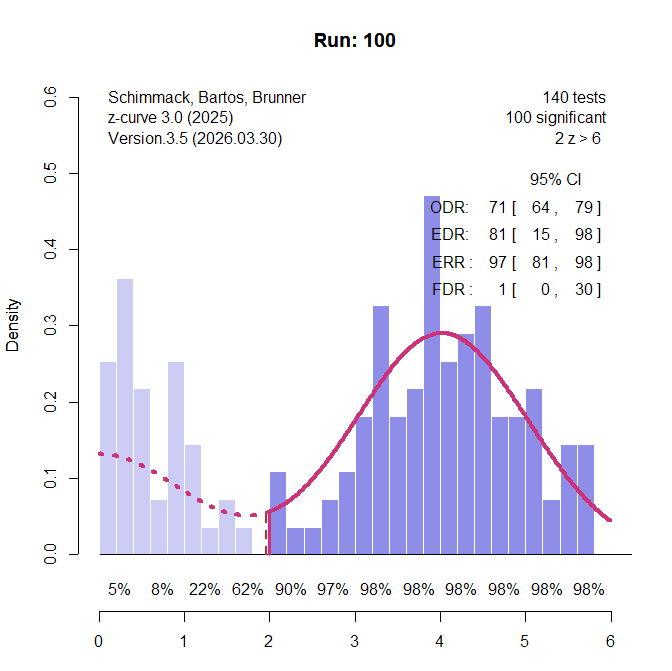
Of course, z-curve is not magic. As the plot shows, the EDR is an estimate of the distribution of non-significant results based on only the significant results. When there are few informative z-values just below significance (z = 1.96 to 2.96), the EDR cannot be estimated. Z-curve.3.0 realizes this and gives a wide confidence interval that ranges from 15% to 98%. This is informative because it tells users that the EDR cannot be estimated and the point estimate cannot be trusted. However, the confidence interval will be smaller and more informative in other situations and with larger sets of studies.
In short: z-curve.2.0 is dead. Long live z-curve.3.0
Now, this is how you respond to valid concerns and demonstration of errors. You learn from them and fix them. That is how real science advances and z-curve has been developed, evaluated, and improved for over 10 years now.
Waiting for Gelman and van Zwet’s Response to this Criticism
It will be interesting to see how van Zwet and Gelman respond to this criticism of their criticism. The ladder of responses is clear and now also includes pointing out errors in my response or in z-curve.3.0 In the age of preregistration, let me preregister my prediction.
4. Avoid looking into the question, ignore the possible error, act as if it had never happened, and keep making the same mistake over and over.
I hope this is a mistake that I am happy to correct when proven wrong.