Category Archives: Life-Satisfaction

Personality Skills and Wellbeing

Personality psychology is built on the discovery that humans are not blank slates that can be programmed by reinforcement schedules; the strong, situationistic version of human nature that dominated psychology during the area of behaviorism and was maintained by experimental social psychologists.

Instead humans have personality that is reflected in everyday terms like kind, assertive, fearful, courageous, punctual, spontaneous, sociable, curious, or creative. Personality psychologists developed the Five Factor Model to describe the variation in people’s personalities at an abstract level. This model has been the dominant framework to study personality since the 1980s. Longitudinal and twin studies have shown that these personality traits are partially heritable, not much influenced by parenting, and highly stable in adulthood.

Not everybody is happy with the existence of stable personality traits, especially because some traits are considered to be undesirable. Many people would like to be less prone to anxiety and other negative thoughts and feelings. Others want to be more outgoing and sociable. Companies want their workers to be more achievement motivated and hard working. Teachers and professors would like their students to be more curious. This has led to research programs that make change of personality attainable.

One line of research examines voluntary personality change. Just like loosing weight is possible, changing personality is possible if you just want it and are willing to work on it. The evidence suggests that small changes of personality are possible, but even this evidence is not conclusive and limited to short follow-up periods.

This blog post is about the second line of research into personality change. The basic idea is that behaviors require skills and skills can be learned. Making eye contact with a stranger is just like riding a bike. The first time without training wheels, it can be scary, but then it gets easier. So people who are shy can just learn social skills to become more sociable. Some people are always late, but being on time is a skill that can be learned. Soto et al. (2022) call these social, emotional, and behavioral skills, and introduced the Behavioral, Emotional, and Social Skills Inventory (BESSI) to measure these skills.

The BESSI aims to measure 37 skills. The key difference between the measurement of skills and personality traits is the framing of self-report questions. Personality is typically measured by asking participants about their typical tendencies or behaviors. In contrast, the skills measure asks participants about their level of expertise.

“Its instructions asked participants to rate how well they could perform each behavior, reflecting their current level of expertise, on a scale ranging from 1 = not at all well
(beginner) to 5 = extremely well (expert).” (Soto et al., 2022).

The rest of the question is often similar for skills and personality traits. For example, the Big Five Inventory item “Stays optimistic after experiencing a setback” is nearly identical to the BESSI item “Stay optimistic when things go wrong.”

The high similarity between personality and skill items raises concerns about participants’ willingness or ability to distinguish between these two questions. To demonstrate that they do, we need evidence of discriminant validity. That is, participants’ answers to the two questions should differ in a predictable manner.

In addition, the idea of personality skills raises some theoretical questions. If some people have optimism skills, why do they have a pessimistic personality that lowers their wellbeing. Why are these people not use the skills that they apparently posses to make themselves happier?

Evidence of Construct Validity

I am focusing on wellbeing because I study wellbeing/happiness. Personality skills may have benefits for other outcomes (e.g., better time management skills may help with productivity), but I was intrigued by the idea that people can learn specific skills that increase their wellbeing because other attempts to do so have not been very successful.

Soto et al. (2022) examined the relationship between BESSI scales and wellbeing in a study with 492 high-school students. Wellbeing was measured with Diener’s Satisfaction With Life Scale, a valid measure of subjective wellbeing. The 37 skill scales used to create five broader (domain) scales. Simple correlations were positive for all five skill domains. However, these simple correlations can be inflated by response styles like socially desirable responding. More informative are regression results. The regression results in Table 15 show the strongest unique positive relationship for Emotional Resilience skills, b = .3. Self-management and social engagement showed weaker positive relationships, b ~ .15. Cooperation skills were unrelated and innovation skills were negative related to wellbeing, b = -.23.

Further analyses suggested that two specific skill scales account for most of the variation in life-satisfaction, namely confidence regulation, b = .30, and capacity for optimism, b = .23. Together, these two scales imply that people who are above average on these two skills have a 75% chance of being above average in life-satisfaction. This effect size is stronger than the effect size for extraversion or income. Taken at face value, the results suggest that learning emotional resilience skills could make people happier.

Own Analyses

Study 1

In the new spirit of open science, Soto and colleagues shared their data (https://osf.io/4zgyr/) to allow independent researchers to critically examine the evidence. In the same spirit, I used their data to fit a measurement model to their data. The difference between this analysis and Soto et al.’s published result is that correlations with scale scores assume that scales are perfectly valid measures of the construct that they aim to measure. For example, it is assumed that the BESSI “Capacity for Optimism” scale is a perfect measure of individuals’ skills to maintain an optimistic attitude even during difficult times. Personality psychologists use scale scores even though they are aware that scales are not perfect measures. For example, Soto et al. (2022) note that “This positive manifold [positive correlations among all scales] likely reflects, at least in part, measurement artifacts (e.g., evaluative bias, response style,
use of unipolar scales; Anusic et al., 2009; Goldberg, 1992; Rammstedt et al., 2013). However, it may also partly reflect a substantive individual difference (e.g., in people’s overall levels of
functioning; Musek, 2007). Future research can test these possibilities” (p. 217).

My own analyses take up this request for future research using their own data to demonstrate and control for the influence of desirability bias in skill ratings on correlations between skills and life-satisfaction.

I also included other outcome variables in my analysis. The purpose of including other outcome variables is to explore how skills might influence life-satisfaction. For example, Soto et al. also included measures about relationships with parents and GPA. It is possible that some skills help to raise GPA which in turn might increase students’ life-satisfaction. Other skills might help to have better relationship with parents, which could also increase life-satisfaction of high school students.

In short, I use advanced statistical methods that have been around for 60 years to provide a better understanding of the relationship between personality skills and wellbeing, using Soto et al.’s data to test Soto et al.’s (2022) claim that the BESSI scales are valid measures of personality skills that predict – and possibly cause – variation in important life outcomes like life-satisfaction.

The BESSI has 192 items. It is not possible to fit a measurement model for 192 items with just 492 participants. Fortunately, it is not necessary to use all items to create a measurement model. A minimum of two items per construct is sufficient to create a measurement model. Initial analysis confirmed Soto et al.’s findings that life-satisfaction is mainly related to emotion regulation skills. Thus, these constructs were measured with more than two items to get more stable parameter estimates. The full results are reported on OSF (https://osf.io/5dqzv/). The key finding was that confidence skills were the only direct predictor of life-satisfaction with a strong effect size, b = .40, SE = .06. Additional unique predictors were relationship satisfaction with father, b = .35, SE = .06, relationship satisfaction with mother, b = .21, SE = .06, GPA, b = .16, SE = .06, and relationship with peers, b = 15, SE = .06. The only skill predictor of these life-satisfaction predictors was a negative effect of warmth skills on GPA. This produced a weak indirect relationship with life-satisfaction. Thus, the key finding is that confidence skills are the only reliable predictor of life-satisfaction. Of course, these results are limited to Soto et al.’s high-school student sample, but the other datasets did not include life-satisfaction measures to examine the generalizability of this finding.

Study 2

Study 1 assumed that the desirability factor reflects a rating bias. However, it may also partially reflect some real differences in skills. Study 2 examines this possibility by modeling personality and skill items in a single model. The data are from Soto et al.’s (2022) Study 4 with N = 313 university students. Students completed the BESSI and the BFI-2, a Big Five personality questionnaire developed by Soto and John (2017). The BFI-2 uses three facets for each of the Big Five traits and each facet is measured with four items.

I developed a measurement model for the BFI 2 with a desirability bias and an acquiescence bias factor. In Study 2, I used this model to examine convergent validity between the desirability factors for the BESSI and the BFI-2. In addition, I examine discriminant validity of the BESSI scales by examining the unique variance in BESSI scales that is not explained by desirability bias or the personality traits measured with the BFI-2.

The detailed results of the model and the code to reproduce the results are posed on OSF (https://osf.io/5dqzv/). The key finding is that the desirability factor of the BFI-2 was correlated very highly with the desirability factor of the BESSI scales, r = .84. In addition, the BESSI desirability factor was related to the acquiescence factor of the BFI-2, r = .22.

The following results show the factor loadings of the BESSI scales on the desirability factor, the relationship to the strongest personality predictor from the BFI-2, and the amount of explained and unique variance in the BESSI scales.

BESSI ScaleDESIRABILITYPREDEffect SizeEVUV
SM-Time Management0.39RES0.620.750.25
SM-Organizational Skills0.48ORG0.800.860.14
SM-Capacity for Consistency0.48RES0.630.630.37
SM-Task Management0.45PRO0.830.890.11
SM-Detail Management0.57RES0.560.650.35
SM-Rule Following Skill0.45RES0.960.740.26
SM-Responsibility Management0.61RES0.580.720.28
SM-Goal Regulation0.71RES0.290.770.23
SM-Decision Making Skill0.68RES0.450.660.34
SE-Leadership Skill0.53ASS0.760.870.13
SE-Persuasive Skill0.49ASS0.390.680.32
SE-Expressive Skill0.59SOC0.360.480.52
SE-Conversational Skill0.56SOC0.650.740.26
SE/SM-Energy Regulation0.60PRO0.500.730.27
CO-Perspective Taking Skill0.71SYM0.520.820.18
CO-Capacity for Trust0.54TRU0.710.790.21
CO-Capacity for Social Warmth0.68EXT0.430.750.25
CO-Teamwork Skill0.66POL0.330.580.42
CO/SM-Ethical Competence0.69RES0.300.600.40
ER-Stress Regulation0.52ANX-0.620.840.16
ER-Capacity for Optimism0.52DEP-0.680.770.23
ER-Anger Management0.56EMO-0.510.700.30
ER-Confidence Regulation0.52DEP-0.640.680.32
ER/SM-Impulse Regulation0.55CON0.400.600.40
IN-Abstract Thinking Skill0.73INT0.530.820.18
IN-Creative Skill0.59INV0.700.840.16
IN-Artistic Skill0.42ART0.480.650.35
IN-Cultural Competence0.63OPE0.220.450.55
IN/SM Information Processing Skill0.62CON0.320.480.52
XX-Self Reflection Skill0.690.480.52
XX-Adaptability0.63ANX-0.220.550.45
XX-Capacity For Independence0.66CON0.330.580.42

The most important finding is that the confidence skill scale had a strong loading on the desirability factor, b = .52 and is strongly negatively related to the Depression facet of the BFI-2, r = -.64. Only 32% of the variance in this scale is unique variance that could add to the prediction of life-satisfaction above and beyond the variance explained by a depressive disposition. Previous studies have shown that a depressive personality is a strong predictor of life-satisfaction (Anglim et al., 2020; Røysamb, Nes Czajkowski, & Vassend, 2018; Schimmack, Oishi, Furr, & Funder, 2004). A latent variable analysis of Anglim et al.’s data showed an effect size of b = .6 for the depression facet of the IPIP-300. With effect sizes of r = -.64 between depressiveness and confidence skills and r = .6 for depressiveness and life-satisfaction, depressiveness accounts for most of the correlation between confidence skills and life-satisfaction in Study 1, r = .40. Thus, the existing data suggest that confidence skills do not make a strong unique contribution to life-satisfaction. However, it remains possible that confidence skills have an indirect effect on life-satisfaction under the assumption that confidence skills reduce the disposition to experience depressive affect. However, this is an unproven causal assumption and it is equally possible that people who are prone to depression rate themselves as low on confidence skill items.

In conclusion, Soto et al.’s article provides no evidence for the claim that personality skills measured with the BESSI influence life-satisfaction or that improving these skills would produce an increase in life-satisfaction.

Study 3: Multi-Method Study

The most important form of construct validity examines convergent validity across different methods. In personality psychology, the most common approach to provide this information is to complement self-ratings with informant ratings by knowledgeable others like parents, spouses, or close friends. Soto et al. (2022) did not provide information about convergent validity, but a large project by the OECD (Organization for Economic Cooperation and Development) obtained data on children’s personality skills, using self-ratings, ratings by a caregiver (mostly mothers), and a teacher. These data were used in a JPSP article by Guo, Tang, Marsh et al. (2022) to relate personality skills to life-satisfaction.

The abstract claims that the “inclusion of multi-informant ratings substantially enhanced the ability of social–emotional skills in predicting outcome variables, with parent- and self-rated skills playing important, unique roles” (p. 1079). The results section reports that personality skills explained 70% of the variance in life-satisfaction! This is an unbelievable result because the outcome measure was a single life-satisfaction rating that have at best 70% reliable variance. Thus, the authors are claiming that life-satisfaction is fully determined by personality skills. This is implausible because 40% of the reliable variance in life-satisfaction judgments is heritable and stable over long periods of time, whereas skills are by definition learned behaviors. The estimate is also vastly larger than the effect size estimate based on Soto et al.’s (2022) data.

Another major problem of their analysis was that they used ratings by all three raters as predictor variables. This decision implies that each skill measure measures a unique construct without measurement error. However, the authors’ do not explain how self-reported skills are conceptually different from informant rated skills. Theoretically, a skill is a skill is a skill and does not depend on the observer of a skill. Either I can ride a bike or I cannot ride a bike. Thus, it makes more sense to treat unique variance in ratings by a single rater as systematic measurement error and to use the shared variance among raters as a measure of the actual skill. This use of multi-method data is the most commonly used approach to separate construct variance from method variance. I therefore conducted a proper multi-method analyses of the openly accessible OECD data. The complete results are posted on OSF.

I used a multi-group model to distinguish between younger ((10y) and older (15y) cohorts. The measurement model assumed equal validity for parent ratings, but allowed for different validity of self-ratings, under the assumption that cognitive abilities to make self-ratings increase from age 10 to 15. Method variance was modeled with residual correlations among ratings by the same rater. Correlations showed the strongest simple correlation for the Optimism skill factor followed by the Energy skill factor. I followed up on this model with a regression model. The only statistically significant predictor was the Optimism skill factor. The effect size was smaller for the younger cohort, b = .27, than for the older cohort, b = .44. One possible explanation for this finding is that skills become more important as children become more autonomous. Another explanation could be that life-satisfaction ratings of younger children are less valid. However, even the strong effect size of b = .44 in the older cohort implies that skills explain only 20% of the variance in life-satisfaction, not 70% as claimed in Guo et al.’s article.

For some unknown reason, Guo et al. limited their analysis to the Finish sample. Table 2 reports the results for the Finish and the other samples. The results for the Finish sample produced somewhat stronger effect sizes with b = .42 in the younger cohort and b = .53 in the older cohort. Thus, while skills may play a bigger role in Finland, the authors failed to point out that data from other nations were available and produce weaker effect size estimates.

SampleYoungerOlder
Canada (Ottowa)0.580.33
USA (Huston)0.400.41
Columbia (Bogota)0.260.49
Columbia (Manizales)0.360.44
Finland (Helsinki)0.430.53
Russia (Moscow)0.320.48
Turkey (Istanbul)0.340.54
Sout Korea (Daegu)0.370.44
China (Suzhou)0.200.21

Importantly, even the strong effect sizes of b > .5 for the younger cohort in Canada and the older cohorts in Finland and Turkey do not provide strong evidence that optimism skills can be learned and increase life-satisfaction. A plausible alternative explanation is that skill measures are confounded with inherited personality traits.

General Discussion

The scientific search for predictors of life-satisfaction is nearly 100-years old (Hartmann, 1936). If these predictors are causes of life-satisfaction, changes in the predictors would result in changes in life-satisfaction. Decades of research have identified some predictors of life-satisfaction that are stable and others that can change. Twin studies suggest that stable predictors like personality traits are partially inherited and difficult to change. Twin studies and longitudinal studies also show that other factors can change and predict changes in wellbeing. For example, marriage and divorce produce changes in life-satisfaction.

The concept of personality – socio-emotional -skills is relatively knew and aims to bridge stable and changing predictors of life-satisfaction. The key distinction between a personality trait and a personality skill is that personality skills are learned behaviors. It is assumed that they are “social–emotional skills are more malleable than cognitive skills through targeted interventions, programs, and policies” (p. 1080). This assumption implies that it is possible to teach children skills that can improve their life-satisfaction. Two studies suggest that the key skills that predict life-satisfaction are related to self-esteem, confidence, and optimism. This finding is consistent with evidence that personality traits related to self-esteem are strong predictors of life-satisfaction. However, the existing evidence makes it impossible to assess whether skill measures are valid measures of learned skills or whether these measures merely reflect differences in personality traits.

Future research needs to validate skill measures and demonstrate that interventions can actually change self-esteem and life-satisfaction. At present, the assumption that happiness is a skill that can be learned lacks empirical support, contrary to the sweeping and invalid claims in prominent publications that suggest skill measures are valid and that skills have a strong influence on life-satisfaction.

Open-SOEP: Personality and Wellbeing Revisited

[corrected 8/6/2019 5.29pm – there was a mistake in the model for worry]

After behaviorism banned emotions as scientific constructs and cognitivism viewed humans as computers, the 1980s witnessed the affective revolution. Finally, psychologists were again allowed to study feelings.

The 1980s also were a time where personality psychologists agreed on the Big Five as a unified model of personality traits. Accordingly, personality can be efficiently summarized by individuals’ standing on five dimensions: Neuroticism, Extraversion, Openness, Agreeableness, and Conscientiousness.

Not surprisingly, the 1980s also produced a model of personalty, emotions (affect), and well-being that has survived until today. The model was first proposed by Costa and McCrae in 1980 (see Schimmack, 2019, for details). This model assumed that extraversion is a disposition to experience more positive affect, neuroticism is a disposition to experience more negative affect, and the balance of positive and negative affect is a major determinant of life-satisfaction. As extraversion and neuroticism are independent dimensions, the model also assumed that positive affect and negative affect are independent, which led to the creation of the widely used Positive Affect and Negative Affect Schedule (Watson et al., 1988) as a measure of well-being.

The model also assumed that general affective dispositions account for most of the stability in well-being over time, while environmental factors produce only momentary and short-lived fluctuations around dispositional levels of well-being (Diener, 1984; Lykken & Tellgen, 1996). This model dominated well-being research in psychology for 20 years (see Diener, Suh, Lucas, & Smith, 1999, for a review).

However, when Positive Psychology emerged at the beginning of the new millenium, psychologists focus shifted from the influence of stable dispositions to factors that could be changed with interventions to boost individuals’ wellbeing (Seligman & Csikszentmihalyi, 2000) and some articles even questioned the influence of dispositions on well-being (Diener, Lucas, & Scollon, 1996). As a result, the past 20 years have seen very little new research on dispositional influences on well-being. The last major article is a meta-analysis that showed positive correlations of extraversion and neuroticism with several well-being indicators (Steel, Schmidt, & Shultz, 2008).

Revisiting the Evidence

There is robust evidence for the influence of neuroticism on wellbeing. Most important, this relationship has been demonstrated in multi-method studies that control for shared method variance when self-ratings of personality are correlated with self-ratings of well-being (McCrae & Costa, 1991; Schimmack, Oishi, Funder, & Furr, 2004). However, the relationship between extraversion and well-being is not as strong or consistent as one would expect based on Costa and McCrae’s (1980) model. For example, McCrae and Costa failed to find evidence for this relationship in a multi-method study, and other studies that controlled for response styles also failed to find the predicted effect (Schimmack, Schupp, & Wagner, 2008).

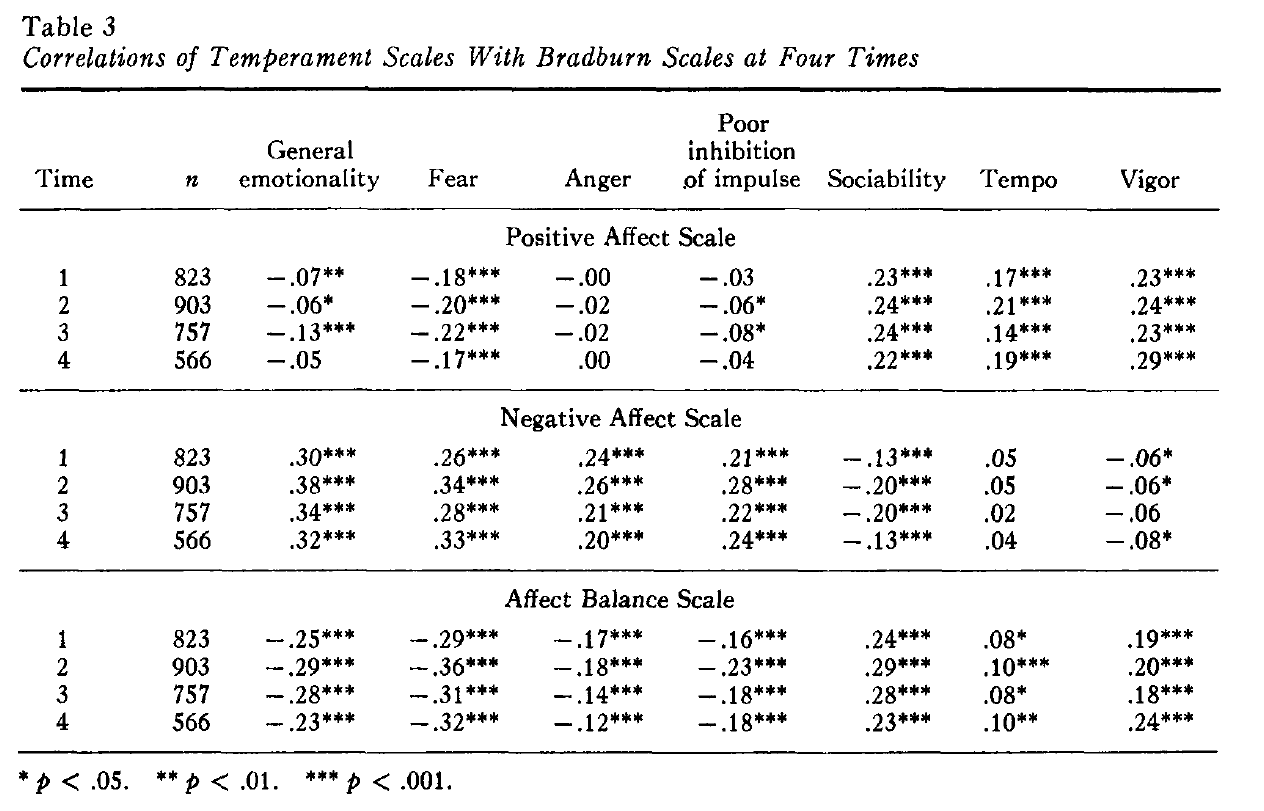
Taking a closer look at Costa and McCrae’s (1980) article, we see that they did not include life-satisfaction measures in their study. The key empirical finding supporting their model is that extraversion facets like sociabilty measured at time 1 predict positive affect and hedonic balance (positive affect minus negative affect) concurrently and longitudinally and that these correlations remain fairly stable over time. This suggests that personality is stable and contributes to the stable variance in the affect measures. However, the effect size is small (r = .22 to .24). This suggests that extraversion accounts for about 5% of the variance in affect. This finding hardly supports the claim that extraversion accounts for half of the stable variance in well-being.

It is symptomatic of psychology that subsequent articles run with the story while ignoring gaps in the actual empirical evidence. As longitudinal studies in psychology are rare, there have been few attempts to replicate Costa and McCrae’s findings.

Headey and Wearing (1989) replicated and extended Costa and McCrae’s study by including life-satisfaction measures as an indicator of wellbeing. They replicated the key findings and showed that personality also predicts future life-satisfaction. However, the effect size for extraversion was again fairly small; as was the effect of neuroticism, suggesting that most of the stable variance in life-satisfaction is not explained by extraversion and neuroticism.

A key limitation of both studies is that they do not take shared method variance into account. Although method variance may be transient, it is also possible that it is stable over time (Anusic et al., 2009). Thus, even the already modest effect sizes may still be inflated by shared method variance.

New Evidence

Data and Model

Fortunately, better data are now available to revisit the longitudinal relationships between personality and life-satisfaction. I used the data from the German Socio-Economic Panel (SOEP). The SOEP measured the Big Five personality traits on four occasions (waves) spanning a period of 12 years (2005, 2009, 2013, 2017). Personality was measured with the 15-item BFI-S. I created a measurement model for the BFI-S that shows measurement invariance across the four occasions (Schimmack, 2019a). I also related personality to the single-item life-satisfaction rating in the SOEP (Schimmack, 2019b). Here, I extend this analysis by taking advantage of the fourth measurement of personality in 2017, which makes it possible to separate trait and state variance in personality and well-being.

The SOEP measures life-satisfaction in two ways. First, it includes several domain-satisfaction items (health, finances, recreation, housing). Second, it includes a global life-satisfaction item. In a different post (Schimmack, 2019c), I examined the relationship between these items and found that global items are influenced by a general disposition factor and satisfaction with finances and health, while the other two domains are relatively unimportant. Based on this finding and related evidence (Zou, Schimmack, & Gere, 2013), I averaged the domain satisfaction judgments and used it as an indicator of life-satisfaction. This makes it possible to remove random measurement error from the measurement of life-satisfaction on a single occasion. I then fitted latent-trait-state (LST) models to the personality factors and the well-being factor. These models separate the longitudinal correlations into two components. A stable trait component and a changing state component. A third parameter estimates how stable state variance is over time.

There are several ways to relate personality to life-satisfaction in this model. I chose to predict life-satisfaction variance on each occasion to the personality variances on the same occasion. The model indirect function can then be used to examine how much of the variance is due to stable personality traits or due to personality states.

The availability of four waves of data also makes it possible to model stability of the residual variances in personality items. Typically, these residuals are allowed to correlate to allow for item-specific stability, but the use of correlated residuals makes it impossible to relate this variance to other constructs. With four waves, it is possible to fit an LST model to item-residuals. Exploration of the data showed that the neuroticism item “worry” showed consistent relationships with well-being. Thus, I fitted an LST model to this item and allowed for an influence of worry on life-satisfaction.

The synatax and the complete results are posted on OSF (SOEP.4W.B5.DSX.LS).

Results

Overall model fit was acceptable, CFI = .967, RMSEA = .019, SRMR = .030.

Trait Variance and Stability of State Variance

Table 1 shows the amount of trait variance and the stability of state variance in the personality predictor variables. A more detailed discussion of the implications of these results for personality research can be found elsewhere (Schimmack, 2019a). The results for the Big Five serve as a comparison for the trait variance in life-satisfaction.

TraitStability1Y-Stability
Neuroticism0.690.380.790.56
Extraversion0.740.380.780.51
Openness0.710.340.760.53
Agreeableness0.680.200.670.57
Conscientiousness0.600.290.730.64
Halo0.600.360.780.63
Acquiescence0.340.110.580.81
Worry0.640.520.850.60

Table 2 shows how life-satisfaction at each time point is related to personality predictors. For model identification purposes, it is necessary to fix one relationship to zero. I used openness because meta-analysis show that it is the weakest predictor of life-satisfaction (Steel et. al., 2008). I did not impose constraints across the four waves.

LS-T1LS-T2LS-T3LS-T4
Neuroticism-0.29-0.27-0.27-0.26
Extraversion0.080.070.080.09
Openness
Agreeableness0.080.050.040.03
Conscientiousness0.040.040.040.04
Halo0.190.280.240.26
Acquiescence0.180.080.120.16
Worry-0.35-0.34-0.35-0.33

The results show that out of the Big Five, neuroticism is the only notable predictor of life-satisfaction with a moderate effect size (r = -.26 to -.29). A notable finding is that extraversion is a weak predictor of life-satisfaction (r = .07 to .09). This finding is inconsistent with Costa and McCrae’s (1980) model. The results for agreeableness and conscientiousness are also weak. This finding is inconsistent with meta-analysis and with McCrae and Costa’s (1991) suggestion that high agreeableness and conscientiousness are also instrumental for higher life-satisfaction. Both halo and acquiescence bias are stronger predictors of life-satisfaction judgments than extraversion, agreeableness, and conscientiousness. Another notable finding is that the worry-facet of neuroticism is the strongest personality predictor; even stronger than the neuroticism factor (rs = -.33 to -.35). This finding is consistent with previous studies that facets of neuroticism and extraversion are better predictors of life-satisfaction than the global factors (Schimmack, Oishi, Funder, & Furr, 2004).

Table 3 shows how much of the variance in life-satisfaction is explained by trait factors that remain stable over time.

LS-T1LS-T2LS-T3LS-T4
Neuroticism0.050.050.050.05
Extraversion0.000.000.000.01
Openness
Agreeableness0.000.000.000.00
Conscientiousness0.000.000.000.00
Halo0.020.040.030.04
Acquiescence0.010.000.000.01
Worry0.080.080.080.07
Unexplained0.380.380.380.38
Total0.550.560.560.55

Given the weak effects of extraversion, agreeableness, and conscientiousness, it is not surprising that these Big Five traits explain less than 1% of the variance in life-satisfaction judgments. The only notable predictor is neuroticism, which explains 5-6% of the variance. In addition, the worry facet of neuroticism is an even stronger predictor of trait variance in life-satisfaction. This finding shows that more specific traits below the Big Five add to the prediction of life-satisfaction (Schimmack, Oishi, Furr, & Funder, 2004). Halo adds only 2% and acquiescence only 1%. By far the largest portion of the trait variance was unexplained with 41% of the variance. Combined this implies that approximately half of the variance in life-satisfaction is trait variance. This finding is consistent with estimates in a meta-analysis and other analyses of the SOEP data (Anusic & Schimmack, 2016; Schimmack, Krupp, Wagner & Schupp, 2010). The estimate of 55% trait variance is also smaller than the estimate of 70% trait variance in the Big Five personality traits. This finding is also consistent with meta-analytic comparison of personality and well-being measures (Anusic & Schimmack, 2016).

Table 4 shows the results for the state-predictors of life-satisfaction. Once more extraversion, agreeableness, and conscientiousness predict less than 1% of the variance. This time, neuroticism and worry are also relatively weak predictors because most of the relationship for this traits stems from the stable component. However, the results suggest that some changes in neuroticism and worry are related to changes in life-satisfaction. However, most of the state variance in life-satisfaction is not explained by the personality predictors (33% out of 44%).

LS-T1LS-T2LS-T3LS-T4
Neuroticism0.020.020.020.02
Extraversion0.000.000.000.00
Openness
Agreeableness0.000.000.000.00
Conscientiousness0.000.000.000.00
Halo0.010.030.020.03
Acquiescence0.020.000.010.02
Worry0.040.040.040.04
Unexplained0.330.340.340.34
Total0.440.440.440.45

Conclusion

These results challenge Costa and McCrae’s (1980) model of personality and well-being in several ways. First, extraversion is not a strong predictor of the stable variance in life-satisfaction. Second, even the influence of neuroticism accounts for only 10% of the stable trait variance in life-satisfaction. Adding other Big Five predictors also does not help because they have negligible relationships with life-satisfaction. Thus, most of the trait variance in life-satisfaction remains unexplained. It is either explained by more specific personality traits than the Big Five (facets) or by stable environmental factors (e.g., income). The SOEP data provide ample opportunity to look for additional predictors of trait variance. Also, researchers should conduct studies with broader personality questionnaires to find additional predictors of life-satisfaction. Searching for these predictors is an important area of research in an area that has stagnated over the past two decades.

Costa and McCrae’s model also underestimated the importance of state-factors. State factors are highly stable over fairly long periods of times and account for 50% of the reliable variance in life-satisfaction. As the Big Five mostly reflect stable traits, they cannot account for this important variance in life-satisfaction. Schimmack and Lucas (2010) argued that these factors are environmental factors because changes in life-satisfaction are shared between spouses. Thus, changes in actual life-circumstances may contribute to state variance in life-satisfaction. Consistent with this model, spouses were more similar in domains that are shared (housing, income) than in domains that are less shared (health, recreation).

Evidently, the conclusions are based on a single German sample. As impressive as these data are, it is important to compare results across samples from different populations. At least regarding the influence of extraversion, the present results are consistent with other studies that suggest the influence of extraversion on life-satisfaction (Kim, Schimmack, & Tsutsui, 2019). The idea that extraverts are happier has been exaggerated by Costa and McCrae’s model, while their own empirical results did not warrant this claim. The reason is that psychologists often ignore effect sizes.

Implications

The present results also have implications for developmental theories of personality. The idea of development is a process with an ideal outcome. For humans, the outcome is an adult human being with optimal capabilities. A collective of personality psychologists suggested that optimal personality development results in a personality type with optimal personality characteristics. I criticized this idea and argued that there is no such thing as an optimal personality. Just like there is no optimal height as the end-goal of human growth, there is no optimal level of extraversion or conscientiousness. In clinical psychology, the key criterion of mental health is that an intervention is beneficial for a patients’ well-being. Thus, we could argue that an optimal personality is a personality that maximizes individuals’ well-being. Meta-analyses suggests that extraveted, agreeable, and conscientious people have higher well-being. Thus, it might be beneficial for individuals to become more extraverted, agreeable, and conscientious. However, the present results challenge this view. After removing the evaluative aspect of personality from the Big Five only neuroticism remains a notable predictor of well-being. Thus, the key personality trait for self-improvement is neuroticism. Not surprisingly, this is also the key aspect that is targeted in self-help books and well-being programs. Until we have a better understanding of the relationship between personality and well-being, it seems premature to propose interventions that are aimed at changing individuals’ personality. Just like personality psychologists no longer endorse conversion therapy for sexual orientation, I urge for caution in submitting individuals who are carefree and impulsive to a conscientiousness conversion program. You never know when acting on the spur of a moment is the best course of action.

Thinking Too Fast About Life-Satisfaction Judgments

In 2002, Daniel Kahneman was awarded the Nobel Prize for Economics.   He received the award for his groundbreaking work on human irrationality in collaboration with Amos Tversky in the 1970s. 

In 1999, Daniel Kahneman was the lead editor of the book “Well-Being: The foundations of Hedonic Psychology.”   Subsequently, Daniel Kahneman conducted several influential studies on well-being. 

The aim of the book was to draw attention to hedonic or affective experiences as an important, if not the sole, contributor to human happiness.  He called for a return to Bentham’s definition of a good life as a life filled with pleasure and devoid of pain a.k.a displeasure. 

The book was co-edited by Norbert Schwarz and Ed Diener, who both contributed chapters to the book.  These chapters make contradictory claims about the usefulness of life-satisfaction judgments as an alternative measure of a good life. 

Ed Diener is famous for his conception of wellbeing in terms of a positive hedonic balance (lot’s of pleasure, little pain) and high life-satisfaction.   In contrast, Schwarz is known as a critic of life-satisfaction judgments.  In fact, Schwarz and Strack’s contribution to the book ended with the claim that “most readers have probably concluded that there is little to be learned from self-reports of global well-being” (p. 80).   

To a large part, Schwarz and Strack’s pessimistic view is based on their own studies that seemed to show that life-satisfaction judgments are influenced by transient factors such as current mood or priming effects.

the obtained reports of SWB are subject to pronounced question-order- effects because the content of preceding questions influences the temporary accessibility of relevant information” (Schwarz & Strack, p. 79). 

There is only one problem with this claim; it is only true for a few studies conducted by Schwarz and Strack.  Studies by other researchers have produced much weaker and often not statistically reliable context effects (see Schimmack & Oishi, 2005, for a meta-analysis). 
In fact, a recent attempt to replicate Schwarz and Strack’s results in a large sample of over 7,000 participants failed to show the effect and even found a small, but statistically significant effect in the opposite direction (ManyLabs2).   

Figure 1 summarizes the results of the meta-analysis from Schimmack and Oishi 2005), but it is enhanced by new developments in meta-analysis. The blue line in the graph regresses effect sizes (converted into Fisher-z scores) onto sampling error (1/sqrt(N -3). Publication bias and other statistical tricks produce a correlation between effect size and sampling error. The slope of the blue line shows clear evidence of publication bias, z = 3.85, p = .0001. The intercept (where the line meets zero on the x-axis) can be interpreted as a bias-corrected estimate of the real effect size. The value is close to zero and not statistically significant, z = 1.70, p = .088. The green line shows the effect size in the replication study, which was also close to zero, but statistically significant in the opposite direction. The orange vertical red line shows the average effect size without controlling for publication bias. We see that this naive meta-analysis overestimates the effect size and falsely suggests that item-order effects are a robust phenomenon. Finally, the graph highlights the three results from studies by Strack and Schwarz. These results are clear outliers and even above the biased blue regression line. The biggest outlier was obtained by Strack et al. (1991) and this is the finding that is featured in Kahneman’s book, even though it is not reproducible and clearly inflated by sampling error. Interestingly, sampling error is also called noise and Kahneman wrote a whole new book about the problems of noise in human judgments.

While the figure is new, the findings were published in 2005, several years before Kahneman wrote his book “Thinking Fast and Slow). He was simply to lazy to use the slow process of a thorough literature research to write about life-satisfaction judgments. Instead, he relied on a fast memory search that retrieved a study by his buddy. Thus, while the chapter is a good example of biases that result from fast information processing, it is not a good chapter to tell readers about life-satisfaction judgments.

To be fair, Kahneman did inform his readers that he is biased against life-satisfaction judgments.  Having come to the topic of well-being from the study of the mistaken memories of colonoscopies and painfully cold hands, I was naturally suspicious of global satisfaction with life as a valid measure of well-being (Kindle Locations 6796-6798). Later on, he even admits to his mistake.  Life satisfaction is not a flawed measure of their experienced well-being, as I thought some years ago. It is something else entirely (Kindle Location 6911-6912)

However, insight into his bias was not enough to motivate him to search for evidence that may contradict his bias. This is known as confirmation bias. Even ideal-prototypes of scientists like Nobel Laureates are not immune to this fallacy. Thus, this example shows that we cannot rely on simple cues like “professor at Ivy League,” “respected scientists,” or “published in prestigious journals.” to trust scientific claims. Scientific claims need to be backed up by credible evidence. Unfortunately, social psychology has produced a literature that is not trustworthy because studies were only published if they confirmed theories. It will take time to correct these mistakes of the past by carefully controlling for publication bias in meta-analyses and by conducting pre-registered studies that are published even if they falsify theoretical predictions. Until then, readers should be skeptical about claims based on psychological ‘science,’ even if they are made by a Nobel Laureate.