
Are Republicans more racist? I am not the only one who is asking themselves this question. In 2014, Nate Silver and Allison McCann examined this question using data from the General Social Survey (538.2014). The political landscape has changed since Trump was elected in 2016 and it is interesting to reexamine this question with the latest data.
Like Silver and McCann, I limit the analysis to White respondents because Black voters are much more likely to support the Democratic party. Thus, a trivial reason why Republicans are more likely to be racist is that they are more likely to be White. The more interesting question is whether there is an additional difference between White Republicans and White Democrats.
Political Orientation
The General Social Survey (GSS) asks two questions about political orientation. One question asks about party identification. Responses range from strong democrat to strong republican. To identify conservative Republicans, I classified respondents who responded with “independent – close to Republican”, “not very strong Republican”, and “strong republican” as Republicans.
Another question asks respondents to locate their political orientation on a liberal versus conservative dimension on a 7-point scale ranging from extremely liberal to extremely conservative. To identify conservatives, I combined the three response categories slightly conservative, conservative, and extremely conservative.
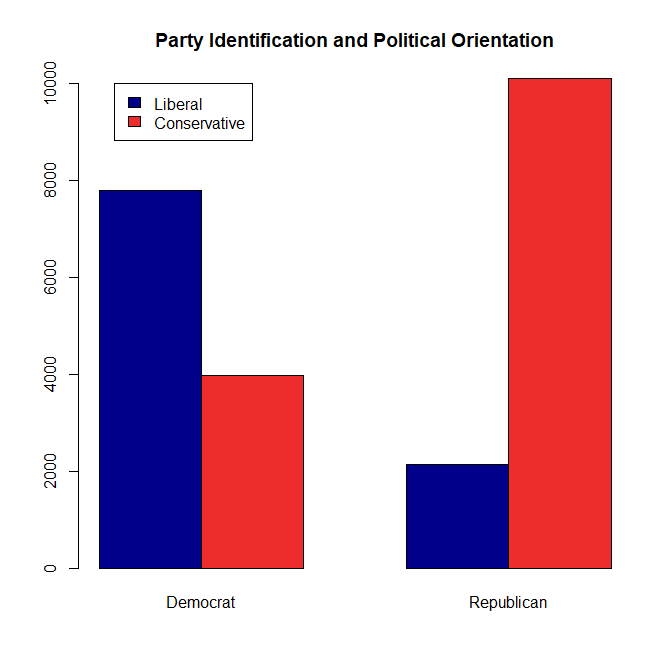
Figure 1 shows that responses to these two questions are not perfectly aligned. There are conservative Democrats and liberal Republicans. There are several ways to deal with this inconsistency. I chose to contrast conservative Republicans with the other three groups (liberal Republicans, conservative Democrats, & liberal Democrats).
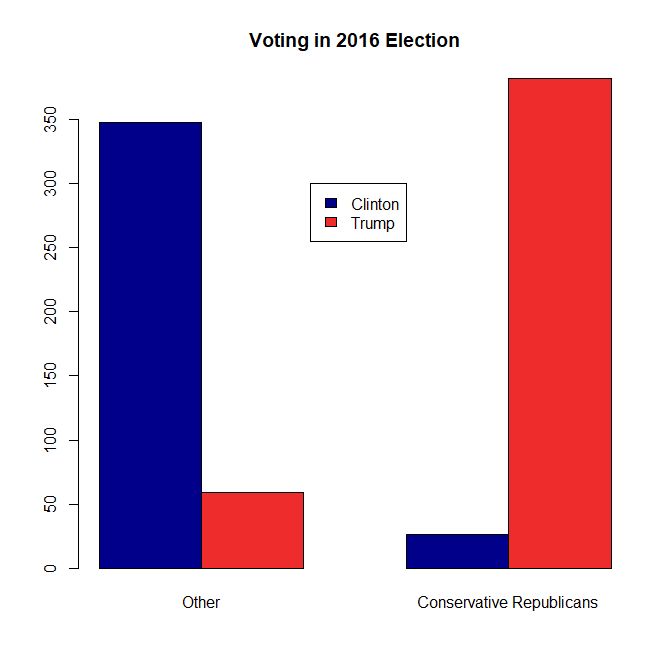
The GSS also asked about voting behavior in past elections. In the 2018 survey, most conservative Republicans voted for Trump.
Racism
Racism is a loaded word with no clear meaning. While the majority of Democrats considers Donald Trump to be a racist, most Republicans disagree. Yet, we need a term to describe people who do not see or treat Black and White people as equal. Given the history of the United States, it is difficult for a White American to live up to the ideal of racial equality. However, there is variation in the degree to which White Americans treat Black and White people as equal or not. Thus, the question is not whether somebody is a racist or not, but the degree to which White’s treat people equally or unequally.
The GSS includes several questions that measure racism. Some of these questions were discontinued and others were added in later years. I found five questions that were asked in later years that measure racism.
1. Feeling Thermometer.
Feeling thermometers are a widely used measure of racism. One question is about feelings towards Black people. Another question is about feelings towards White people. The difference between these two ratings indicates how much people have more positive feelings towards White people than towards Black people. Feelings are assessed on a 9-point scale ranging from 1 = not at all close to 9 = very close. The difference score can range from -8 to + 8.
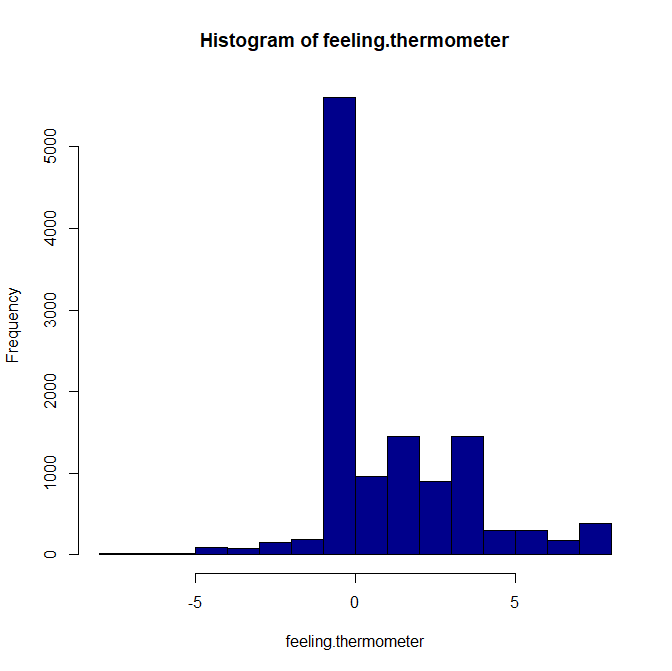
The Figure shows that most respondents indicate that they make no difference in their feelings based on race, while some participants report feeling closer to White people.
2. Interracial Marriages
The United States have a long history of racism that is reflected in laws against interracial marriages (Loving vs. Virginia). Even today, some Americans do not approve of interracial marriages. The GSS asks respondents “What about having a close relative marry a Black person? Would you be very in favor of it happening, somewhat in favor, neither in favor nor opposed to it happening, somewhat opposed, or very opposed to it happening?” The Figure shows the distribution of the responses before and after 2016. The results show a decrease in opposition to mixed marriages, but even today many US American are against somebody in their family marrying an African American.

3. Like other Immigrants
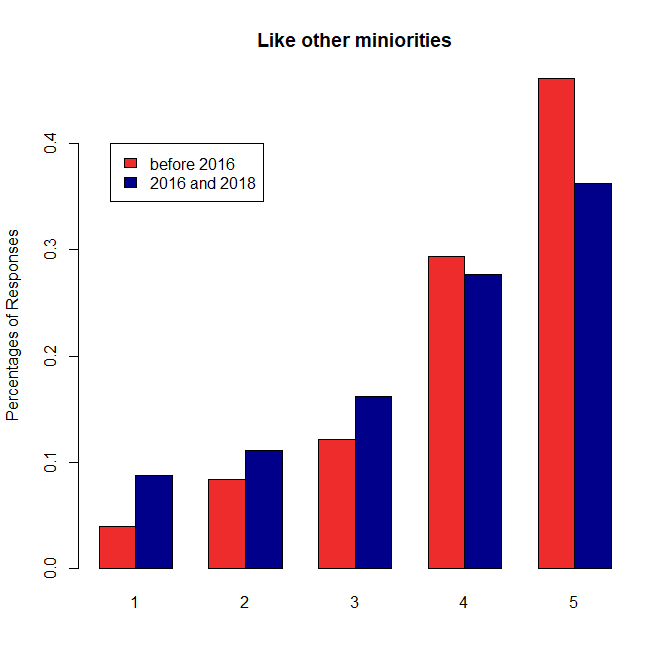
The third item asks respondents how much they agree with an item that ignores the special history of slavery, discrimination, and police brutality that African Americans are subjected to. “Irish, Italians, Jewish and many other minorities overcame prejudice and worked their way up. Blacks should do the same without special favors.” Responses are made on a 5-point scale ranging from 1=strongly disagree to 5=strongly agree. The Figure shows that even today a majority of White Americans agree with this statement.
4. Opposing Affirmative Action
One question in the GSS asks about respondents’ attitudes towards affirmative actions.
“Some people say that because of past discrimination, blacks should be given preference in hiring and promotion. Others say that such preference in hiring and promotion of blacks is wrong because it discriminates against whites. What about your opinion — are you for or against preferential hiring and promotion of blacks?” Responses are favor strongly, favor, oppose, and oppose strongly.
It is important to point out that opposition to affirmative actions may be based on other consideration than racism. Nevertheless, the item can be used to measure racism because racists are much more likely to agree with the item than respondents who strive towards racial equality.
The advantage of this item for measuring racism is that it provides opportunity for plausible deniability. It is possible to endorse the item without revealing that the response is motivated by racism. This may explain the high proportion of Americans who express strong opposition to affirmative actions.

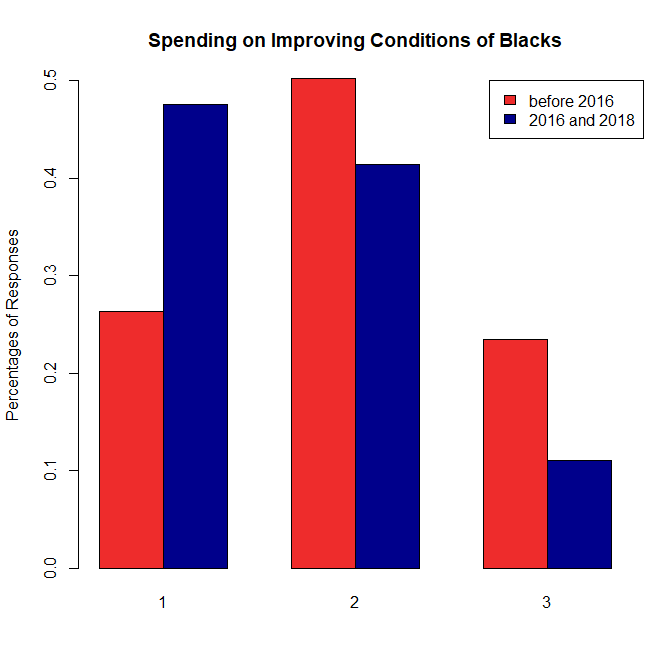
5. Spending on Improving the conditions of Blacks
The fifth question is part of a series of questions about public spending. One question asks whether respondents think the government is spending too little or too much on “improving the conditions of Blacks.” As with the previous item, respondents may answer “too much” for several reasons. For example, some may oppose taxation and government spending on anything. Thus, responding “too much” does not directly imply that the response is racially motivated, but individuals who are more racists are more likely to answer “too much.”
A Measurement Model of Racism
Responses to each of the five items can be influenced by many factors (causes) other than racism. Thus, we cannot simply look at individual items to determine how racist somebody is. Psychologists have developed measurement models to examine whether responses to items are driven by a common cause. Finding evidence for a common cause does not conclusively show that the cause is racism, but it makes it more likely.
The Figure shows the measurement model of racism. In this model racism is an attribute (trait) that varies across individuals. Individuals with high racism are more likely to respond to the five items in ways that express a dislike of African Americans. The numbers next to the arrows show how much a specific item reflects racism. Interestingly, the feeling thermometer is a relatively weak measure of racism. One concern could be that the racism factor is dominated by issues related to money, but the opposition to a black family member shows that that racism is not limited to equity issues.

Another concern is that responses to a survey are different from actual traits. Some respondents may downplay their racism because they are aware that racism is offensive. The GSS makes it possible to test this hypothesis because respondents were sometimes interviewed by Black interviewers. The next figure shows that White respondents respond to the question in a less racist manner when they are interviewed by a black interviewer. This effect is general across all five items, but especially strong for the feeling thermometer and the spending question.
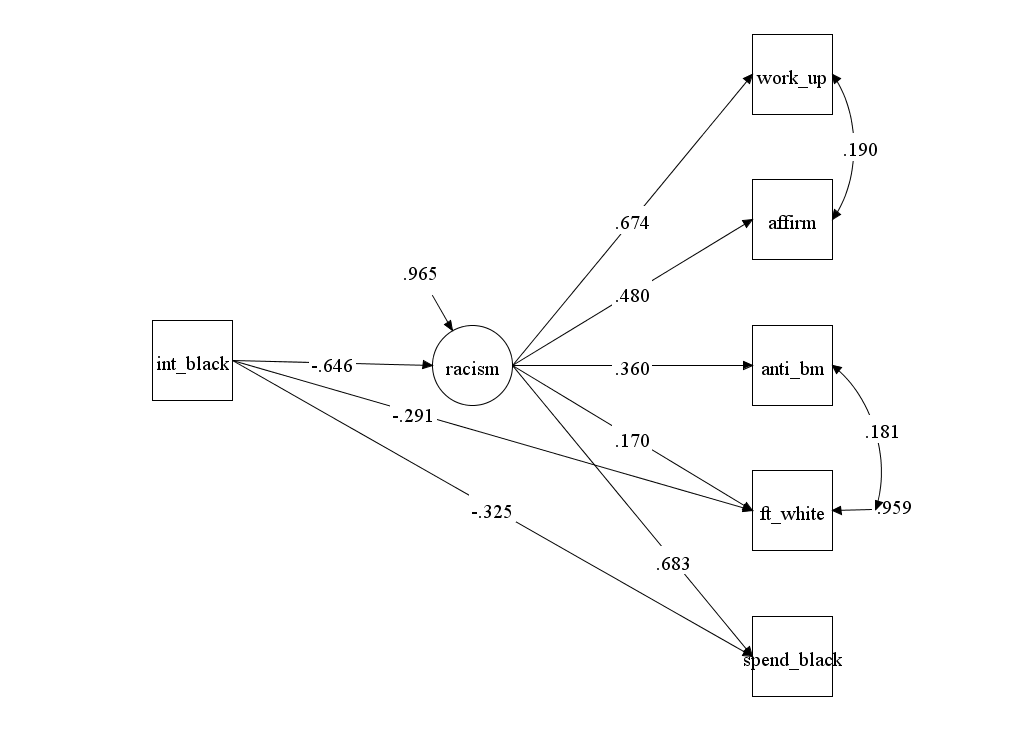
In short, measuring racism is difficult and no single question provides a clear and unambiguous measure of racism. However, there is clear evidence that people respond to the five questions in a consistent manner that is more or less racist, suggesting that the factor underlying their responses can be used as a measure of racism.
Political Orientation and Racism
The next analysis examined differences between conservative republicans and other Americans. The results show that conservative republicans are more racist (.769 standard deviations). In addition, they oppose affirmative actions and spending on Black issues. This shows that politics also influence responses to the items independent of racism, but even when we allow for such extra relationships, there is a strong relationship between identifying as a conservative republican and racism. In psychology a difference of .8 standard deviations is considered a large effect. In intelligence testing, a standard deviation is 15, and a difference of .769 would be a difference by 12 IQ points.

Political Orientation and Racism Over Time
The first figures showed that racism was lower in 2016 and 2018 than in the years before. To examine whether changes in racism differ as a function of political orientation, I added time to the model and examined different time trends for conservative republicans and others. I used presidents to measure time using the 1990s as the reference period and counted 2016 as a Trump year, although he was only elected at the end of the year to have two years of observations (2016, 2018). The results of the model showed a significant interaction between political orientation and time. While racism levels remained nearly unchanged for conservative republicans, they decreased for other Americans.
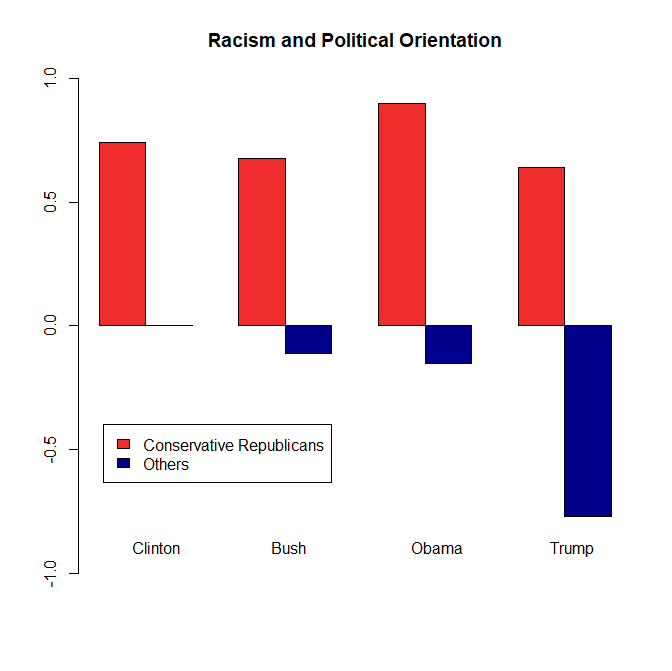
The figure shows a dramatic difference in racism during the Trump years. The difference of 1.4 standard deviations corresponds to a difference of 21 points in IQ testing. Interestingly, the difference is not due to increasing racism among conservative republicans, but rather decreasing racism among Americans.
It is tempting to suggest that this large difference in racism explains the much stronger response to George Floyd’s murder by a police officer, while similar events in previous years did not spark the widespread protests the US have seen in the last weeks. The data suggest that America as a whole is moving towards more racial equality and that many White Americans empathize with African Americans. However, conservative republicans are an exception. Many of them are opposed to racial equality.
Complicit Racism
Psychological research over the past two decades has focused a lot on implicit racism. The idea is that individuals can hide their racism from themselves. The notion of unconscious bias or racism is controversial and there is no solid scientific evidence for implicit racism. Most people know whether they would welcome a Black family member or not. A more common form of racism is a conscious choice to ignore the racism of others, whether it is a colleague, a friend, a family member or a party member. You know they are racist, but you don’t say anything about it. Most people, including conservative republicans, are not surprised by the finding that conservative republicans are more likely to be racist. We all know examples of racist conservative republicans and the Republican party carefully avoids alienating racist voters. The current Republican party suffers from complicit racism. Some party strategists even admit that complicit racism was used to win majorities. However, most Americans are increasingly appalled by the complicit racism that is inconsistent with modern American values. Just like the civil war and the civil rights movement, America today is still struggling with the “birth defect of slavery” (Condoleezza Rice).
Political Science and Political Bias
It is not hard to figure out my personal political views and I have no reason to hide them. I am not a fan of conservative republicans and their current leader. This may have influenced the way I analyzed and presented the results. Fortunately, the data are openly available and conservatives are welcome to analyze the data and present their findings. In this spirit, I consider this blog post as a thesis that is awaiting a critical examination and response. However, is it really in doubt that respondents who voted for Trump are more likely to oppose affirmative action and to object to a Black family member? Many probably think that these results merely show the obvious.