Brief History
Factor analysis (FA) is a statistical model for analyzing correlations among a set of observed variables. Its foundations were developed by Charles Spearman (1904) to investigate correlations among measures of cognitive abilities. Spearman proposed that several observed variables were influenced by a single unobserved variable, called a common factor, in addition to influences unique to each measure. His analyses suggested that a general factor could explain the positive correlations among cognitive tests. This finding led to the influential and controversial conception of intelligence as a general cognitive ability (g). Spearman also developed statistical methods to test whether the correlations were consistent with a single common factor.
However, Spearman’s approach was limited to models with one common factor. Thurstone (1934) extended factor analysis to models with multiple common factors. This approach, subsequently called multiple factor analysis (MFA), became the dominant method for analyzing complex patterns of correlations. The terminology was still used by Lykken (1971) in his influential critique of factor analysis in personality research.
In an early application of MFA to personality, Thurstone (1934) analyzed descriptions of acquaintances provided by approximately 1,300 raters using a list of 60 personality adjectives. He found that five factors provided a reasonable approximation to the observed correlations. Although these factors were not the modern Big Five, the study demonstrated the possibility of describing personality characteristics with a relatively small number of broad dimensions. Similar findings eventually contributed to the emergence of the Big Five as the dominant taxonomy of personality traits.
An important problem with MFA is that the number of factors does not uniquely determine their interpretation. Once a factor solution has been extracted, the factors can be rotated without changing the covariance structure reproduced by the model. Different rotations produce different loading patterns, even though they fit the data equally well. To obtain interpretable results, Thurstone developed the principle of simple structure, favoring solutions in which observed variables load strongly on a small number of factors and weakly on the others.
Simple structure is a useful ideal for constructing psychological measures. Researchers can deliberately select items that measure one intended construct while minimizing associations with other constructs. However, it is not necessarily an accurate model of naturally occurring psychological characteristics. Personality adjectives, for example, were not created to satisfy a factor model. An adjective such as assertive may describe aspects of Extraversion, low Agreeableness, and perceived competence. Its multidimensionality is not necessarily a measurement defect but may reflect the complexity of the characteristic being described.
Thus, simple structure is a principle for obtaining interpretable measurement models, not a theoretical demonstration that psychological attributes are naturally organized into independent clusters.
Tucker (1954, 1955) further developed methods for identifying simple structure in multiple-factor analysis. In this context, he distinguished between exploratory and confirmatory factorial studies, recognizing that the identification of a factor structure depends partly on the design and objectives of the investigation. His distinction concerned different approaches to studying factor structures, rather than fundamentally different statistical models.
During the 1960s, Karl Jöreskog developed an important extension of factor analysis. Rather than specifying only the number of factors and relying on rotation to obtain an interpretable loading pattern, researchers could explicitly specify the expected relationships between observed variables and latent factors. For example, a simple multiple-factor model could assume that each observed variable measures only one factor. This assumption could be specified by fixing all secondary loadings to zero while freely estimating the primary loadings and allowing the factors to correlate.
Crucially, however, Jöreskog’s method was not restricted to simple structure. Researchers could specify more complex models with secondary loadings and other parameter restrictions, estimate their parameters using maximum likelihood, and evaluate how well they reproduced the observed correlations. When a model failed to fit, researchers could investigate the discrepancies and revise the model. Thus, the approach provided a powerful method not only for testing existing factor structures but also for developing better models of complex psychological data.
Jöreskog called this approach confirmatory factor analysis (CFA; Jöreskog, 1967, 1969), adopting terminology consistent with Tucker’s earlier distinction between exploratory and confirmatory factorial studies. Unfortunately, this name emphasized only one possible application of the method. Jöreskog himself recognized that the same statistical approach could be used for exploratory model development. In his later work, he explicitly recommended examining model misfit and modifying parameters to improve the representation of the data (Jöreskog, 1978).
Nevertheless, the terminology encouraged a misleading distinction between two approaches to factor analysis. The traditional multiple-factor method, which relied on rotation to identify interpretable factors, became known as exploratory factor analysis (EFA). Jöreskog’s more flexible approach, which allowed researchers to specify, test, and revise explicit measurement models, became known as confirmatory factor analysis (CFA).
Thus, two methods for estimating factor models became equated with two different stages of scientific inquiry: EFA with exploration and CFA with confirmation. As we shall see, this equation had unfortunate consequences for the development and testing of theories about personality structure.
The Confirmatory Catch-22
The distinction between exploratory and confirmatory factor analysis creates a methodological catch-22. Researchers are encouraged to use EFA to discover the factor structure of a set of variables and CFA to confirm this structure. However, when CFA reveals that the proposed model does not fit the data, researchers are often discouraged from modifying it because modifications would undermine the confirmatory purpose of the analysis. As a result, CFA identifies problems with a model, but researchers are discouraged from using the same method to solve them.
Consider a typical study of personality structure. Researchers administer a large set of personality items and conduct an EFA to identify the underlying factors. They retain a solution with five factors because the loading pattern is interpretable and resembles the familiar Big Five. Some items have substantial secondary loadings, and the five-factor model may not reproduce all observed correlations adequately. Nevertheless, the interpretable loading pattern is taken as evidence for a five-factor structure.
The next step is to test this structure with CFA. Researchers specify a model in which each item loads on its designated factor, all secondary loadings are fixed to zero, and the factors are allowed to correlate. Not surprisingly, this simple-structure model often fails to fit (McCrae et al., 1996). There are several possible reasons for this failure. Correlations among personality ratings may reflect shared evaluative response biases (Anusic et al., 2009; Biesanz & West, 2004; DeYoung, 2006). Some personality characteristics are related to more than one Big Five factor. Moreover, narrower dispositions may produce correlations among items or facets that are not explained by the broad factors. Thus, even when EFA produces an interpretable loading pattern, the underlying measurement model may be seriously misspecified.
The initial CFA therefore often produces a model with poor fit. Rather than confirming the proposed structure, CFA reveals problems with its assumptions. Strictly speaking, a CFA that fixes secondary loadings to zero tests a more restrictive model than the preceding EFA. However, CFA also provides information about which restrictions are inconsistent with the observed data. Instead of being the end of the analysis, the failure of the initial model should be the beginning of a more detailed investigation.
At this point, researchers face a dilemma. They can retain the poorly fitting model, remove items until acceptable fit is obtained, or conclude that CFA is unsuitable for complex personality data. Alternatively, they can investigate why the model does not fit, develop alternative explanations, and test whether these explanations improve the representation of the data. This is how scientific theories normally develop. As Popper emphasized, falsification of theoretical predictions can stimulate scientific progress by revealing weaknesses in existing theories and motivating their revision.
McCrae et al. (1996) provide a particularly revealing example of this dilemma. They used CFA to examine the five-factor structure of the 30 NEO-PI-R facets. The authors tested several models, including models with correlated factors and secondary loadings. Although the familiar five-factor loading pattern was clearly recognizable, none of the models provided satisfactory fit according to their principal fit criteria.
Importantly, the authors also examined the sources of model misfit. They identified a substantial residual association between Activity, a facet of Extraversion, and Achievement Striving, a facet of Conscientiousness. The authors recognized that this association could be modeled as a correlated residual. They also considered the possibility that the relationship reflected a narrower substantive disposition, such as Industriousness, that was not adequately represented by the Big Five.
This finding illustrates the scientific value of CFA. The analysis identified a potentially meaningful aspect of personality structure that was missing from the initial model. A plausible next step would have been to investigate this association, evaluate alternative specifications, and determine whether the relationship could be replicated in independent samples.
Instead, McCrae et al. questioned the usefulness of conventional CFA fit criteria for evaluating personality structure and advocated Procrustes rotation as an alternative. Their argument was partly motivated by evidence that the five broad factors replicated across samples, whereas additional factors suggested by statistical tests were less stable. This was a legitimate concern about the replicability and substantive importance of residual structure. However, it did not establish that the unexplained correlations could be ignored.
The central issue was not whether the Big Five could be recovered. The recognizable loading pattern was already evident. The more important question was whether five broad factors adequately explained the correlations among the 30 personality facets. The CFA results suggested that they did not. Rather than treating these discrepancies as opportunities for further model development, McCrae et al. treated them as reasons to question the appropriateness of CFA for personality research.
This is the confirmatory catch-22 in practice. A statistical method reveals problems with a theoretical model, but investigating those problems appears to violate the confirmatory purpose assigned to the method. The problem with the label confirmatory becomes obvious when researchers describe their analyses as exploratory confirmatory factor analysis. This apparent oxymoron describes a perfectly legitimate scientific activity: using Jöreskog’s statistical framework to investigate why an initial model fails and to develop a better one. The contradiction lies not in the statistical analysis but in the misleading name of the method.
Imagine that researchers were instructed to use ANOVA for exploratory research but t tests for confirmatory research. Such a distinction would be nonsensical. An omnibus ANOVA may reveal a significant interaction, but researchers must investigate the pattern of means to understand it. This process involves developing and testing additional hypotheses, often within the same ANOVA framework. Similarly, CFA can be used not only to test predetermined factor models but also to investigate why models fail and to develop better explanations of the observed covariance structure. Exploration and confirmation are properties of the research process, not of the statistical method.
This is why I propose thinking of EFA as Easy Factor Analysis and CFA as Complicated Factor Analysis. The labels are partly humorous, but they preserve the familiar acronyms while removing the misleading implication that Jöreskog’s method should be used only for confirmatory analyses.
Exploratory CFA
The distinction between Easy and Complicated Factor Analysis does not refer to the simplicity of the resulting models. Conventional EFA is easy because researchers can specify the number of factors, select a rotation, and obtain an interpretable loading pattern without specifying which observed variables are related to which factors. All variables are allowed to load on all factors, potentially producing complicated loading patterns. Thus, performing an EFA is easy even when the resulting model is complicated. Moreover, researchers often focus on the interpretability of the loading pattern without evaluating global model fit. This practice makes it unnecessary to investigate why the model fails to reproduce the observed correlations. Although researchers can change the number of factors or the rotation, conventional EFA offers limited opportunities to diagnose and correct specific sources of model misspecification.
In contrast, Exploratory Complicated Factor Analysis (E-CFA) is more demanding because its goal is to develop a theoretical model that adequately reproduces the observed covariance structure. Rather than relying on a rotation criterion to determine the loading pattern, researchers must decide which parameters to estimate and which restrictions to impose. This flexibility makes it possible to develop models that fit the data without imposing unrealistic simple-structure assumptions. The challenge is not merely to achieve good fit, but to find a parsimonious model that also makes theoretical sense.
E-CFA does not prescribe a particular starting point. Researchers may begin with an existing theoretical model, an EFA solution, or a bottom-up investigation of correlations among observed variables. What distinguishes E-CFA is the iterative process of specifying models, evaluating their fit, diagnosing misspecification, and developing alternative explanations of the observed covariance structure. Researchers may introduce secondary loadings, correlated residuals, method factors, or additional substantive factors. They may also reconsider the number of factors or the relationships among them. The goal is not to confirm a predetermined model but to develop a statistically adequate and substantively meaningful explanation of the data.
An important tool for E-CFA is the modification index (MI), which helps researchers diagnose why a model does not fit. Modification indices estimate how much the model chi-square statistic is expected to decrease when a specific constrained parameter is freed (Sörbom, 1989; Saris et al., 2009). They therefore provide valuable information about potentially incorrect restrictions in a model. However, the use of modification indices to improve model fit has been criticized for several reasons (MacCallum et al., 1992).
One concern is that searching for modifications may capitalize on chance characteristics of the data and produce models that do not replicate (Hopwood & Donnellan, 2010). Yet the statistical evidence provided by a large modification index should not be dismissed simply because the parameter was not specified in advance. The risk of false positives can be substantially reduced by using a stringent criterion for freeing parameters. The logic is similar to that of controlling false discoveries when testing large numbers of hypotheses (Benjamini & Hochberg, 1995). The conventional significance criterion of alpha = .05 (MI ≈ 4) would produce too many false positives when hundreds of potential modifications are examined.
A substantially higher threshold reduces this risk. For a single parameter, an MI of 25 corresponds to a score-test chi-square statistic of 25 with one degree of freedom, equivalent to an approximate z-value of 5 (p < .000001). This provides strong evidence against the zero constraint, conditional on the current model. However, a stringent threshold does not eliminate the risk of capitalization on chance from repeated model searches, nor does it determine which substantive explanation of the observed misfit is correct.
In large samples, even small secondary loadings may produce substantial MIs. Such parameters may improve model fit without materially changing the interpretation of the factor structure. The recognition that exact-zero constraints are often unrealistic is also central to Bayesian structural equation modeling, which allows small secondary loadings and residual correlations through informative priors centered on zero (Muthén & Asparouhov, 2012). Thus, not every freely estimated parameter requires a substantive theoretical interpretation. The more important challenge is to ensure that the substantial parameters defining the model’s structure are theoretically meaningful rather than ad hoc modifications introduced merely to improve fit.
A more fundamental objection to model modification arises from the distinction between exploration and confirmation. Using information from the data to modify a theoretical model contradicts the traditional purpose assigned to CFA as a method for confirming an existing theory. Moreover, researchers may report the final model as if it had been predicted before examining the data, a questionable research practice known as HARKing (John et al., 2012; Kerr, 1998).
However, neither objection justifies prohibiting model modification. The possibility of capitalizing on chance is a reason to evaluate the replicability of a modified model, not a reason to ignore evidence that the original model is misspecified. Likewise, HARKing is a problem of misrepresenting the research process, not a problem with exploratory analysis itself. The term Confirmatory Factor Analysis creates the misleading expectation that the method should be used exclusively for confirmation, even when the actual analysis involves extensive exploration and model modification. The proposed term Complicated Factor Analysis avoids this implication. Researchers can explicitly describe their analyses as Exploratory Complicated Factor Analysis (E-CFA), making clear that they are developing a model rather than claiming to confirm one.
A model developed through extensive exploration is not inherently inferior to an identical model specified before examining the data. Both models have the same parameters and reproduce the same correlations. However, the data used to develop a model cannot provide independent confirmation of it. Moreover, different theoretical models may explain the same covariance structure. For example, an unexplained correlation may reflect a secondary loading or a narrower common factor. These alternative explanations can be evaluated with additional data and theoretically informative predictions.
In sum, restricting CFA to confirmatory research questions has discouraged researchers from using one of its most valuable capabilities: identifying weaknesses in existing models and developing better alternatives. Using CFA for exploration allows researchers to exploit the flexibility of structural equation modeling to develop statistically adequate and theoretically meaningful models. No new statistical method is needed. We only need to abandon the assumption that a method called confirmatory factor analysis must be restricted to confirmation.
An Exploratory CFA Analysis of the Big Five in Saucier’s Adjective Rating
The purpose of this example is not to evaluate substantive theories of personality, but to demonstrate that it is possible to develop a well-fitting and replicable model of personality using Exploratory Complicated Factor Analysis (E-CFA). This is noteworthy because personality researchers have often regarded CFA as too restrictive for complex personality data. McCrae et al. (1996) failed to obtain satisfactory fit for the five-factor structure of the NEO-PI-R and questioned the usefulness of CFA for evaluating personality structure. Hopwood and Donnellan (2010) revisited this issue and used modification indices to improve model fit. Although the modifications produced good fit in the development sample, they did not generalize adequately to an independent validation sample. The authors concluded that obtaining acceptable CFA fit for an omnibus personality inventory would be a major achievement. More than 15 years later, personality researchers continue to rely on EFA models that do not necessarily reproduce the observed correlations adequately (DeYoung et al., 2026). Thus, demonstrating that E-CFA can produce a well-fitting model with stable parameter estimates is not a trivial achievement.
I focus on adjective ratings from the Eugene–Springfield Community Sample because these data have been analyzed repeatedly for nearly 30 years (Saucier, 1997; Wood et al., 2010; DeYoung et al., 2026). Although CFA has been used to evaluate established personality models using other inventories administered to this sample (Hopwood & Donnellan, 2010), to my knowledge, no previous study has used CFA to develop a well-fitting theoretical model of the adjective ratings themselves.
The following example illustrates how E-CFA can be used to develop a well-fitting Big Five model. For this demonstration, I selected 25 adjectives representing the Big Five dimensions. The items were deliberately selected to minimize semantic redundancy and local dependencies, while retaining several indicators with theoretically plausible secondary loadings. The goal was to provide a manageable illustration of exploratory model development rather than to establish a definitive measurement instrument.
The starting point was a simple-structure CFA model with five independent Big Five factors. Each adjective loaded only on its designated factor, and all secondary loadings were fixed to zero. As expected, this restrictive model showed poor fit (CFI = .674, RMSEA = .085, SRMR = .135; Table 1). Rather than treating this result as evidence against the Big Five or against CFA, I used E-CFA to investigate the sources of model misspecification.
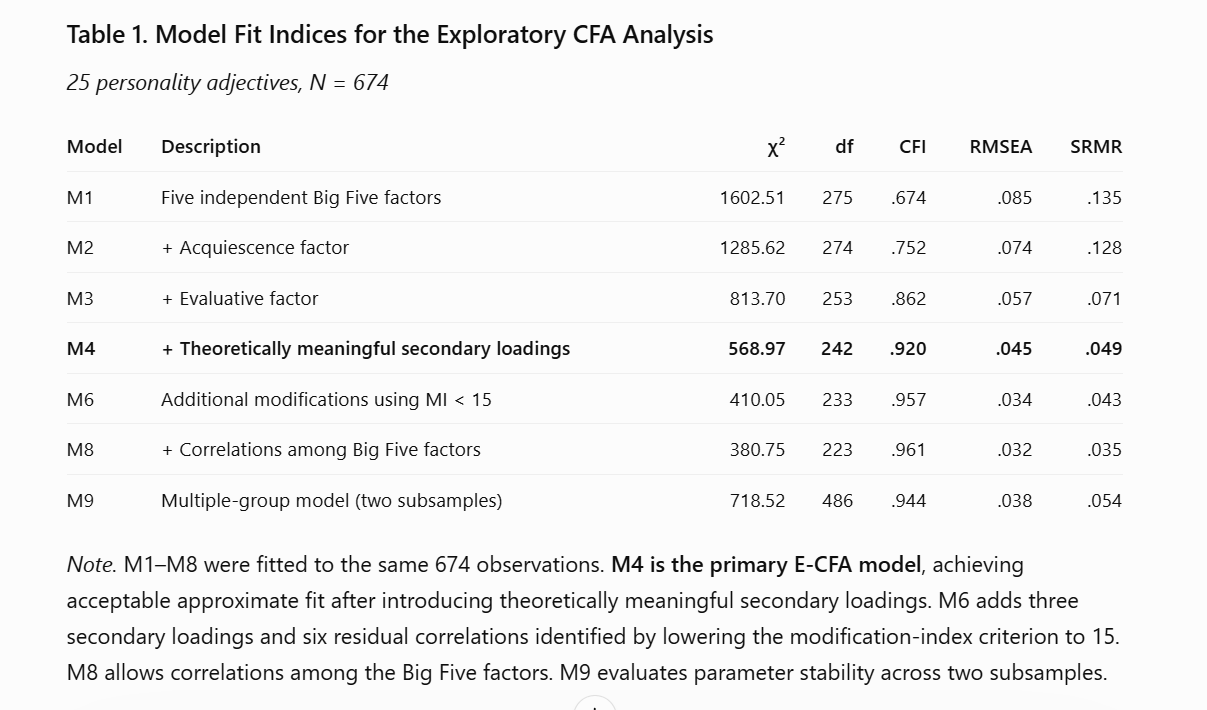
The first modification introduced an acquiescence factor to account for individual differences in the tendency to agree with questionnaire statements independently of their content. Acquiescence can be represented by a method factor with fixed, equal loadings on the original, unreversed item responses (Danner et al., 2021). Adding this response-style factor improved fit modestly (CFI = .752, RMSEA = .074, SRMR = .128), but substantial misfit remained.
The second modification introduced a general evaluative factor. Previous research has demonstrated that evaluative variance contributes to correlations among Big Five ratings (Anusic et al., 2009). One approach is to represent this variance as a higher-order factor that influences the Big Five dimensions. An alternative is a bifactor-style model in which items load directly on a general factor in addition to their primary personality factors (Chen et al., 2016). The latter approach allows individual adjectives to differ in their evaluative loadings independently of their substantive trait loadings. For example, kind may have a stronger evaluative component than a relatively neutral adjective such as talkative. Adding the evaluative factor substantially improved fit (CFI = .862, RMSEA = .057, SRMR = .071), although the model still failed to reproduce the observed correlations adequately.
The next step was to examine modification indices and introduce theoretically meaningful secondary loadings with MIs greater than 25. This modification addressed the unrealistic assumption that every adjective measures only one Big Five dimension. The resulting model (M4) achieved acceptable approximate fit (CFI = .920, RMSEA = .045, SRMR = .049). Thus, a model with five independent substantive factors, two method factors, and theoretically interpretable secondary loadings was sufficient to provide an adequate representation of the selected personality data.
Model development could have stopped at this point. However, to examine the consequences of using a less stringent modification criterion, I continued the analysis with an MI threshold of 15. This identified three additional secondary loadings and six residual correlations. The additional parameters were relatively small, but freeing them further improved global fit (CFI = .957, RMSEA = .034, SRMR = .043; M6). The residual correlations largely represented localized relationships among particular adjectives rather than additional broad personality dimensions. This illustrates that researchers can continue improving model fit after achieving an adequate model, although such modifications may have limited implications for the interpretation of personality structure.
Finally, I relaxed the assumption that the five substantive factors were independent and allowed them to correlate. This produced a small improvement in approximate global fit (CFI = .961, RMSEA = .032, SRMR = .035; M8). The chi-square difference was statistically significant, Δχ²(10) = 29.30, but the improvement in CFI was only .004. These results suggest that allowing substantive factor correlations provides some additional explanatory power, although the model with independent Big Five factors already reproduces the observed covariance structure adequately.
[
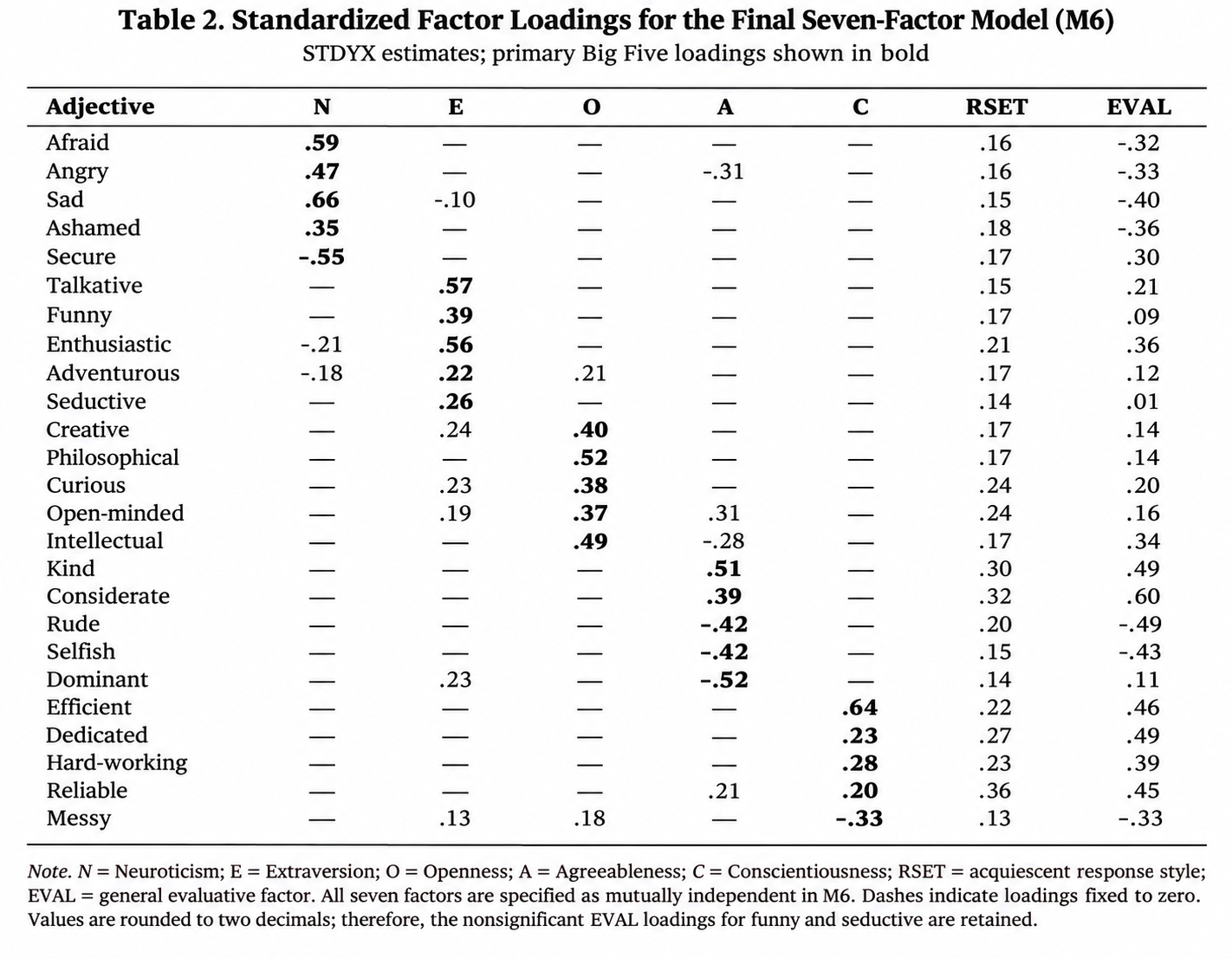
Table 2 presents the standardized factor loadings for M6. The substantive Big Five factors show recognizable loading patterns, and several secondary loadings have straightforward psychological interpretations. For example, angry loads positively on Neuroticism and negatively on Agreeableness, consistent with the view that anger reflects both emotional instability and antagonism. Similarly, dominant loads negatively on Agreeableness and positively on Extraversion, suggesting that dominance combines antagonistic and assertive characteristics. These relationships are not merely statistical adjustments; they illustrate how adjectives can describe characteristics that span more than one broad personality dimension.
The two method factors also account for substantial variance in item responses. Acquiescence contributes to the ratings independently of adjective content, whereas the evaluative factor distinguishes positively and negatively evaluated characteristics. Importantly, the five substantive factors were specified as independent in M6. This demonstrates that the observed correlations among personality adjectives can be reproduced without assuming that the Big Five themselves are substantially correlated. An alternative model with correlated substantive factors also fits the data, however. Thus, the present results do not establish that the Big Five are genuinely independent or that all shared evaluative variance represents response bias. Rather, they demonstrate that these are alternative theoretical explanations that can be explicitly specified and evaluated using CFA.
To examine the stability of the resulting model, I divided the sample into two groups using an odd-even split of participant IDs and estimated the model with freely estimated parameters in both groups. Despite the reduced sample sizes and statistical power, the substantive loading pattern was largely reproduced. Particularly noteworthy, all nine additional parameters introduced using the lower MI criterion of 15 retained their directions and were statistically significant in both subsamples. The multiple-group model also showed good approximate fit (CFI = .944, RMSEA = .038, SRMR = .054). Because the model had been developed using the complete dataset, this analysis is best interpreted as an internal test of parameter stability rather than an independent confirmation. Nevertheless, the results demonstrate that even relatively small modifications identified during exploratory model development can be stable across subsamples.
The selected adjectives also produced good approximate fit in a conventional five-factor EFA with correlated factors (CFI = .948, RMSEA = .041, SRMR = .028). Thus, the advantage of E-CFA is not that it necessarily fits better than EFA. The advantage of E-CFA over EFA is that it is possible to modify models that do not fit the data. For example, EFA cannot represent correlated residuals, but CFA makes it possible to model these relationships. CFA can also be used to compare alternative theoretical models to see whether one model produces better fit than another. EFA can only improve fit by adding factors and none of the factor models may correspond to a theoretical model.
In short, CFA has many advantages over EFA, but its potential has been neglected because researchers have often used it to confirm EFA-derived models that already failed to reproduce the observed correlations adequately. Imposing more restrictive assumptions only produced worse fit. This example demonstrates that CFA models can fit personality data and that E-CFA can be used to explore personality structure rather than merely confirm existing models. Although the present demonstration is limited to 25 adjectives, previous analyses have developed fitting CFA models with substantially larger item sets, including the IPIP-100 (Schimmack, 2019) and hierarchical models of the NEO-PI-R and IPIP-NEO (Schimmack, 2024). These examples illustrate that exploratory model development with CFA is feasible even for complex personality inventories.
Discussion
Model Modification Is Not a Questionable Research Practice
Psychology lacks a unified research culture. The replication crisis in experimental social psychology revealed serious problems associated with presenting exploratory findings as confirmatory evidence (Open Science Collaboration, 2015). Kerr (1998) identified the practice of presenting hypotheses developed after examining the results as if they had been specified in advance as HARKing (Hypothesizing After the Results are Known). John et al. (2012) documented the prevalence of questionable research practices, including undisclosed flexibility in data analysis and reporting. Methodological reforms have therefore emphasized the distinction between exploratory and confirmatory analyses (Wagenmakers et al., 2012) and encouraged preregistration to prevent researchers from presenting exploratory findings as confirmatory evidence (Nosek et al., 2018).
This distinction is relatively straightforward in experimental research, where studies often test a limited number of hypotheses using a small number of dependent variables. Multivariate research presents a different challenge. Theoretical models may contain dozens or hundreds of parameters, and it is unrealistic to expect researchers to anticipate every relevant relationship among variables before examining the data. Preregistration can establish the initial model and planned tests, but it cannot eliminate the need to investigate why a theoretically motivated model fails to fit.
As Jöreskog (1978) recognized, studies of covariance structures often combine confirmatory and exploratory elements. This was evident in the present example. The initial model was based on the well-established Big Five structure and previous findings concerning method factors. However, even after accounting for these sources of covariance, the model did not fit adequately. Exploration was necessary to identify additional relationships and develop a model that reproduced the observed correlations.
The unfortunate name confirmatory factor analysis creates the impression that modifying a model is inconsistent with the proper use of the method. However, model modification is not inherently a questionable research practice. The problem arises when researchers present a model developed through exploration as if it had been independently confirmed (Kerr, 1998; Wagenmakers et al., 2012). Exploratory model development is subject to capitalization on chance, and the resulting model must be evaluated using additional evidence (MacCallum et al., 1992). These limitations require transparency and subsequent testing, not a prohibition against modifying models.
The solution is to distinguish the statistical method from the scientific purpose of the analysis. E-CFA uses the same statistical framework conventionally called CFA but explicitly recognizes that the objective is exploratory model development. Researchers can report their initial assumptions, document modifications, explain their theoretical rationale, and present the resulting model as a hypothesis for further testing. Rather than treating poor model fit as the end of an analysis, researchers can use CFA to investigate why a model fails and develop theoretically meaningful alternatives.
It may seem unlikely that a change in terminology could substantially influence research practices. However, removing the misleading association between CFA and strictly confirmatory research may encourage personality researchers to use its full capabilities without treating legitimate exploration as a questionable research practice. Conversely, emphasizing model fit raises a different question: Is it a questionable research practice to use a poorly fitting EFA model as evidence for a theoretical claim? Poor model fit does not invalidate exploratory analyses, but presenting an interpretable factor solution as confirmation of a theory while ignoring evidence of model misspecification is difficult to justify.
It may seem unlikely that a change in terminology could substantially influence research practices. However, removing the misleading association between CFA and strictly confirmatory research may encourage personality researchers to use its full capabilities without treating legitimate exploration as a questionable research practice.
Conversely, emphasizing the poor fit of conventional CFA models raises a different question: Is it a questionable research practice to use a poorly fitting EFA model as evidence for a theoretical claim? The importance of evaluating model fit in EFA has long been recognized (Fabrigar et al., 1999; Hopwood & Donnellan, 2010). Yet researchers often interpret factor solutions without reporting whether the model adequately reproduces the observed correlations. Poor model fit does not invalidate exploratory analyses, but presenting an interpretable factor solution as confirmation of a theory while ignoring evidence of model misspecification is difficult to justify. Once model fit in EFA is taken seriously, E-CFA offers a way to investigate and address the shortcomings of poorly fitting factor models.
Exploratory Complicated Factor Analysis versus Exploratory Structural Equation Modeling
One theme of this article is that statistical labels can be misleading. Confirmatory factor analysis (CFA) is an unfortunate name for a statistical method that can be used for both confirmation and exploration. It is therefore useful to compare E-CFA with a similar method called Exploratory Structural Equation Modeling (ESEM). ESEM was developed to integrate exploratory factor analysis (EFA) into the structural equation modeling framework (Asparouhov & Muthén, 2009; Marsh et al., 2009). Although ESEM and E-CFA use the same general statistical framework, they emphasize different research objectives.
ESEM extends EFA by allowing exploratory measurement models to be incorporated into more complex structural analyses. It also allows researchers to introduce additional parameters, such as correlated residuals, when an exploratory factor model does not fit the data adequately. Marsh et al. (2010) provided an influential application of ESEM to the 60-item NEO Five-Factor Inventory. Their initial five-factor ESEM model did not fit the data adequately (CFI = .851). To improve fit, they introduced 57 correlated residuals based on the assignment of items to narrower NEO personality facets. This modification increased CFI to .914. The resulting model could then be used to investigate measurement invariance across gender and over time. Thus, ESEM provides important advantages over conventional EFA.
Nájera et al. (2025) proposed EFA-based CFA, a variation of the ESEM approach in which negligible secondary loadings are constrained to zero to produce more parsimonious measurement models. This procedure retains the exploratory factor structure as its starting point and differs from conventional ESEM primarily by introducing additional restrictions on the loading matrix.
The fundamental difference between ESEM and E-CFA concerns the distinction between the empirical operationalization of personality dimensions and the measurement of theoretical constructs. EFA is useful for identifying dimensions that summarize individual differences across a broad domain of personality characteristics. These dimensions are defined by the variables included in an analysis, their correlations, and mathematical procedures for extracting and rotating factors. Researchers subsequently interpret the factors based on their loading patterns and assign descriptive labels such as Extraversion or Agreeableness. This approach provides a useful empirical taxonomy of personality without requiring a theoretical model of the psychological constructs underlying the observed characteristics.
However, an empirically identified factor is not necessarily equivalent to a theoretical construct. As Lykken (1971) pointed out, the use of factor analysis for dimensional discovery raises questions that are distinct from its use for testing hypotheses. Reproducing an exploratory factor structure within SEM does not, by itself, resolve these questions. For example, identifying a factor that resembles Extraversion does not establish that it measures the theoretical construct of Extraversion. The interpretation of the factor depends on its observed loading pattern, and unexpected loadings can change that interpretation without necessarily challenging the statistical model. The factor remains an empirically defined dimension, even if its theoretical meaning is uncertain.
E-CFA takes the theoretical construct, rather than the exploratory factor solution, as its starting point. Researchers specify a model based on theoretical assumptions about the relationships between latent constructs and observed characteristics. These assumptions generate predictions that can be evaluated against the observed correlations. For example, a theoretical model may define Extraversion as a broad disposition underlying narrower traits such as cheerfulness and assertiveness (McCrae et al., 1996). The model predicts that measures of these traits should load on a common Extraversion factor. If the predicted relationships are not observed, the discrepancy raises questions about the proposed measurement model or the underlying theory of Extraversion. Researchers can then investigate alternative explanations and modify the model accordingly.
This distinction is central to the concept of construct validity (Cronbach & Meehl, 1955). The question for an exploratory factor is primarily what the empirically identified dimension represents. The question for a theoretically specified measurement model is whether the observed indicators measure the construct they are intended to measure. Answering the second question requires theoretical predictions that go beyond the factor solution itself. Exploratory factors can also be subjected to construct validation, but their identification and interpretation through EFA do not, by themselves, provide such evidence.
The different objectives are reflected in the treatment of secondary loadings. In conventional ESEM, secondary loadings are estimated as part of an exploratory factor model, and rotation criteria determine the orientation of the loading pattern. Although target rotation allows theoretical expectations to guide this process, individual secondary loadings do not require substantive theoretical justification. In E-CFA, researchers begin with a theoretically specified loading pattern and use modification indices to identify restrictions that may be incorrect. Substantial secondary loadings can then be evaluated for their theoretical meaning. For example, allowing angry to load on both Neuroticism and low Agreeableness expresses a substantive hypothesis about the relationship between emotional instability and antagonism. Smaller modifications may be necessary for statistical adequacy without having major theoretical implications.
This approach also has implications for parsimony. An unrestricted ESEM measurement model estimates numerous secondary loadings, including some that contribute little to substantive interpretation. E-CFA instead aims to obtain adequate fit by selectively freeing parameters that are statistically necessary or theoretically meaningful. The present demonstration illustrates that good model fit can be achieved without estimating every possible secondary loading.
ESEM and E-CFA are therefore complementary approaches. Both approaches demonstrate that structural equation modeling need not be restricted to strictly confirmatory research. Whereas ESEM brings exploratory factor analysis into structural equation modeling, E-CFA brings exploration into confirmatory factor analysis.
ESEM and E-CFA can also be viewed as complementary approaches that emphasize different stages of scientific theory development. Exploratory factor analysis has been particularly useful for developing descriptive taxonomies of personality traits. The identification of the Big Five was a major achievement that provided a common framework for describing individual differences and developing personality measures. However, scientific progress also requires moving from description toward explanation. Systematic observations provide the foundation for developing theoretical constructs, which in turn generate predictions that can be used to evaluate and improve measurement (Cronbach & Meehl, 1955).
Despite decades of research on the Big Five, there is still considerable uncertainty about the theoretical meaning of these dimensions and how they should be distinguished from related constructs. Although explanatory theories have been proposed, they have not produced a generally accepted theoretical measurement model of personality structure. E-CFA provides an opportunity to advance this process by specifying theoretical constructs, evaluating their relationships with observed indicators, and revising models when theoretical predictions fail. Thus, ESEM extends the usefulness of empirically derived personality dimensions, whereas E-CFA emphasizes the development and evaluation of theories that may ultimately improve how personality is described and measured.
Conclusion
Methodological advances often encounter skepticism and resistance. In 1928, Thurstone published a provocative article entitled Attitudes Can Be Measured. Although he expected his proposed measurement method to be welcomed, he later recalled that it generated considerable criticism (Thurstone, 1952). Thurstone subsequently became a leading developer of multiple-factor analysis, which provided the foundation for much of modern personality research. Several decades later, Jöreskog (1969) introduced confirmatory factor analysis (CFA), which allowed researchers to specify and test explicit measurement models. Yet EFA remained the dominant approach to studying personality structure.
The key message of this article is that personality can be measured with theoretically specified models that fit the data. The present demonstration shows that the poor fit of conventional CFA models is not an insurmountable obstacle. Rather than abandoning CFA or accepting exploratory factor solutions as adequate representations of personality structure, researchers can investigate model misspecification and develop better-fitting theoretical models. This opens the door to moving beyond the descriptive Big Five taxonomy toward a better understanding of the internal causes of behaviors and their covariation.
No new statistical tools or datasets are required to begin this work. What is needed is a willingness to use CFA for exploration and to treat model modification as an opportunity for theory development rather than a questionable research practice. Unlike Thurstone, I do not anticipate a warm welcome for this suggestion. Nevertheless, I hope this article encourages a new generation of personality researchers to think outside the EFA box. At a minimum, this article provides researchers with a peer-reviewed citation to justify the exploratory use of CFA by removing the confirmatory label from the statistical tool. The complexity of personality is not a reason to abandon CFA. It is a reason to use its full capabilities. At a minimum, this article provides researchers with a peer-reviewed citation to justify the exploratory use of CFA.
Thurstone (1952) was already concerned that researchers were constructing more and more attitude scales without making corresponding theoretical progress. His development of multiple-factor analysis was motivated by the limitations of existing methods and the desire to advance the scientific understanding of human differences (Thurstone, 1934). I do not have a time machine to ask Thurstone what he would have thought of CFA, but I suspect he would have welcomed a method that overcomes some of the limitations of his own pioneering work. The complexity of personality is not a reason to abandon CFA. It is a reason to use its full capabilities.
References
References
Anusic, I., Schimmack, U., Pinkus, R. T., & Lockwood, P. (2009). The nature and structure of correlations among Big Five ratings: The halo–alpha–beta model. Journal of Personality and Social Psychology, 97(6), 1142–1156. https://doi.org/10.1037/a0017159
Asparouhov, T., & Muthén, B. (2009). Exploratory structural equation modeling. Structural Equation Modeling: A Multidisciplinary Journal, 16(3), 397–438. https://doi.org/10.1080/10705510903008204
Benjamini, Y., & Hochberg, Y. (1995). Controlling the false discovery rate: A practical and powerful approach to multiple testing. Journal of the Royal Statistical Society: Series B (Methodological), 57(1), 289–300. https://doi.org/10.1111/j.2517-6161.1995.tb02031.x
Biderman, M. D., McAbee, S. T., Chen, Z. J., & Hendy, N. T. (2018). Assessing the evaluative content of personality questionnaires using bifactor models. Journal of Personality Assessment, 100(4), 375–388. https://doi.org/10.1080/00223891.2017.1406362
Chen, Z., Watson, P. J., Biderman, M. D., & Ghorbani, N. (2016). Investigating the properties of the general factor (M) in bifactor models applied to Big Five or HEXACO data in terms of method or meaning. Imagination, Cognition and Personality, 35(3), 216–243. https://doi.org/10.1177/0276236615590587
Cramer, A. O. J., van der Sluis, S., Noordhof, A., Wichers, M., Geschwind, N., Aggen, S. H., Kendler, K. S., & Borsboom, D. (2012). Dimensions of normal personality as networks in search of equilibrium: You can’t like parties if you don’t like people. European Journal of Personality, 26(4), 414–431. https://doi.org/10.1002/per.1866
Cronbach, L. J., & Meehl, P. E. (1955). Construct validity in psychological tests. Psychological Bulletin, 52(4), 281–302. https://doi.org/10.1037/h0040957
Danner, D., Lechner, C. M., Soto, C. J., & John, O. P. (2021). Modelling the incremental value of personality facets: The domains-incremental facets-acquiescence bifactor model. European Journal of Personality, 35(1), 67–84. https://doi.org/10.1002/per.2268
DeYoung, C. G. (2006). Higher-order factors of the Big Five in a multi-informant sample. Journal of Personality and Social Psychology, 91(6), 1138–1151. https://doi.org/10.1037/0022-3514.91.6.1138
DeYoung, C. G., Tai, M. H., Chou, E., & Mlačić, B. (2026). Are the metatraits fact or artifact? Ruling out alternative explanations for the higher-order factors of the Big Five. Journal of Personality and Social Psychology, 130(6), 1190–1207. https://doi.org/10.1037/pspp0000593
Fabrigar, L. R., Wegener, D. T., MacCallum, R. C., & Strahan, E. J. (1999). Evaluating the use of exploratory factor analysis in psychological research. Psychological Methods, 4(3), 272–299. https://doi.org/10.1037/1082-989X.4.3.272
Gignac, G. E. (2016). The higher-order model imposes a proportionality constraint: That is why the bifactor model tends to fit better. Intelligence, 55, 57–68. https://doi.org/10.1016/j.intell.2016.01.006
Hopwood, C. J., & Donnellan, M. B. (2010). How should the internal structure of personality inventories be evaluated? Personality and Social Psychology Review, 14(3), 332–346. https://doi.org/10.1177/1088868310361240
John, L. K., Loewenstein, G., & Prelec, D. (2012). Measuring the prevalence of questionable research practices with incentives for truth telling. Psychological Science, 23(5), 524–532. https://doi.org/10.1177/0956797611430953
Jöreskog, K. G. (1969). A general approach to confirmatory maximum likelihood factor analysis. Psychometrika, 34(2), 183–202. https://doi.org/10.1007/BF02289343
Jöreskog, K. G. (1978). Structural analysis of covariance and correlation matrices. Psychometrika, 43(4), 443–477. https://doi.org/10.1007/BF02293808
Kerr, N. L. (1998). HARKing: Hypothesizing after the results are known. Personality and Social Psychology Review, 2(3), 196–217. https://doi.org/10.1207/s15327957pspr0203_4
Lykken, D. T. (1971). Multiple factor analysis and personality research. Journal of Experimental Research in Personality, 5, 161–170.
MacCallum, R. C., Roznowski, M., & Necowitz, L. B. (1992). Model modifications in covariance structure analysis: The problem of capitalization on chance. Psychological Bulletin, 111(3), 490–504. https://doi.org/10.1037/0033-2909.111.3.490
Marsh, H. W., Muthén, B., Asparouhov, T., Lüdtke, O., Robitzsch, A., Morin, A. J. S., & Trautwein, U. (2009). Exploratory structural equation modeling, integrating CFA and EFA: Application to students’ evaluations of university teaching. Structural Equation Modeling: A Multidisciplinary Journal, 16(3), 439–476. https://doi.org/10.1080/10705510903008220
Marsh, H. W., Lüdtke, O., Muthén, B., Asparouhov, T., Morin, A. J. S., Trautwein, U., & Nagengast, B. (2010). A new look at the Big Five factor structure through exploratory structural equation modeling. Psychological Assessment, 22(3), 471–491. https://doi.org/10.1037/a0019227
McCrae, R. R., Zonderman, A. B., Costa, P. T., Jr., Bond, M. H., & Paunonen, S. V. (1996). Evaluating replicability of factors in the Revised NEO Personality Inventory: Confirmatory factor analysis versus Procrustes rotation. Journal of Personality and Social Psychology, 70(3), 552–566. https://doi.org/10.1037/0022-3514.70.3.552
Muthén, B., & Asparouhov, T. (2012). Bayesian structural equation modeling: A more flexible representation of substantive theory. Psychological Methods, 17(3), 313–335. https://doi.org/10.1037/a0026802
Nájera, P., Abad, F. J., & Sorrel, M. A. (2025). Is exploratory factor analysis always to be preferred? A systematic comparison of factor analytic techniques throughout the confirmatory–exploratory continuum. Psychological Methods, 30(1), 16–39. https://doi.org/10.1037/met0000579
Nosek, B. A., Ebersole, C. R., DeHaven, A. C., & Mellor, D. T. (2018). The preregistration revolution. Proceedings of the National Academy of Sciences, 115(11), 2600–2606. https://doi.org/10.1073/pnas.1708274114
Open Science Collaboration. (2015). Estimating the reproducibility of psychological science. Science, 349(6251), aac4716. https://doi.org/10.1126/science.aac4716
Reise, S. P. (2012). The rediscovery of bifactor measurement models. Multivariate Behavioral Research, 47(5), 667–696. https://doi.org/10.1080/00273171.2012.715555
Saucier, G. (1997). Effects of variable selection on the factor structure of person descriptors. Journal of Personality and Social Psychology, 73(6), 1296–1312. https://doi.org/10.1037/0022-3514.73.6.1296
Spearman, C. (1904). “General intelligence,” objectively determined and measured. The American Journal of Psychology, 15(2), 201–292.
Thurstone, L. L. (1928). Attitudes can be measured. American Journal of Sociology, 33(4), 529–554. https://doi.org/10.1086/214483
Thurstone, L. L. (1934). The vectors of mind. Psychological Review, 41(1), 1–32. https://doi.org/10.1037/h0075959
Thurstone, L. L. (1952). L. L. Thurstone. In E. G. Boring, H. S. Langfeld, H. Werner, & R. M. Yerkes (Eds.), A history of psychology in autobiography (Vol. 4, pp. 294–321). Clark University Press.
Tucker, L. R. (1955). The objective definition of simple structure in linear factor analysis. Psychometrika, 20(3), 209–225. https://doi.org/10.1007/BF02289018
Wagenmakers, E.-J., Wetzels, R., Borsboom, D., van der Maas, H. L. J., & Kievit, R. A. (2012). An agenda for purely confirmatory research. Perspectives on Psychological Science, 7(6), 632–638. https://doi.org/10.1177/1745691612463078
Wood, D., Nye, C. D., & Saucier, G. (2010). Identification and measurement of a more comprehensive set of person-descriptive trait markers from the English lexicon. Journal of Research in Personality, 44(2), 258–272. https://doi.org/10.1016/j.jrp.2010.02.003