Two Scientific Traditions and Two Crises in Psychology
Cronbach (1957) distinguished two scientific traditions in psychology. The experimental tradition studies the effects of manipulated conditions, whereas the correlational tradition investigates naturally occurring individual differences and relationships among variables. More than half a century later, Tracy et al. (2009) found that this distinction remained evident in social and personality psychology.
One important reason for the persistence of these traditions is that some scientific questions are difficult or impossible to investigate experimentally. Researchers interested in these questions recognize the advantages of experiments for establishing causality, but they cannot always manipulate the variables they wish to understand. This limitation is not unique to psychology. Astronomy, for example, is a branch of physical science that relies heavily on observations because astronomers cannot experimentally manipulate stars, galaxies, or the evolution of the universe. Nevertheless, astronomers have developed sophisticated methods for testing theories against observational evidence.
From the perspective of Kuhn’s (1962) theory of science, the two traditions can be viewed as partially distinct methodological paradigms. Each has characteristic research questions, methods, scientific communities, journals, and foundational findings. Although they overlap, researchers working within these traditions often approach scientific problems in different ways.
My own field, social and personality psychology, is particularly interesting because it encompasses both traditions. Experimental social psychologists typically investigate the effects of manipulated social conditions, such as exposure to prejudice or social rejection. Correlational researchers investigate individual differences in personality traits, attitudes, values, social relationships, self-esteem, and life satisfaction. Several journals have Social and Personality in their titles, but experimental social psychology and correlational social-personality research remain distinct research traditions with different scientific challenges.
The major challenge for experimental social psychology has been the replication crisis. Many experiments investigated relatively subtle psychological effects using small samples and outcome measures with modest or unknown reliability and validity. Small effects and imprecise measurement resulted in low statistical power. When researchers selectively reported statistically significant results, the published literature became populated with findings that were difficult to replicate (Open Science Collaboration, 2015). Flexibility in selecting dependent variables and modifying analyses created additional opportunities for obtaining significant results (Simmons et al., 2011; Flake & Fried, 2020). These problems stimulated reforms, including preregistration, greater transparency, and larger samples.
Correlational personality psychology faces a different problem. Researchers frequently use established questionnaires that produce reliable scores and replicable correlations. For example, Neuroticism scores are negatively correlated with life satisfaction, and Conscientiousness scores predict academic achievement. These relationships have been observed repeatedly, often using the same or closely related measures. Although replication problems are not absent from personality psychology, many established correlations are remarkably robust (Soto, 2019).
However, replicable findings are not sufficient for scientific progress. A science advances when reliable observations are used to develop, evaluate, and improve theories.
Astronomers observed and recorded the movements of celestial bodies for centuries before the development of theories that adequately explained those movements. Scientific progress required more than accumulating increasingly accurate observations. It required theoretical models that generated predictions about observations, including predictions that could distinguish competing explanations.
The same principle applies to personality psychology. Repeatedly demonstrating that Neuroticism is negatively correlated with life satisfaction does not explain why the two variables are related. To develop and test explanations, researchers must understand what the variables represent.
This brings us to a second requirement for scientific progress. Observations must not only be reliable; they must also be valid indicators of the theoretical variables that scientists seek to understand.
The need for construct validation was recognized decades ago by Cronbach and Meehl (1955) and has been emphasized repeatedly since then (Flake & Fried, 2020; Schimmack, 2021). Nevertheless, personality and social psychologists continue to struggle with construct validation.
The basic idea of construct validity is simple: A measure is valid to the extent that it measures the construct it is intended to measure. For example, a thermometer can provide a valid measure of temperature because its readings respond predictably to changes in temperature and can be calibrated against established physical standards.
In psychology, construct validation is more difficult because many theoretical constructs cannot be observed directly. We can observe that some students study more than others and that students who study more tend to obtain better grades. However, we cannot directly observe the psychological dispositions that influence these differences in behavior. Constructs such as motivation, intelligence, self-control, and conscientiousness are theoretical explanations of observable individual differences.
This problem is familiar in other observational sciences. Black holes provide an instructive example. Because black holes do not emit light from within their event horizons, astronomers cannot observe them as ordinary luminous objects. Instead, they infer their existence and properties from observable consequences, including the motion of nearby stars, radiation from surrounding matter, and gravitational waves. The strength of the evidence comes from the ability of physical theories to predict these observations and distinguish black holes from alternative explanations.
The same logic applies to psychological constructs. We cannot establish the existence or nature of a psychological disposition simply by assigning a name to a collection of correlated behaviors. We must develop theories that specify what the disposition is, how it influences observable behavior, and which observations would distinguish it from competing explanations.
This is the purpose of construct-validation research. It does not end with demonstrating that a questionnaire produces reliable scores or replicable correlations. It seeks to determine whether the observed relationships support the theoretical interpretation of the construct and, ultimately, how accurately the measure represents that construct.
The Construct Validity of Thermometers
The Construct Validity of Thermometers
Cronbach and Meehl (1955) used temperature as an example in their foundational article on construct validity. Initially, temperature was a vague concept based on the observation that some objects feel hotter than others. The invention of thermometers made it possible to measure differences in temperature reliably. However, scientists did not yet have a satisfactory theory explaining what temperature was or why heating objects produced observable changes, such as the expansion of liquids or the boiling of water.
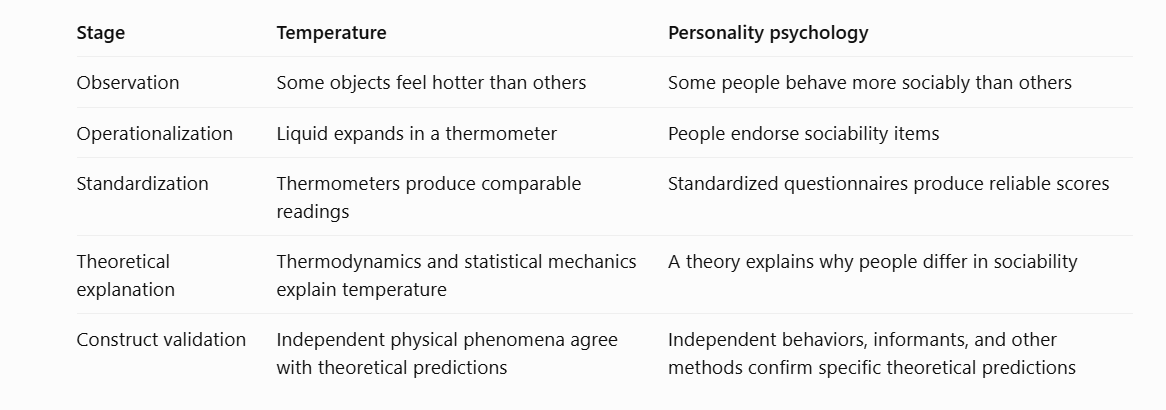
Over time, increasingly precise measurements contributed to the development of theories of heat and temperature. The kinetic theory of gases and, eventually, statistical mechanics connected temperature to the behavior of microscopic particles. These theories generated new predictions that could be tested through observations and experiments. In turn, the results of these investigations led to improvements in measurement and theoretical understanding.
The important lesson is that scientists were able to measure temperature before they fully understood what temperature was. Scientific progress emerged from a continuous interaction between measurement and theory. Better measures produced observations that challenged existing theories. Better theories generated new predictions and contributed to the development of better measures. Cronbach and Meehl (1955) described this process as the bootstrapping of construct validity.
The same process is possible in personality and social psychology. Researchers can observe that some people experience more anxiety, are happier, or behave more conscientiously than others without having a complete theory of the psychological processes responsible for these differences. Reliable measures provide a starting point for developing such theories. However, reliable measurement is only the beginning of a construct-validation program, not its final achievement.
Unfortunately, much of personality psychology has made limited progress beyond this initial stage. Researchers continue to use established questionnaires and report correlations that have been observed for decades. The stability of these findings creates an impression of cumulative scientific progress, but accumulating replicable correlations is not the same as developing and testing explanations of those correlations.
Consider the well-established finding that Conscientiousness scores predict academic achievement. Students with higher Conscientiousness scores tend to obtain higher grades. Researchers may explain this relationship by proposing that conscientious students work harder, study more consistently, and complete their assignments on time.
At first glance, this explanation resembles the claim that temperature causes water to boil. In both cases, an underlying attribute is proposed as the cause of an observable phenomenon. However, the ability to predict an outcome does not establish that we understand the attribute responsible for it.
Scientists initially knew that heating water could make it boil without understanding the underlying physical processes. They subsequently developed theories that explained boiling in terms of temperature, pressure, and the behavior of molecules. Temperature acquired a theoretical meaning independent of water boiling. This made it possible to predict boiling points under different conditions and to test those predictions using independent measures of temperature.
What would comparable theoretical progress look like for Conscientiousness?
Conscientiousness is typically defined as a general disposition toward organization, responsibility, persistence, self-discipline, and industriousness. However, this definition lists characteristics that are assumed to reflect a common disposition without explaining what that disposition is. Saying that conscientious students work harder because they are conscientious comes close to explaining industrious behavior by referring to industriousness.
Of course, predicting that Conscientiousness scores are associated with independently observed studying behavior or academic achievement is an empirical finding, not a tautology. The problem arises when these predictions are mistaken for explanations of the underlying psychological processes.
A theory of Conscientiousness would need to specify the psychological attribute responsible for differences in organization, persistence, responsibility, and self-discipline. Is it the ability to inhibit immediate impulses? A stronger motivation to achieve long-term goals? Greater sensitivity to social expectations and obligations? These possibilities imply different psychological processes and generate different predictions. Moreover, different characteristics associated with Conscientiousness may have different causes.
Without a theory specifying what Conscientiousness is, the construct remains primarily a descriptive label for a collection of related characteristics rather than an explanation of their relationships.
This does not make the measurement of Conscientiousness useless. Just as early thermometers provided valuable observations before the development of modern thermodynamics, personality questionnaires can provide useful descriptions and predictions before the underlying psychological processes are understood. However, the scientific challenge is to use these observations to develop and test increasingly precise theories.
The goal of construct validation is therefore not merely to demonstrate that a measure predicts other variables. It is to develop and evaluate theories of the psychological attributes that account for those predictions. Reliable measurements and replicable correlations are essential foundations, but theoretical progress requires moving beyond describing relationships toward explaining why they exist.
However, this virtuous cycle that has produced amazing developments in the natural sciences has not even started in social and personality psychology. Research is stuck at the stage of observation. This lack of progress is often obscured by the confusion of prediction with explanation. Conscientiousness scores can predict GPA, but they do not explain why some students have higher GPAs than others. Conscientiousness is a name for a scale, not a theoretical construct that can explain behavior.
Defining Psychological Constructs
The lack of clear construct definitions contributes to two longstanding problems in psychological science: the jingle fallacy, which occurs when different psychological attributes are studied under the same name, and the jangle fallacy, which occurs when the same or highly similar attributes are studied under different names. These problems have been discussed for more than a century, yet they remain widespread (Lawson & Robins, 2021).
Recent research has also documented extensive proliferation of psychological constructs and measures. Anvari et al. (2025) found that thousands of new constructs and measures have been introduced into the psychological literature, with little evidence of convergence toward a common set of well-established constructs and measures. As a result, researchers may repeatedly study the same psychological attributes under different names or combine findings from studies that use the same construct name but measure different attributes.
The importance of clear conceptual definitions has been emphasized repeatedly (Podsakoff et al., 2016; Bringmann et al., 2022; Peters & Crutzen, 2024). However, defining constructs independently of their operationalizations remains uncommon in much empirical personality research. Instead, researchers often treat the names of established questionnaires as sufficient definitions of the psychological attributes they intend to study.
The goal of this article is therefore not to introduce a new principle of construct validation. It is to put a well-established principle into practice by providing explicit definitions of widely studied personality constructs. These definitions are intended to facilitate comparisons among existing measures, identify conceptual overlap among constructs, and provide a starting point for systematic construct-validation research.
What is … ?
Theoretical Definitions of Major Personality Constructs
| Construct and source | Theoretical definition |
|---|---|
| 1. Neuroticism (N) — John et al. (2008) | A general disposition to experience negative emotions, including anxiety, sadness, anger, and emotional distress, relatively frequently and intensely, particularly in response to stress or adversity. |
| 2. Extraversion (E) — John et al. (2008) | A general disposition toward sociability, assertiveness, positive emotionality, and energetic engagement with other people and the environment. |
| 3. Openness to Experience (O) — John et al. (2008) | A general disposition toward intellectual curiosity, imagination, creativity, aesthetic appreciation, and exploration of unfamiliar ideas and experiences. |
| 4a. Agreeableness (Big Five) — John et al. (2008) | A general disposition to treat other people with compassion, kindness, trust, cooperation, and consideration for their welfare rather than hostility or antagonism. |
| 4b. Agreeableness (HEXACO) — Ashton & Lee (2007) | A general disposition to forgive others, judge them leniently, accommodate their wishes, and remain patient rather than becoming angry when mistreated or frustrated. |
| 5. Conscientiousness (C) — Soto & John (2017) | A general disposition to organize and regulate one’s behavior in a responsible, disciplined, persistent, and goal-directed manner, including meeting obligations and completing tasks. |
| 6. Honesty–Humility (HH) — Ashton & Lee (2007) | A general disposition to behave sincerely and fairly, avoid exploiting others for personal gain, and refrain from excessive greed, entitlement, or claims of superiority. |
| 7. Self-esteem — Orth & Robins (2014) | A person’s overall subjective evaluation of their worth and value as a human being, including feelings of self-acceptance and self-respect. |
| 8a. Grandiose narcissism — Krizan & Herlache (2018) | A disposition characterized by an exaggerated sense of personal importance or superiority, expectations of special treatment, and a tendency to seek recognition, admiration, or status. |
| 8b. Vulnerable narcissism — Pincus & Lukowitsky (2010) | A disposition involving fragile or unstable self-worth, heightened sensitivity to criticism and rejection, shame, and defensive reactions to perceived failures of recognition or admiration. |
| 9. Psychopathy — Patrick et al. (2009) | A configuration of personality characteristics involving callousness and disregard for others, behavioral disinhibition, and, in some conceptualizations, fearlessness and interpersonal boldness. |
| 10. Machiavellianism — Jones (2020) | A disposition to pursue personal goals through strategic manipulation, deception, and exploitation of others, accompanied by cynical beliefs about human motives and a willingness to disregard conventional moral constraints. |
| 11. Impulsivity — Whiteside & Lynam (2001) | A tendency to act in response to immediate desires, emotions, or opportunities without adequate consideration of consequences or longer-term goals. Broader conceptualizations also include difficulties with perseverance and the pursuit of exciting experiences. |
| 12. Self-control — Tangney et al. (2004) | The capacity or disposition to regulate immediate impulses, emotions, and behavior in accordance with longer-term goals, intentions, and standards. |
| 13. Sensation seeking — Zuckerman (2010) | A disposition to seek novel, varied, complex, and intense experiences, including a willingness to accept risks to obtain such experiences. |
| 14a. Positive affectivity (PANAS) — Watson et al. (1988) | A general disposition to experience energized positive engagement, characterized by enthusiasm, activity, alertness, excitement, and interest in the environment. |
| 14b. Positive affectivity (SPANE) — Diener et al. (2010) | A general disposition to experience pleasant feelings, including joy, happiness, contentment, and other positive emotional experiences, regardless of their level of arousal. |
| 15a. Negative affectivity (PANAS) — Watson et al. (1988) | A general disposition toward subjective distress and unpleasant emotional engagement, particularly feelings such as fear, anger, nervousness, irritability, and guilt. |
| 15b. Negative affectivity (SPANE) — Diener et al. (2010) | A general disposition to experience unpleasant feelings, including sadness, fear, anger, and other negative emotional experiences, regardless of their level of arousal. |
| 16. Trait anxiety — Spielberger (1983) | A relatively stable disposition to perceive situations as threatening and to experience worry, apprehension, and anxiety across different circumstances. |
| 17. Optimism — Carver et al. (2010) | A generalized tendency to expect favorable outcomes in the future, including the expectation that things will generally turn out well. |
| 18. Pessimism — Carver et al. (2010) | A generalized tendency to expect unfavorable outcomes in the future, including the anticipation that things will turn out badly. |
| 19. Locus of control — Rotter (1966) | A generalized belief about whether important outcomes depend primarily on one’s own actions or on external forces such as chance, fate, circumstances, or powerful others. |
| 20. General self-efficacy — Schwarzer & Jerusalem (1995) | A generalized belief in one’s capacity to organize and carry out the actions necessary to overcome challenges, manage difficult situations, and achieve desired goals. |
| 21. Life satisfaction — Diener et al. (1985) | A person’s overall cognitive evaluation of the quality of their life according to personally meaningful standards, expectations, and values. |
| 22. Secure attachment — Bartholomew & Horowitz (1991) | A disposition to regard oneself as worthy of love and others as generally trustworthy and supportive, resulting in comfort with both intimacy and independence in close relationships. |
| 23. Anxious/preoccupied attachment — Bartholomew & Horowitz (1991) | A disposition to strongly desire emotional closeness and approval from others while doubting one’s own worthiness of love and fearing rejection or abandonment. |
| 24. Dismissive-avoidant attachment — Bartholomew & Horowitz (1991) | A disposition to emphasize independence and self-reliance while minimizing the importance of emotional intimacy and distrusting or avoiding dependence on others. |
| 25. Fearful-avoidant attachment — Bartholomew & Horowitz (1991) | A disposition to desire close relationships while fearing rejection, betrayal, or emotional harm, resulting in avoidance of intimacy despite a desire for connection. |
Note. The definitions were created by ChatGPT. The use of AI can help to establish consensual definitions that avoid motivated biases by researchers with a particular theoretical viewpoint or an established measure.
Conclusion
The need for clear definitions of scientific constructs is hardly controversial. Yet decades of research have failed to produce sufficiently precise and widely accepted definitions for many of the most widely studied constructs in personality psychology. Researchers continue to use measures with the same names that assess different psychological attributes, while closely related attributes are studied under different names. These problems have been recognized for decades, but progress toward resolving them has been remarkably slow.
One reason may be the organization of psychological research. Researchers who develop and use established measures are rewarded primarily for producing new empirical findings, not for critically evaluating the construct validity of their instruments. Meanwhile, methodological critics have documented problems with existing measures but have often focused on identifying shortcomings rather than developing and testing better alternatives. As a result, criticism and original construct-validation research have remained largely disconnected.
This situation is no longer justified by the practical difficulties of construct-validation research. Advances in statistical modeling, computing power, open data, and scientific publishing have made it easier to evaluate existing measures, compare alternative models, and develop improved instruments. What is needed is a shift in research priorities.
A practical first step is to compare the construct validity of existing measures. The relevant question is not simply whether a measure has some validity, as indicated by a statistically significant correlation (p < .05) with another variable. The more informative question is whether one measure provides a better representation of the intended psychological construct than another.
Importantly, this does not require an exact numerical estimate of construct validity. Even when validity cannot be quantified on an absolute scale, researchers can make ordinal judgments about the relative validity of competing measures. Given a sufficiently clear theoretical definition, researchers can examine which measure better represents the intended attribute, which measure contains less irrelevant variance, and which measure produces stronger evidence in theoretically relevant tests.
For example, if positive affect is defined as the experience of pleasant emotional states across different levels of arousal, a measure that includes both excitement and contentment has better content coverage than one that focuses primarily on enthusiasm and alertness. This conclusion does not require knowing the precise percentage of valid variance in either measure. It follows from the theoretical definition of the construct and the content of the measures.
Such comparisons will not resolve every problem of construct validity. Different measures may have different strengths, and judgments of relative validity depend on the theoretical definition and the intended use of a measure. Nevertheless, identifying which measures are more valid, and why, would represent genuine scientific progress.
The definitions presented in this article are intended to facilitate this process. They are not final answers but starting points for theoretical debate and empirical evaluation. As researchers compare measures and test competing explanations of their relationships, the definitions themselves can be refined.
Construct validation should become a cumulative research program in which better definitions lead to better measures, better measures produce more informative observations, and those observations contribute to better theories. This is how construct validation advances scientific understanding, rather than merely attaching familiar names to replicable correlations.
References
Anvari, F., Alsalti, T., Oehler, L. A., Marion, Z., Hussey, I., Elson, M., & Arslan, R. C. (2025). A fragmented field: Construct and measure proliferation in psychology. Advances in Methods and Practices in Psychological Science, 8(3). https://doi.org/10.1177/25152459251360642
Ashton, M. C., & Lee, K. (2007). Empirical, theoretical, and practical advantages of the HEXACO model of personality structure. Personality and Social Psychology Review, 11(2), 150–166. https://doi.org/10.1177/1088868306294907
Bartholomew, K., & Horowitz, L. M. (1991). Attachment styles among young adults: A test of a four-category model. Journal of Personality and Social Psychology, 61(2), 226–244. https://doi.org/10.1037/0022-3514.61.2.226
Bringmann, L. F., Elmer, T., & Eronen, M. I. (2022). Back to basics: The importance of conceptual clarification in psychological science. Current Directions in Psychological Science, 31(4), 340–346. https://doi.org/10.1177/09637214221096485
Carver, C. S., Scheier, M. F., & Segerstrom, S. C. (2010). Optimism. Clinical Psychology Review, 30(7), 879–889. https://doi.org/10.1016/j.cpr.2010.01.006
Cronbach, L. J. (1957). The two disciplines of scientific psychology. American Psychologist, 12(11), 671–684. https://doi.org/10.1037/h0043943
Cronbach, L. J., & Meehl, P. E. (1955). Construct validity in psychological tests. Psychological Bulletin, 52(4), 281–302. https://doi.org/10.1037/h0040957
Diener, E., Emmons, R. A., Larsen, R. J., & Griffin, S. (1985). The Satisfaction With Life Scale. Journal of Personality Assessment, 49(1), 71–75. https://doi.org/10.1207/s15327752jpa4901_13
Diener, E., Wirtz, D., Tov, W., Kim-Prieto, C., Choi, D. W., Oishi, S., & Biswas-Diener, R. (2010). New well-being measures: Short scales to assess flourishing and positive and negative feelings. Social Indicators Research, 97, 143–156. https://doi.org/10.1007/s11205-009-9493-y
Flake, J. K., & Fried, E. I. (2020). Measurement schmeasurement: Questionable measurement practices and how to avoid them. Advances in Methods and Practices in Psychological Science, 3(4), 456–465. https://doi.org/10.1177/2515245920952393
Flake, J. K., Pek, J., & Hehman, E. (2017). Construct validation in social and personality research: Current practice and recommendations. Social Psychological and Personality Science, 8(4), 370–378. https://doi.org/10.1177/1948550617693063
John, O. P., Naumann, L. P., & Soto, C. J. (2008). Paradigm shift to the integrative Big Five trait taxonomy: History, measurement, and conceptual issues. In O. P. John, R. W. Robins, & L. A. Pervin (Eds.), Handbook of personality: Theory and research (3rd ed., pp. 114–158). Guilford Press.
Jones, D. N. (2020). Machiavellianism. In V. Zeigler-Hill & T. K. Shackelford (Eds.), Encyclopedia of personality and individual differences (pp. 2710–2718). Springer. https://doi.org/10.1007/978-3-319-24612-3_1245
Krizan, Z., & Herlache, A. D. (2018). The narcissism spectrum model: A synthetic view of narcissistic personality. Personality and Social Psychology Review, 22(1), 3–31. https://doi.org/10.1177/1088868316685018
Kuhn, T. S. (1962). The structure of scientific revolutions. University of Chicago Press.
Lawson, K. M., & Robins, R. W. (2021). Sibling constructs: What are they, why do they matter, and how should you handle them? Personality and Social Psychology Review, 25(4), 344–366. https://doi.org/10.1177/10888683211047101
Open Science Collaboration. (2015). Estimating the reproducibility of psychological science. Science, 349(6251), aac4716. https://doi.org/10.1126/science.aac4716
Orth, U., & Robins, R. W. (2014). The development of self-esteem. Current Directions in Psychological Science, 23(5), 381–387. https://doi.org/10.1177/0963721414547414
Patrick, C. J., Fowles, D. C., & Krueger, R. F. (2009). Triarchic conceptualization of psychopathy: Developmental origins of disinhibition, boldness, and meanness. Development and Psychopathology, 21(3), 913–938. https://doi.org/10.1017/S0954579409000492
Peters, G.-J. Y., & Crutzen, R. (2024). Knowing what we’re talking about: Facilitating decentralized, unequivocal publication of and reference to psychological construct definitions and instructions. Meta-Psychology, 8. https://doi.org/10.15626/MP.2022.3638
Pincus, A. L., & Lukowitsky, M. R. (2010). Pathological narcissism and narcissistic personality disorder. Annual Review of Clinical Psychology, 6, 421–446. https://doi.org/10.1146/annurev.clinpsy.121208.131215
Podsakoff, P. M., MacKenzie, S. B., & Podsakoff, N. P. (2016). Recommendations for creating better concept definitions in the organizational, behavioral, and social sciences. Organizational Research Methods, 19(2), 159–203. https://doi.org/10.1177/1094428115624965
Rotter, J. B. (1966). Generalized expectancies for internal versus external control of reinforcement. Psychological Monographs: General and Applied, 80(1), 1–28. https://doi.org/10.1037/h0092976
Schimmack, U. (2021). The validation crisis in psychology. Meta-Psychology, 5. https://doi.org/10.15626/MP.2019.1645
Schimmack, U. (2026, October 31). Narcissism is not a trait: Entitlement and grandiosity are. Replicability-Index. https://replicationindex.com/2026/10/31/narcissism-is-not-a-trait-entitlement-and-grandiosity-are/
Schwarzer, R., & Jerusalem, M. (1995). Generalized Self-Efficacy Scale. In J. Weinman, S. Wright, & M. Johnston (Eds.), Measures in health psychology: A user’s portfolio. Causal and control beliefs (pp. 35–37). NFER-Nelson.
Simmons, J. P., Nelson, L. D., & Simonsohn, U. (2011). False-positive psychology: Undisclosed flexibility in data collection and analysis allows presenting anything as significant. Psychological Science, 22(11), 1359–1366. https://doi.org/10.1177/0956797611417632
Soto, C. J. (2019). How replicable are links between personality traits and consequential life outcomes? The Life Outcomes of Personality Replication Project. Psychological Science, 30(5), 711–727. https://doi.org/10.1177/0956797619831612
Soto, C. J., & John, O. P. (2017). The next Big Five Inventory (BFI-2): Developing and assessing a hierarchical model with 15 facets to enhance bandwidth, fidelity, and predictive power. Journal of Personality and Social Psychology, 113(1), 117–143. https://doi.org/10.1037/pspp0000096
Spielberger, C. D. (1983). Manual for the State-Trait Anxiety Inventory (Form Y). Consulting Psychologists Press.
Tangney, J. P., Baumeister, R. F., & Boone, A. L. (2004). High self-control predicts good adjustment, less pathology, better grades, and interpersonal success. Journal of Personality, 72(2), 271–324. https://doi.org/10.1111/j.0022-3506.2004.00263.x
Tracy, J. L., Robins, R. W., & Sherman, J. W. (2009). The practice of psychological science: Searching for Cronbach’s two streams in social–personality psychology. Journal of Personality and Social Psychology, 96(6), 1206–1225. https://doi.org/10.1037/a0015173
Watson, D., Clark, L. A., & Tellegen, A. (1988). Development and validation of brief measures of positive and negative affect: The PANAS scales. Journal of Personality and Social Psychology, 54(6), 1063–1070. https://doi.org/10.1037/0022-3514.54.6.1063
Whiteside, S. P., & Lynam, D. R. (2001). The five factor model and impulsivity: Using a structural model of personality to understand impulsivity. Personality and Individual Differences, 30(4), 669–689. https://doi.org/10.1016/S0191-8869(00)00064-7
Zuckerman, M. (2010). Sensation seeking. In I. B. Weiner & W. E. Craighead (Eds.), The Corsini encyclopedia of psychology. Wiley. https://doi.org/10.1002/9780470479216.corpsy0843