In The Structure of Scientific Revolutions, Thomas Kuhn (1962) described how scientific communities develop around a paradigm. A paradigm involves more than a theory. It includes assumptions about what exists, which questions are worth asking, which methods are appropriate, and what constitutes acceptable evidence. These shared assumptions make cumulative research possible. However, they can also prevent researchers from recognizing the limitations of established practices.
Paradigms are like cultures, and like cultures, they can contain subcultures. For example, academic psychologists generally favor quantitative methods to provide empirical evidence for theoretical claims. Within academic psychology, experimental psychologists emphasize the manipulation of independent variables to test causal hypotheses. Personality psychologists, in contrast, rely primarily on correlational evidence because personality traits are difficult or impossible to manipulate directly.
This does not make personality psychology inherently less scientific. Astronomy also relies extensively on observational data, yet few would question its status as a science.
However, there is an important difference between astronomy and mainstream personality psychology.
Astronomers distinguish between the objects they study and the instruments used to observe them. A star is not defined by the measurements obtained with a particular telescope. Different instruments provide different information about the same object, and astronomers develop theories that explain these observations, taking the properties of the instruments into account.
Personality psychologists are less consistent in maintaining this distinction. Personality inventories often serve simultaneously as measurement instruments and definitions of the constructs they supposedly measure.
Consider Extraversion. Personality psychologists have proposed several theories about its psychological nature, emphasizing sociability, positive affect, reward sensitivity, or approach motivation. However, proposing a theory is not the same as providing empirical support for it. The existence of competing theories does not tell us which, if any, identifies the psychological disposition responsible for individual differences in Extraversion.
Meanwhile, researchers continue to use questionnaire sum scores labeled Extraversion as if the theoretical construct were already established. Different inventories combine different behaviors and characteristics, producing positively correlated but nonidentical scores. Yet there is no generally accepted explanatory model that specifies precisely what Extraversion is, demonstrates how its underlying disposition produces the observed responses, and establishes which inventory provides the most valid measurement.
Extraversion is therefore an established label for a family of correlated questionnaire scores, but not an equally well-established explanatory construct.
Another way to understand this problem is to compare personality taxonomies with geographical maps.
Maps represent real properties of Earth, including the distribution of land and water, elevation, and the location of geographical features. We can evaluate their accuracy by comparing them with observations of the physical world.
However, maps also use coordinate systems whose reference points are conventional rather than natural. Longitude provides a familiar example.
Greenwich became the internationally accepted reference for longitude in 1884. Before that, different countries used different prime meridians. The choice of Greenwich did not reveal a fundamental property of Earth. It established a common reference system that made navigation and geographical communication easier.
Changing the prime meridian changes the longitude assigned to a location. It does not change the location itself.
Personality inventories are similar to coordinate systems. They organize individual differences within a multidimensional personality space. The Big Five, the Big Five Aspect Scales, and HEXACO provide different ways of representing that space.
The existence of parallel and competing paradigms has advantages and disadvantages. The advantage is that competing paradigms can lead to empirical tests of competing predictions and lead to new discoveries. The disadvantage is that it is difficult to integrate research findings from different paradigms. For descriptive paradigms, the later problem can be resolved by translating findings from one descriptive system into another. For example, we can translate 15.00 Berlin into the local time in Sydney just like we can convert inches into centimeters or Fahrenheit into Celsius.
In personality space, we can use the correlations among dimensions from different inventories to translate findings from one system into another. A recent article by Ashton and Lee, the inventors of the HEXACO paradigm, provides an example. The authors focused on the description of pro- and anti-social traits with the Big Five Aspect Scales (BFAS) and their own HEXACO dimensions.
The BFAS uses two dimensions, Compassion (COM) and Politeness (POL), to represent individual differences in prosocial and antisocial characteristics. Although these names reflect the content of the scales, they do not establish that the dimensions measure compassion or politeness as independently defined psychological constructs. To avoid confusing labels with theoretical constructs, I will refer to these dimensions as BFAS-COM and BFAS-POL.
HEXACO also uses two dimensions to organize much of this domain: Agreeableness and Honesty-Humility. Importantly, HEXACO Agreeableness differs from Big Five Agreeableness, and Honesty-Humility refers to a particular combination of characteristics represented by its questionnaire items. I will therefore refer to these dimensions as HEXACO-A and HEXACO-HH.
Both systems provide two-dimensional representations of interpersonal individual differences. Specific characteristics, such as kindness, sympathy, helpfulness, forgiveness, or fairness, can be located within either system based on their correlations with the respective dimensions.
We can examine how closely these two systems correspond by calculating correlations among their four sum scores.
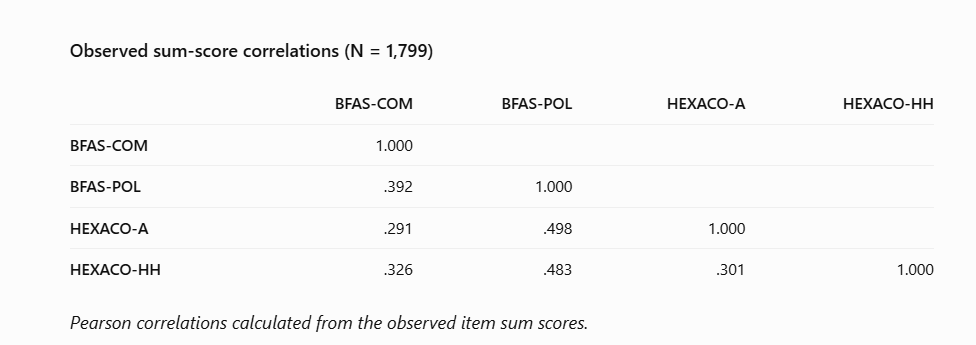
The correlations show that the two coordinate systems are related but not aligned. HEXACO-A correlates .29 with BFAS-COM and .50 with BFAS-POL. Similarly, HEXACO-HH correlates .33 with BFAS-COM and .48 with BFAS-POL. Thus, both HEXACO dimensions are more strongly associated with BFAS-POL than with BFAS-COM.
More importantly, these are not simply two different orientations of the same two-dimensional space. If they were, we could translate scores from one system into the other without losing information. Instead, each system captures information that is not represented by the other.
Some of this difference may reflect measurement error, but it may also reflect the fact that interpersonal personality characteristics cannot be adequately represented in just two dimensions.
The important conclusion is that BFAS and HEXACO provide different descriptive representations of interpersonal personality characteristics. Neither system can be assumed to represent the fundamental psychological structure simply because its dimensions were obtained through factor analysis.
The Confusion of Objects and Instruments in the HEXACO Paradigm
The main problem with personality paradigms organized around specific inventories is that researchers may come to treat their preferred descriptive framework as a theoretically privileged representation of personality.
Lee and Ashton (2026) provide an example. They examined the relationships between BFAS-POL and the HEXACO dimensions and concluded that BFAS Politeness is best understood as roughly an equal blend of HEXACO Agreeableness and Honesty-Humility.
This interpretation goes beyond demonstrating correlations among questionnaire scores. It suggests that the HEXACO dimensions provide the appropriate framework for understanding BFAS Politeness.
But why should we privilege the HEXACO coordinate system?
We would not claim that a location northwest of Greenwich is best understood as a blend of North and West. North and West are coordinates, not fundamental ingredients of a geographical location. A different coordinate system could describe the same location differently.
Similarly, the observation that BFAS-POL correlates with both HEXACO-A and HEXACO-HH does not establish that these HEXACO dimensions are the fundamental psychological dispositions underlying BFAS-POL.
Lee and Ashton go beyond describing correlations. They argue that personality measures must distinguish the six HEXACO dimensions for personality phenomena to be properly understood (p. 7). This is a theoretical claim about the privileged status of the HEXACO framework.
But the analyses do not establish that these six dimensions represent fundamental personality dispositions rather than one useful organization of correlated characteristics.
Observations obtained with one instrument do not explain observations obtained with another. Measurements from one telescope do not explain measurements from a second telescope. Both are observations that require an explanatory theory of the objects and processes producing them.
The same principle applies to personality questionnaires. Correlations among sum scores describe relationships among observations. They do not identify the psychological dispositions responsible for those relationships.
The methods needed to investigate these questions already exist. Structural equation modeling makes it possible to specify latent personality dispositions, distinguish them from their observed indicators, and test whether proposed measurement and structural models adequately reproduce the observed data.
I applied this approach to the same data used by Lee and Ashton, specifying a simple model of the relationships among the 40 items used to construct BFAS-COM, BFAS-POL, HEXACO-A, and HEXACO-HH. The model reproduced the broad pattern of sum-score correlations but failed to adequately reproduce the complete item covariance structure.
The purpose here is not to present an alternative model or claim that a particular personality theory is correct. The point is that an explanatory interpretation should be formulated as a testable model rather than inferred from correlations among questionnaire scores.
There is also a broader problem with the competing descriptive frameworks.
Neither BFAS nor the two HEXACO dimensions provide a comprehensive representation of prosocial and antisocial personality characteristics. The HEXACO dimensions capture much more of the information represented by BFAS-POL than by BFAS-COM. Conversely, HEXACO-HH represents characteristics that are only partly captured by BFAS-POL.
These differences suggest that interpersonal personality characteristics may require more than two dimensions for an adequate representation. Measurement error and differences in item content may also contribute to the imperfect correspondence.
The fundamental question is not whether BFAS or HEXACO provides the better map of personality space. It is whether we can develop and empirically test theories of the psychological dispositions that these maps attempt to represent.
Until we distinguish theoretical constructs from the instruments used to measure them, personality psychology risks confusing its coordinate systems with the underlying structure of personality.
Excellent comment. We need to strictly test theories, and even better, theories against each other.