“You can’t teach an old dog new tricks.” (Proverb)
Dolores Albarracín and the Defense of Old Social Psychology
Dolores Albarracín is a prominent social psychologist at the University of Pennsylvania whose work focuses on attitudes, persuasion, and behavior change. She has held major editorial positions in the field, including editor-in-chief of Psychological Bulletin from 2014 to 2020 and currently editor of the Attitudes and Social Cognition section of the Journal of Personality and Social Psychology (JPSP).
But which social psychology does she represent: the old social psychology of selectively publishing studies that confirmed researcher expectations, or the new open science that reports results independent of their desirability.
The answer can be found in two meta-analyses of the contested social (implicit) priming literature that has been the posterchild of the replication crisis. Albarracin published not one, but two meta-analyses in defense of social priming in Psychological Bulletin (Weingarten et al., 2016; Dai et al., 2023); the first one while she was editor of the journal.
The second one had to deal with the fact that many replication failures by new social psychologists willing to publish replication failures showed no evidence. Albarracin and her co-authors dismiss this evidence. They suggest that replication studies are themselves biased toward null results — a “reverse publication bias” — and therefore should be discounted or at least treated with the same suspicion as the old studies that used unscientific practices and selection of significant results to claim the effects are real and important.
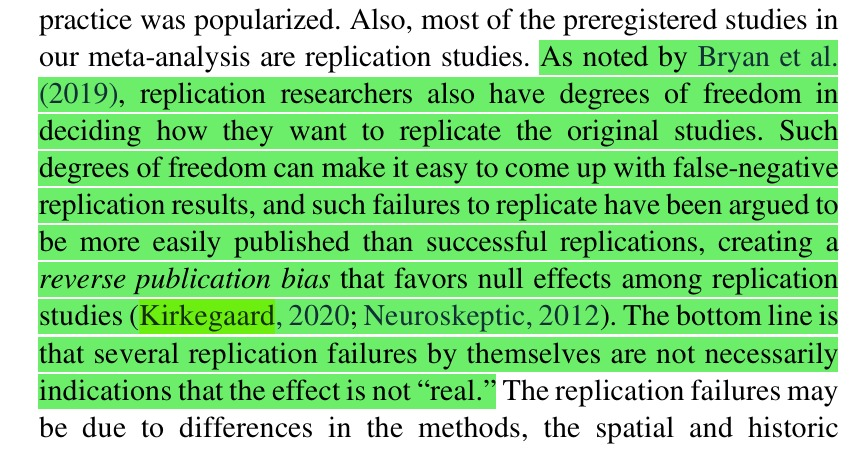
The support for their claim is a blog-post about political bias in social psychology. In contrast, the publication bias in the older studies is not taken seriously leading to the dubious claim that implicit priming is a real phenomenon, even though Albarracin herself has not been able to demonstrate her own findings again in pre-registered new studies.
It is telling that somebody with this track-record and open hostility to the new and open social psychology is now editor of the very same journal that published Bem’s (2011) pseud-scientific evidence of extrasensory abilities. The irony is hard to miss. The journal that published false claims about extrasensory abilities is now controlled by somebody who makes false claims about open science practices and the credibility of implicit priming studies This is not a good look for social psychology in the 2020s.
Science is self-correcting, but nobody said that this process is fast and painless. It may require another decade for social psychology to fix all the problems that gave JPSP the name Journal of Pseudo-Scientific Psychology. Sadly, Albarracin is part of the problem, not of the solution. Fortunately, time is on the side of progress and the time for old social psychology is running out.
I didn’t realise the Dai et al. meta-analysis was by Albarracin when reading your other post. I’ve recently been looking at her pre-registrations – I’m yet to find one without an undisclosed deviation.
So I took a look at the Dai et al. meta-analysis’s pre-registration. No mention of outlier removal in the pre-registration, but the paper excludes fourteen effects for having effect sizes greater than d=2.5. No empirical basis for this (SDs or Cook’s d).
The sensitivity analysis apparently shows that including outliers changes nothing, but the table indicates this only has six more effects than the main results, so what happened to the other 8?
This issue is in every single study from her that I’ve looked at so far.
Interesting observation. Some people will say “witch hunt” others will say “where there is smoke there is fire”