1. Introduction: Competing Stories About Gender
Debates about sex differences often swing between extremes. One narrative, familiar from strands of radical feminism, portrays masculinity as dangerous—a legacy of male violence and domination. The opposite story, popularized by Roy F. Baumeister’s Is There Anything Good About Men? (2010), recasts men as civilization’s heroic builders, unfairly maligned by modern culture. Both stories appeal to emotion and morality more than data.
This essay contrasts Baumeister’s narrative with the actual empirical evidence about evolution and sex (Evolution and Sex Differences in 2025). Unlike dramatic claims that men and women are fundamentally different (“Women are from Venus, Men Are from Mars”), scientific evidence shows that men and women evolved together with shared goals to maximize adaptive fitness. There are likely biological differences related to genetic variation in the sex-chromosomes (XX vs. XY), but even for traits that are strongly influenced by these genes, men and women are not fundamentally different.
2. Baumeister’s Core Thesis
Baumeister’s book advances a provocative claim: cultures “flourish by exploiting men.”
He argues that throughout history men have been socially conditioned—and biologically predisposed—to take greater risks, work harder, and sacrifice themselves for collective benefit.
In his telling, male dominance in politics, science, and business reflects expendability and service, not privilege.
He describes men as driven by status and competition, while women, protected and valued for reproduction, focus on relationships and security.
The argument is moral as much as evolutionary. Baumeister insists he speaks “as a scientist,” yet the book only mentions data that support his ideology. The story drives the data, not the data shape the theory. Data are only used when they verify a claim, never to falsify one—a hallmark of pseudoscience, as Karl Popper argued that genuine science advances by subjecting its theories to potential falsification.
He rarely quantifies differences or cites effect sizes, and he dismisses feminism and patriarchy as conspiracy theories. Instead, he offers anecdotes about male teachers, childbirth, and marital infidelity as evidence of “how the world works.”
3. What Empirical Science Shows
The cumulative evidence from behavioral genetics, developmental endocrinology, and cross-cultural psychology paints a more complex picture (Schimmack, 2025).
1. Magnitude of differences. An undisputed evolved sex difference is the height difference between men and women. The standardized effect size is about 1.5 standard deviations. While this number is abstract, it can serve as a benchmark for potentially evolved sex differences. Most psychological sex differences are small to moderate in size (average d ≈ 0.3–0.5). Distributions overlap substantially—typically more than 70%.
2. Outdated evolutionary theories also ignore that most traits are influenced by genes on the 22 pairs of autosomes that are mixed during reproduction and do not allow for biological sex differences. Any biological differences like those in height are rooted in the fact that men have a Y-chromosome and only one X-chromosome. For example, red-green color blindness is recessive on the X-chromosome and more common in men because the expression of this gene is more likely if only one X-chromosome is present.
3. Claims about achievement are especially fragile. First, sex differences in achievement related traits (Conscientiousness) are very small and tend to favor women, and once women are given a chance to compete they are doing as well as men. Baumeister, in psychology, should know that because the sex-ratio in psychology departments has shifted dramatically since the 1950s when gender-biases made it difficult for women in academia.
In short, scientific evidence shows that men and women as probabilistically different yet fundamentally similar; two overlapping variations of one cooperative species. Baumeister may not realize this because we all suffer from consensus bias; that is, we overestimate how many people are like us: Baumeister may overestimate how many men are like him.
4. Ideological Versus Scientific Reasoning
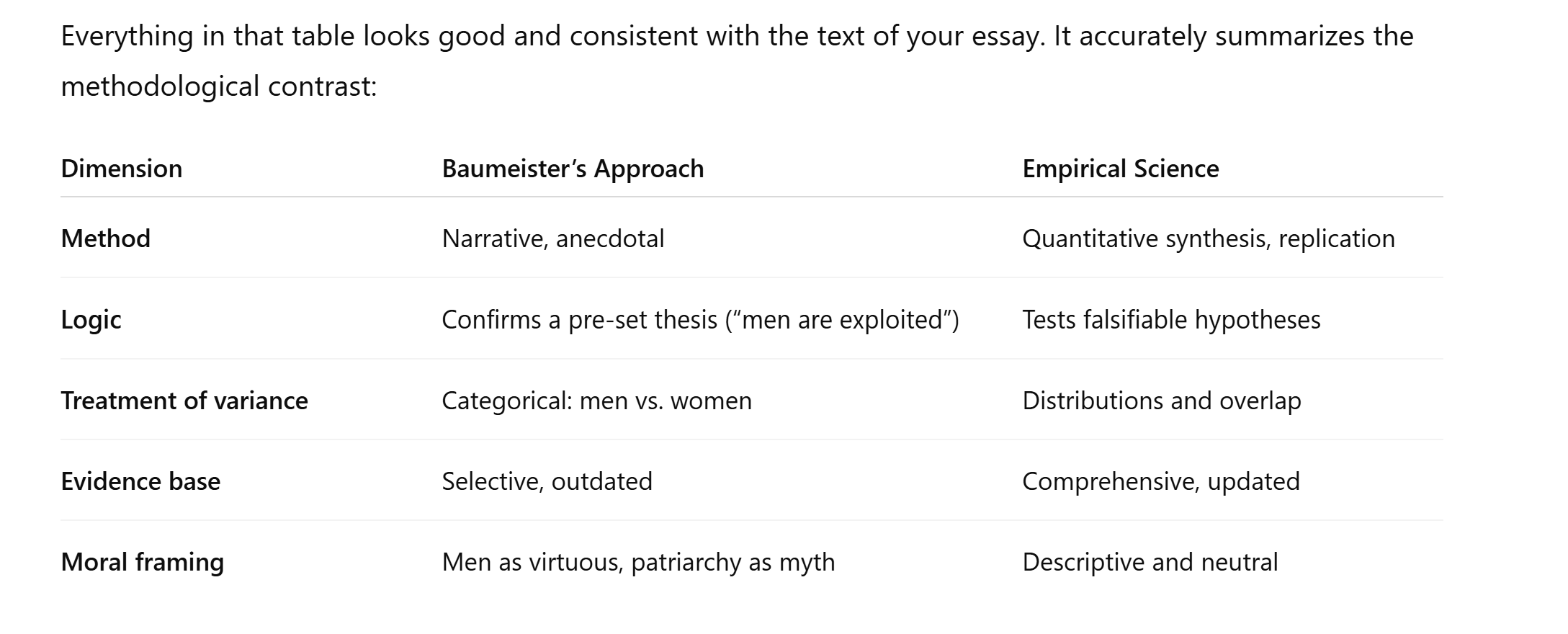
Baumeister’s reasoning resembles moral storytelling: good men, misunderstood by society, suffer for others. Science, by contrast, treats sex differences as empirical questions about magnitude, mechanism, and context. Men are not good or bad, but evolutionary theory explains why men are more likely to be bad people: rapists, murderers than women. This is one of the strongest sex differences that have been scientifically documented (Archer, 2019). They exist because small differences in mean levels of aggression and selfishness can produce large differences in the extremes of a trait. Toxic masculinity is real, but it is limited to a small number of toxic males.
5. Scientifically False Claims
The book makes many scientifically false claims that are ideologically motivated and risk normalizing or excusing abusive behavior.
1. “Research has suggested that most women have said ‘no’ when they meant ‘yes’ at least occasionally, which introduces a further element of confusion to even the most well-intentioned young man.”
Truth: Baumeister misrepresents the original study (Muehlenhard & Hollabaugh, 1988), which found that 39 percent of college women reported ever engaging in token resistance—not “most.” Later research shows this behavior is rare, context-dependent, and declining with improved sexual-education and consent norms (Humphreys, 2004). In contrast, sexual aggression is one of the largest documented sex differences: men are far more likely to be offenders and women to be victims (Archer, 2019). Baumeister’s framing inverts this reality.
2. Baumeister: “women are plenty aggressive—if anything, more violent than men.”
Truth: A meta-analysis of heterosexual partner aggression finds d ≈ –0.05 for act frequency, meaning women report slightly more minor acts—but men cause far more serious injuries (Archer, 2000). Across all forms of violence, the difference reverses dramatically: men commit the vast majority of homicides and serious assaults worldwide (Archer, 2019). Baumeister’s claim ignores the scale and severity of male violence and misrepresents the empirical record.
3. Baumeister “From the unfeeling perspective of the system, it could be worth it to restrict female access to education.” (p. 209)
Truth: Every cross-national dataset shows the opposite: female education increases social stability, child survival, and economic growth (UNESCO, 2019; World Bank, 2020). There is no conceivable “systemic advantage” to restricting women’s education—historically or evolutionarily. This statement is not only unsupported but directly contradicted by global evidence.
4. Baumeister: “After witnessing childbirth, many men find their wives sexually disgusting and thus cheat.” (pp. 246–247)
Truth: No scientific data link childbirth observation to marital infidelity. Longitudinal studies show that relationship satisfaction and communication, not childbirth disgust, predict sexual desire and fidelity (Lawson & Mullett, 2018). Baumeister’s anecdote pathologizes normal experiences of fatherhood without evidence.
5. Baumeister: There was and is no oppression of women; patriarchy is a conspiracy theory.
Truth: “Patriarchy” in social science refers to structural male advantage, not a secret male conspiracy. Historical and economic research documents centuries of legal, educational, and occupational exclusion of women (Goldin, 1990; England, 2010). Dismissing these constraints as myth denies overwhelming empirical documentation.
6. Baumeister: “Men are exploited by society; progress depends on male expendability.”
Truth: Men historically faced higher mortality in war and dangerous work, but these risks were tightly linked to male political and economic power. Men had the benefit of minimal investment in their reproductive success, while leaving women with the risk and costs of childbirth and child rearing. Baumeister’s framing ignores male exploitation by males, not women.
6. Ideological Consequences
Research confirms that exposure to Baumeister’s own Sexual Economics Theory—which portrays sex as a female resource traded for male investment—can shape social attitudes.
Fetterolf & Rudman (2016) found that participants who viewed a video based on this theory endorsed more adversarial beliefs about heterosexual relationships, even after reading feminist rebuttals. This shows that ideas presented as neutral “science” can increase cynicism and hostility between the sexes.
Moreover, the book’s framing has been widely circulated in manosphere communities and cited on forums linked to misogynistic radicalization. In these contexts, Baumeister’s evolutionary language becomes moral ammunition, used to rationalize resentment toward women.
Such diffusion illustrates how ideological narratives dressed as science can travel far beyond academia.
7. Why Scientific Caution Matters
Scientific reasoning differs from ideological rhetoric in three ways:
- Falsifiability. Claims must be open to disconfirmation; Baumeister’s narrative is not.
- Updating. Science revises itself when evidence changes; ideology repeats itself even when data contradict it.
- Value neutrality. Science describes what is, not what ought to be. Moralizing about gender—positive or negative—distorts understanding.
In modern personality and evolutionary psychology, the consensus is clear:
Men and women evolved under shared pressures for cooperation, mutual dependency, and parental investment, not perpetual conflict or one-sided exploitation.
8. Conclusion I: Men and Women Evolved on Earth
Baumeister’s Is There Anything Good About Men? invites sympathy for men but mistakes ideological comfort for scientific truth. By glorifying masculine extremes and dismissing opposing evidence, it replaces inquiry with mythmaking.
The scientific picture that emerges from decades of research is subtler and more interesting.
Sex differences are real yet modest, biologically rooted yet culturally flexible. Both sexes show extraordinary variability, and both contributed to the survival of our species. Men and women did not evolve on separate planets; they evolved together, on Earth, as cooperative partners in a shared evolutionary story.
9. Conclusion II: Baumeister Lacks Scientific Credibility
Baumeister’s research record reveals a consistent pattern of selective evidence use—choosing studies that support his claims while ignoring or concealing results that do not.
His once-famous ego-depletion hypothesis—the idea that self-control operates like a limited resource—was based on publication-biased evidence.
Re-analyses of his own data show that the average effect size is close to zero once unpublished or failed studies are included (Schimmack, 2014, 2016, 2018, 2019, 2025). Meta-scientific investigations further document that his lab withheld null results, giving a misleading impression of robust support.
Baumeister himself admitted this practice in a personal email communication quoted by Schimmack:
“We did run multiple studies, some of which did not work, and some of which worked better than others. You may think that not reporting the less successful studies is wrong, but that is how the field works.”
This admission confirms that his work exemplified the publication-bias culture that triggered psychology’s credibility crisis. Rather than using data to test hypotheses, Baumeister routinely used them to confirm preconceived beliefs—the same confirmatory pattern visible in Is There Anything Good About Men?
Scientific integrity requires falsifiability, transparency, and full reporting.
When these norms are ignored, claims cease to be scientific, even if they borrow the language of science. Authors who present untested opinions as empirical conclusions engage in narrative persuasion rather than data-driven inquiry—a form of writing closer to literature than to science.
Freedom of speech entitles Baumeister to publish ideological opinions, even offensive ones.
But academic freedom is different: it protects the search for truth through open, verifiable evidence. Baumeister’s gender arguments, like his ego-depletion studies, fail that test.
They are expressions of belief, not findings of science. The actual evidence shows not only that men and women are far more similar than his book suggests, but also that Baumeister’s own practices demonstrate a departure from scientific standards.
Key References
Archer, J. (2000). Sex differences in aggression between heterosexual partners: A meta-analytic review. Psychological Bulletin, 126(5), 651–680.
Archer, J. (2019). The reality and evolutionary significance of human psychological sex differences. Biological Reviews, 94(4), 1381–1415. https://doi.org/10.1111/brv.12507
Baumeister, R. F. (2010). Is There Anything Good About Men? Oxford University Press.
Popper, K. R. (1959). The logic of scientific discovery. London: Hutchinson. (Original work published 1934)
Schimmack, U. (2014). Roy Baumeister’s R-Index – Replicability-Index
1 thought on “The Ideology versus the Science of Evolved Sex Differences”