Maslow’s Hierarchy of Needs is a staple of Introductory Psychology textbooks and popular psychology (Johns, 2023).
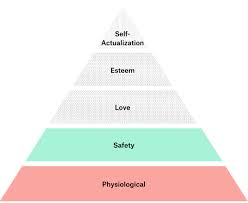
The popularity of this model of human motivation is inversely related to its empirical support. The main appeal appears to be the appealing visual presentation of a ranking in the form of a pyramid.
The lack of empirical support may stem from the lack of a dedicated discipline that studies needs and motives. Animal psychologists can only study basic needs rather than self-esteem or self-actualization. Cognitive psychologists are not concerned with motives and experimental social psychologists focus on situations rather than internal causes of behavior. Finally, personality psychologists are interested in variation of internal causes across individuals, but Maslow’s hierarchy implies a universal law that does not leave room for variation across individuals or cultures.
Despite these problems, empirical researchers have tried to test Maslow’s theory, but the history of this work is largely forgotten. For example, the popular personality textbook “The personality puzzle” by David Funder does not include a single reference to a study that tested Maslow’s theory.
The most influential article on empirical tests of Maslow’s theory was published nearly 50 years ago (Wahba & Bridwell, 1976). The article reviewed factor analytic and ranking studies, neither of which provided much support for Maslow’s theory. The problem of factor analytic studies is obvious. Factor analysis relies on correlations across individuals, while Maslow’s theory makes predictions about the ordering of means and in its strong form assumes that any variation across individuals is just measurement error. Ranking studies, on the other hand, provide a straightforward test of Maslow’s theory. However, none of the ranking studies produced the predicted order from most to least important need.
Physiological Needs - 1. Most important
Security Needs - 2nd
Relationship Needs - 3rd
Self-Esteem Needs - 4th
Self-Actualization - 5. Least Important
The disappointing results may have discouraged other researchers from further empirical tests. A notable exception is a recent study of an online, convenience sample (N = 943). Participants were asked to rank Maslow’s needs. The average rankings of four needs were consistent with Maslow’s model, but relationship needs were ranked number 1, before physiological and safety needs. The problem might be that participants were asked to rank needs according t how important the fulfillment of each need is for them. It is possible that fail to consider fulfilled needs as important and therefore did not rank fulfillment of physiological needs as important.
In sum, empirical studies often fail to support Maslow’s hierarchy of needs, but this lack of empirical support is often ignored in textbooks and pop psychology.
Results Form a Simple Engagement Exercise
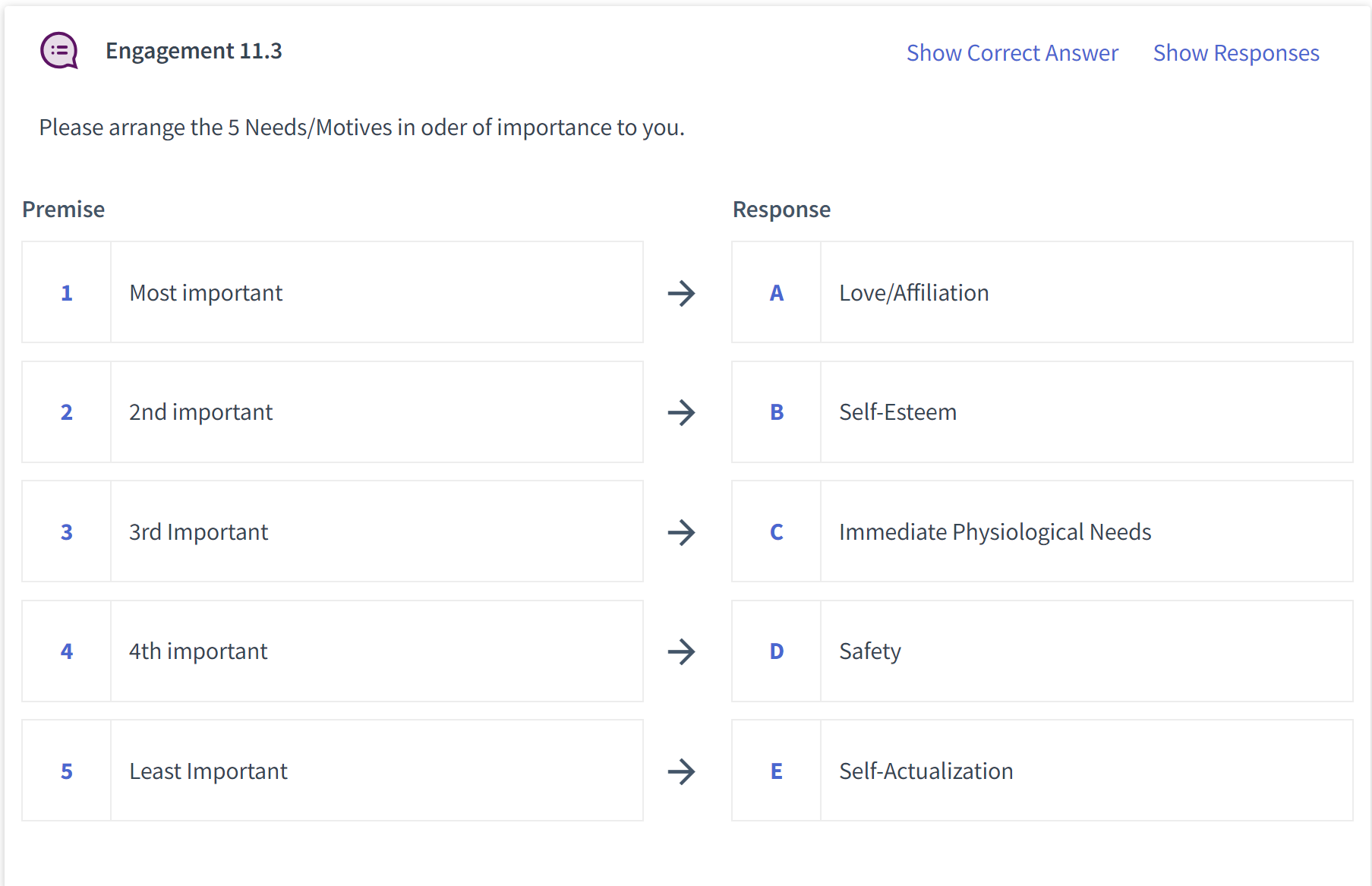
E-textbooks and engagement tools for classrooms (IClicker, TopHat) make it possible to increase engagement with class materials with simple tasks. These exercises provide empirical data that can be shared with students. The results of these exercises can be useful to demonstrate replicability and generalizability of textbook findings that are based on older studies and studies from different populations. My textbook. Personality Science : The Science of Human Diversity (Schimmack, 2020) contains a ranking of Maslow’s values to make students think about the theory in relationship to their own values. TopHat makes it easy to present a ranking task (see Figure 1).
The results have been consistent over the past three years and support Maslow’s theory in terms of the average importance of the five needs. Figure 2 shows the results for N = 129 students at the University of Toronto, Mississauga for 2023.
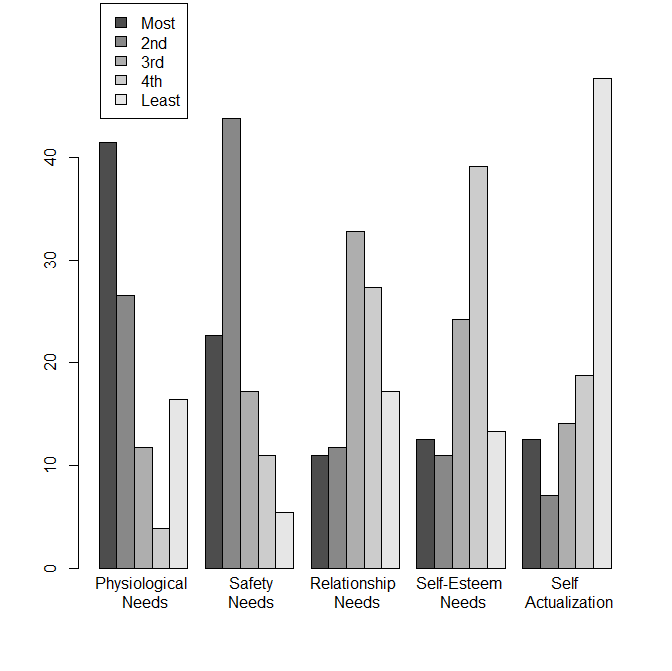
Physiological needs are ranked as most important by over 40% of the sample and second by over 20% of students. Safety needs are ranked second by over 40% of students and first by another 20%. These two needs are clearly ranked as more important than the other three. Relationship needs are ranked third by over 30% of students followed by self-esteem and self-actualization. Self-esteem is ranked forth by nearly 40% of the students, while over 40% rank self-actualization the least important need.
However, the results also show that students differ in their rank orders. For some students self-esteem is more important than relationships and vice versa. Some students even rank self-actualization as higher than physiological needs. While it is not clear whether these differences reflect true personality differences, the results suggest that the hierarchy is not universal and can vary across individuals, time periods, and cultures. I then move on to research on human values using Schwartz’s model of 10 values that has received a lot more attention and explicitly allows for diversity in human’s values, needs, motives, life-goals, etc.
Conclusion
Maslow’s hierarchy of needs is well-known inside and outside of psychology, despite a lack of empirical support for it. In fact, most empirical tests failed to provide support for it. A simple ranking tasks allows students to reflect on the importance of needs in their lives and to examine the plausibility of Maslow’s theory. Ironically, this simple class exercise provides the best empirical evidence for Maslow’s theory. In this regard, the results do not replicate existing evidence, but provide the strongest evidence so far for Maslow’s theory that needs differ in their importance, while also demonstrating that the hierarchy is probabilistic and not deterministic and universal.
2 thoughts on “Maslow’s Hierarchy of Needs: An Empirical Perspective”